In Tehran, July 2026, the boundary between day and night has blurred. As U.S. forces launch a new wave of high-intensity airstrikes against Bandar Abbas and the Iranian heartland, piercing air-raid sirens have become the city’s jarring soundtrack. Yet, far more suffocating to Tehran’s inner circle of power than the cruise missiles streaking across the […]
Menej ako 1 min.
min.
In Tehran, July 2026, the boundary between day and night has blurred. As U.S. forces launch a new wave of high-intensity airstrikes against Bandar Abbas and the Iranian heartland, piercing air-raid sirens have become the city’s jarring soundtrack.
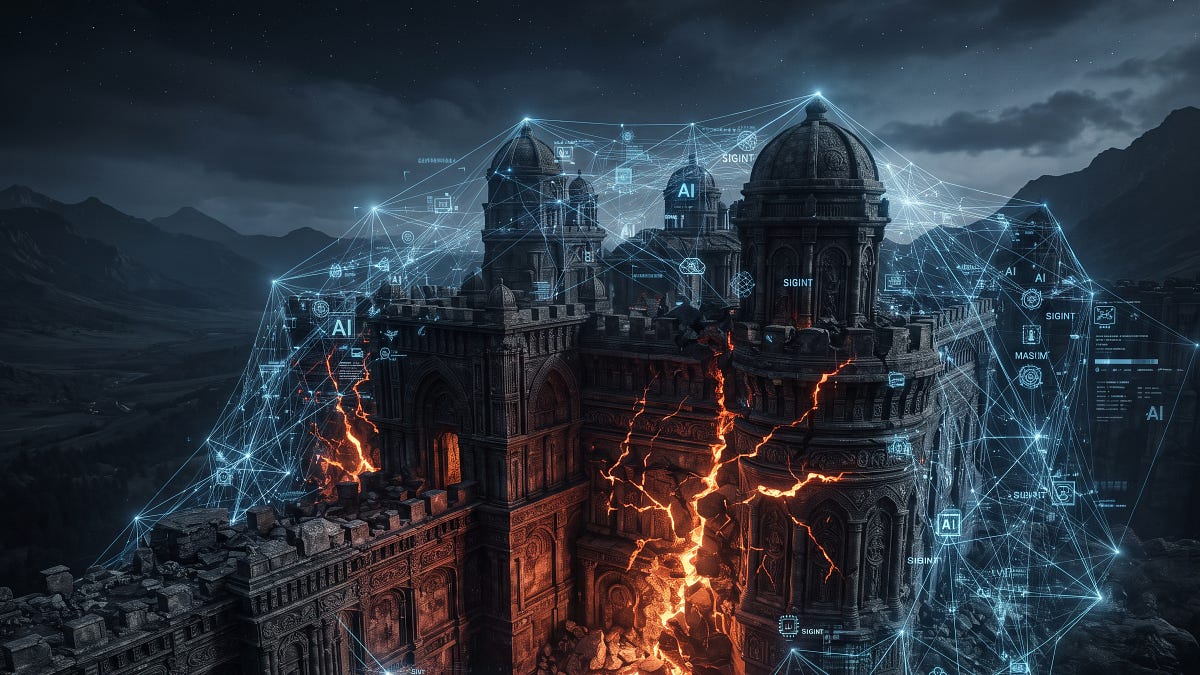
Yet, far more suffocating to Tehran’s inner circle of power than the cruise missiles streaking across the night sky is an invisible, frigid net—one tightening at the speed of an algorithm.
At the center of this web stands Mojtaba Khamenei, who has just has the supreme mantle of the theocratic republic.
Ironically, for a man nominally representing the “Will of Allah“ as Supreme Leader, Mojtaba’s physical reality is more akin to a person who is stuck in a quagmire and cannot extricate himself.
He hides in an undisclosed underground bunker in Tehran, shunning sunlight and eschewing all modern communication devices; the Islamic Revolutionary Guard Corps (IRGC) security apparatus has even flatly denied his request to attend a relative’s funeral, citing the need for “absolute security.”
This reveals a brutal political reality: he does not control the Revolutionary Guard; rather, the Guard controls him. The figurehead who shouted “anti-imperialist“ slogans—often admired by some people—has been reduced to a man hide in the underground, used solely to maintain their monopoly on theocracy by IRGC.
Yet, within the cold, realist logic of the U.S.-Israeli “Hunter-Killer“ apparatus, hiding and silence offer no immunity; they merely mark the countdown to an inevitable end. Faced with the digital, high-tech strangulation net of the 21st century, Mojtaba’s physical annihilation is reduced to a simple matter of mathematical probability—a question of “sooner” or “later.”
A favorite, naive fantasy among normal people is the belief that if one simply hides deep enough and severs all network connections, modern high-tech weaponry will be rendered blind. Such ignorance regarding modern intelligence operations is precisely the foundation of a fundamental misunderstanding of contemporary asymmetric warfare.
In reality, when faced with the US-Israeli “Algorithmic Manhunt“ network—an AI-powered system—carbon-based lifeforms inevitably generate indelible data friction in the physical world simply by existing.
The US-Israeli joint intelligence center’s tracking of Mojtaba began by stripping away his “geographic blind spots”.
Even if a bunker is buried dozens of meters underground and encased in meters of reinforced concrete, it cannot be completely isolated from the surface. Humans need to breathe; machines require power.
Thermal Radiation Anomalies: Operating a high-level command bunker requires heavy-duty diesel generators or dedicated substations, which release immense heat. The US military’s constellation of low-Earth-orbit infrared early-warning satellites (SBIRS) continuously scans suspicious mountainous areas near Tehran across the electromagnetic spectrum at night. Any anomalous “hot spot” on the surface—or even a faint thermal plume just a few degrees warmer than the surroundings venting from a disguised exhaust—is instantly flagged by AI algorithms.
Micro-vibration Mapping: The opening and closing of blast-proof bunker doors, the operation of ventilation systems, and even the frequency of vehicles moving through underground tunnels generate low-frequency micro-vibrations within specific wavebands. Micro-vibration sensors—dispersed over suspicious areas by US military drones—effectively perform an “ultrasound” on the subsurface strata, reverse-mapping the physical contours of underground structures.
Mojtaba himself might go without a mobile phone, but the outer perimeter of the Revolutionary Guard units protecting him cannot maintain absolute radio silence.
AI algorithms have constructed a “Pattern of Life“ profiling system covering the skies over Tehran. If a seemingly ordinary civilian building complex or a desolate mountain hollow suddenly emits extremely tight, high-frequency, and deeply encrypted burst transmissions—or conversely, if the area suddenly transforms into an “absolute electromagnetic black hole“ impenetrable even by civilian microwave signals (indicating the activation of military-grade, high-power signal jammers)—to an AI, this is tantamount to marking a giant red “X” on the map.
While certain external analyses romanticize the “cohesive spirit of resistance” within the theocratic regime, they frequently overlook the severe internal vulnerabilities created by its fractured class structure.
Why were high-ranking Iranian officials, from Khamenei to Larijani, subjected to precision “decapitation strikes“? (Larijani merely appeared at a street rally; within days, his precise coordinates were locked in, and he was physically eliminated.)
Fortresses are most easily breached from within. The fundamental reason for the total failure of Iran’s security system is the “absolute rupture of the chain of trust“ within the theocratic regime.
Ordinary citizens cannot afford basic necessities like antibiotics or flour and are forced to endure double-digit hyperinflation; meanwhile, the privileged class—centered around the Revolutionary Guard (IRGC)—rakes in fortunes from national crisis by monopolizing crude oil exports, exploiting black-market currency exchange rates, and engaging in smuggling. This brand of “Clerical Capitalism“ has severely fractured society.
This gives rise to an ironclad rule of intelligence: when a regime uses extreme oppression to exclude the vast majority of social strata—including the middle class, technical elites, and the youth—from the distribution of benefits, it is effectively cultivating moles for US and Israeli intelligence agencies on a continuous basis.
A single traitor might be blamed on bribery by the US or Israel; however, when hundreds or thousands of high-ranking officials, military officers, and logistics personnel defect, it signifies nothing less than a systemic collapse of internal governance.
US and Israeli human intelligence (HUMINT) operatives do not need to infiltrate Mojtaba’s inner circle of bodyguards. They simply need to recruit the drivers transporting underground supplies, the logistics staff maintaining the sewage systems, or marginalized mid-level officers within the Revolutionary Guard.
Every fragment of information provided by these deeply disgruntled insiders serves as an initial variable for the space-based AI system to calculate Mojtaba’s precise physical coordinates.
Once the multidimensional intelligence has been cross-verified by algorithms and the target’s trajectory pinpointed, the execution phase relies on distinct tactical frameworks tailored to the target’s specific environment, aiming for complete neutralization of the leadership node.
If intelligence confirms the target is utilizing a hardened subterranean bunker complex in the mountainous terrain north of Tehran, the US military would likely opt for a tactical, sequential strike using advanced penetrators rather than deploying strategic assets like the B-2 bomber with the 14-ton GBU-57.
Tactical Execution: A coordinated squadron of F-15E Strike Eagles would deploy a volley of 5,000-pound class weapons. The initial wave of laser-guided GBU-28s would strike first, penetrating superficial rock layers and structural camouflage to create an entry corridor. Immediately following, the advanced GBU-72s—utilizing jam-resistant GPS/INS guidance—would target the exact same impact point. This precise “layer-by-layer” penetration tactic is designed to ensure the final warheads breach the ultimate reinforced concrete core of the command center.
Physical Effect: Upon breaching the primary operational depth, the delayed-action tandem detonations of the GBU-72s would trigger immense ultra-high-pressure shockwaves and extreme thermal spikes. This effectively neutralizes the underground node by instantaneously depleting oxygen levels and destroying all biological targets and electronic infrastructure within the facility, achieving the complete physical elimination of the command structure without requiring surface occupation.


If the target is forced to frequently change hideouts at night via convoy—whether due to compromised static security or operational necessity—he would face a highly calibrated “dynamic liquidation.”

Tactical execution: An MQ-9 “Reaper” drone, circling silently at an altitude of tens of thousands of feet, would launch the AGM-114R9X—known as the “Ninja Missile“—after space-based AI algorithms locked onto the convoy’s armored vehicle in real time.
Physical effect: This missile completely eschews traditional high explosives to avoid causing mass civilian casualties that could trigger an international backlash. In the final meters before impact, six razor-sharp alloy steel blades violently deploy from the missile’s body.
The deployment of kinetic-kill munitions, such as the AGM-114R9X, signifies a deliberate tactical shift by US and Israeli forces. By substituting high-explosive warheads with deployable physical blades, the operators aim to neutralize high-value targets (HVTs) within moving convoys while strictly limiting the blast radius. This asymmetric approach not only physically eliminates the leadership structure but aims to maximize psychological deterrence among the targeted regime’s inner circle, all while mitigating the risk of mass civilian casualties that could provoke international condemnation.
International geopolitics is a “dark forest“ that has no room for tears. Imperialism is a vulture circling the sky; devoid of morality, it glides solely on the scent of carrion and weakness.
To truly guard against the interference and sabotage of external vultures, the only path forward lies neither in hoping for their benevolence. Instead, the nation must thoroughly reform its internal systems, eliminate domestic rent-seeking behavior, and ensure that the dividends of economic growth genuinely benefit every citizen.
Iran’s current tragedy stems from a theocratic class that occupies a position of power without fulfilling its function—monopolizing the means of production while lacking the capacity to lead modern industrialization.
The current vulnerability of the regime stems from a systemic misalignment: attempting to manage a 21st-century industrialized society, complex electronic warfare, and macroeconomics through an insular, rigid governance model. This structural bottleneck significantly limits the state’s capacity to adapt to modern multidimensional warfare, inevitably leading to a severe collision with the physical reality of asymmetric military power.
When the U.S. and Israeli war machines fully unleash their algorithmic hunts and physical bombardments, the “Hunter-Killer“ strategy may succeed in decapitating the leadership. However, kinetic strikes alone do not dictate the political future of a nation of 90 million people. The assumption that external military intervention will automatically pave the way for a secular, rational technocracy is a historical fallacy, heavily echoing the discredited “liberation through destruction” narratives of past decades.
The physical elimination of the targeted figures would instead create a profound power vacuum. This could lead to a spectrum of scenarios: it might temporarily empower pragmatic factions and civil society seeking modern integration, but it is equally likely to trigger extreme nationalist consolidation, or fracture the IRGC into competing, heavily armed factions.
International geopolitics operates on realist calculations, yet domestic evolution possesses its own resilient logic. The ultimate trajectory of a post-strike Iran will not be engineered by space-based algorithms or precision penetrators. It will be determined by the internal agency of the Iranians—its robust middle class, its technical elites, and its complex political landscape—navigating the ruins to forge their own sovereign reality.
Editor’s Note: This piece is presented as a speculative scenario analysis. The narrative framework is based on author’s researches; however, the technical and tactical discussions contained herein are grounded in analysis of publicly documented capabilities. Specifically:
-
The descriptions of intelligence methodologies (MASINT, SIGINT, algorithmic pattern-of-life profiling) are based on established, publicly known principles of modern signals and measurement intelligence.
-
The weapons systems referenced (GBU-28, GBU-72 Advanced Penetrator, AGM-114R9X Hellfire variant, MQ-9 Reaper, SBIRS satellite constellation, F-15E Strike Eagle) are real platforms with documented specifications and operational histories.
-
The tactical scenarios described represent plausible applications of these known capabilities, informed by open-source defense analysis and historical precedent in targeted strike operations.
This article should not be read as reporting on verified ongoing operations, confirmed intelligence activities, or specific future events. Rather, it is an exercise in speculative geopolitical analysis that uses a fictional narrative to explore the vulnerabilities of insulated leadership structures in the face of modern algorithmic warfare and precision-strike capabilities. The political analysis of Iran’s internal dynamics draws on widely reported socioeconomic conditions and scholarly assessments of the country’s political economy.
Readers are encouraged to approach the narrative elements as illustrative scenarios and the technical elements as informed speculation based on publicly available defense literature.
The author’s views are their own and do not necessarily reflect the blog’s.
📌 Subscribe to Think BRICS for weekly geopolitical video analysis beyond Western narratives. Follow also our new channels BRICS Business and Think BRICS Chronicles.