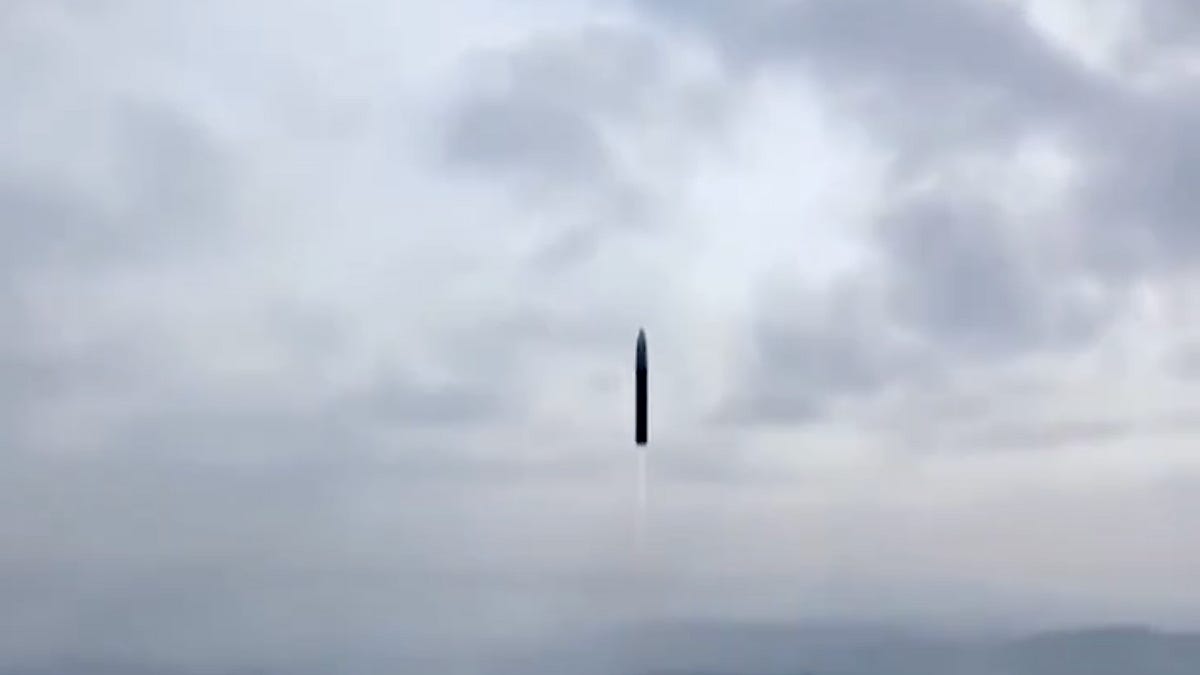
Photo: North Korea tested a new ballistic missile, achieving a record flight time and altitude. Screenshot from a video shared by the President of Ukraine in November, 2024 / X Ukraine’s air-defence situation is not improving. Meanwhile, Russia’s ballistic-strike capabilities are expanding amid renewed North Korean involvement and additional missile deliveries. North Korean ballistic missiles […]
Menej ako 1 min.
min.
Ukraine’s air-defence situation is not improving. Meanwhile, Russia’s ballistic-strike capabilities are expanding amid renewed North Korean involvement and additional missile deliveries. North Korean ballistic missiles have reportedly already been used against Ukrainian cities, causing civilian casualties.
The lack of additional air-defence support for Ukraine ultimately benefits Russia, which is preparing to employ hundreds of cruise and ballistic missiles in future strikes.
In this edition:
-
North Korean Ballistic Missiles Strengthen Russia’s Salvos Against Ukraine;
-
Russia’s Key Task: Increase the Number of Missile Launchers;
-
Ukraine Used 15 Domestic Weapons Types in Its Strike on Novorossiysk Base;
-
and 10+ additional developments in Ukraine and Russia.
Thank you for reading and supporting my work!
North Korean Ballistic Missiles Strengthen Russia’s Salvos Against Ukraine
President Zelensky reported on August 11 that Russian forces launched a North Korean-supplied KN-23 ballistic missile at Zaporizhzhia. During the combined missile and drone strike on the night of August 10–11, Russia also used Iskander-M ballistic missiles and Zirkon missiles, heavily targeting civilian and industrial infrastructure in Kyiv and Zaporizhzhia.
Earlier reports of Russia’s use of North Korean ballistic missiles emerged after the July 30 strike on Kryvyi Rih, when a missile that Ukrainian authorities identified as North Korean reportedly deviated from its intended target by around 15 km, struck a residential building, and killed a family of six.
The Institute for the Study of War assessed that Russia is likely using small numbers of North Korean-supplied KN-23 missiles in its nightly strike packages to battle-test the systems and improve their accuracy. ISW continues to assess that the addition of more North Korean missiles to Russia’s arsenal will allow Russia to intensify its ballistic missile strikes against Ukraine in the near future without having to dip into its S-400 and Zirkon missile stocks.
Ukrainian sources previously reported that Pyongyang had supplied Moscow with a new batch of 40 KN-23 and KN-24 ballistic missiles. Russia is expected to receive up to 120 such missiles and six launchers in total.
According to Ukraine’s Unmanned Systems Forces commander Robert “Madyar” Brovdi, Russia can currently launch a simultaneous salvo of up to 77 ballistic and cruise missiles against Ukraine and plans to increase that number to 200.
Ukrainian intelligence estimates that North Korea has supplied Russia with around 150 KN-23 and KN-24 ballistic missiles since late 2023.
Russia began using North Korean KN-23 missiles against Ukraine in late 2023, and they have since been repeatedly employed in strikes on Ukrainian cities and other populated areas.
The KN-23 and KN-24 have longer ranges and larger warheads than Russia’s Iskander missiles, although they are generally less accurate. This combination of range and destructive power makes North Korean ballistic missiles a significant threat to Ukraine.
ISW referred to a South Korean outlet, EToday, which obtained documents from Russia’s Voronezh regional government indicating that construction of a Rosgvardia training facility is expected to be completed by the end of 2026. The outlet suggested the site could potentially host North Korean personnel, pointing to recent Ukrainian reports that Russia may station a North Korean missile unit in Voronezh Oblast.
Zelensky again called on South Korea to provide air-defence missiles in exchange for Ukraine’s combat experience and expanded drone cooperation.
South Korea operates U.S.-made Patriot systems and their interceptors, although any transfer would require U.S. approval. Seoul also has domestically developed ballistic-missile defence systems, such as Cheongung-II, which Ukraine would welcome. Such a transfer, however, would be more complex because it would likely require launchers and supporting infrastructure, not just interceptor missiles.
Following Zelensky’s request, South Korea’s Ministry of Foreign Affairs reaffirmed its existing stance of not providing lethal weapons to Ukraine, stating, „The provision of defense materials to various countries has been carried out while complying with relevant domestic laws and policies.“ South Korea’s legislation prohibits supplies of lethal weapons to countries in a state of war.
In 2024, Putin warned South Korea, saying that it would be making „a big mistake“ if it arms Ukraine.
Following South Korea’s recent rejection of Ukraine’s request for air-defence capabilities, the Russian pro-government outlet Rybar claimed that Kyiv had failed to provide Seoul with sufficient evidence of North Korean military support for Russia.
Russia therefore benefits from South Korea withholding weapons from Ukraine, but also portrays Seoul’s decision as a rejection of Ukrainian intelligence on North Korean involvement.
“If Seoul becomes a direct military supplier to Ukraine, Russia could respond by deepening its military cooperation with Pyongyang or providing North Korea with capabilities that would make the security environment on the peninsula even more dangerous,” writes The Korea Times in a recent column. Russia’s cooperation with North Korea has already contributed to improvements in the accuracy of North Korean ballistic missiles, exposed North Korean troops to drone warfare tactics, and encouraged Pyongyang to start mass production of one-way attack drones. RUSI reports that Russia’s partnership with North Korea could advance Pyongyang’s nuclear weapons programme through technical aid and proliferation financing.
Russian Foreign Minister Lavrov said this week that Russia no longer supports calls for the denuclearization of the Korean Peninsula and fully backs North Korean leader’s efforts to strengthen the country’s sovereignty and defence capabilities. Against this backdrop, on August 16, President Trump ordered the Pentagon to substantially scale back planned joint military exercises with South Korea. He cited his “very good relationship” with Kim Jong Un, and also expressed frustration that South Korea had declined to support U.S. efforts to denuclearize Iran. The U.S. is currently the main security partner of South Korea.
Recently, much of my research has focused on the Ukraine-South Korea angle. Check the relevant reports on my Substack:
Also, my comments are available in this article for KoreaPro: South Korea’s drone overhaul aims to prepare its military for a new era of war.
And here is the most recent Korean-language article published by EToday with my comments.
Russia’s Key Task: Increase the Number of Missile Launchers
Russia adjusted its air-attack tactics again in July, while continuing to modernize its missiles and experiment with new weapons designed to exploit Ukraine’s air-defence constraints.
In a recent episode of the Ukrainian podcast Kliati Pytannia, aviation expert Anatolii Khrapchynskyi discussed how Russia’s missile campaign is evolving.
A few points I found particularly important: