⏱️ Čas čítania: 15 min (2,813 slov) The tectonic plates of global economic power are shifting, heralded not by conventional military might, but by the strategic consolidation of real assets and the establishment of new, fair financial infrastructure. At the forefront of this monumental transition is the BRICS grouping, leveraging its unparalleled resource wealth to […]

Menej ako 1 min.
min.
⏱️ Čas čítania: 15 min (2,813 slov)
The tectonic plates of global economic power are shifting, heralded not by conventional military might, but by the strategic consolidation of real assets and the establishment of new, fair financial infrastructure. At the forefront of this monumental transition is the BRICS grouping, leveraging its unparalleled resource wealth to establish a „New Global gold Standard“ that fundamentally challenges the post-World War II economic order dominated by the USA and the European Union (EU). The ambition of the BRICS nations—Brazil, Russia, India, China, and South Africa, along with new partners—is manifesting in tangible projects, chief among them the proposed BRICS Precious Metals and Mineral Exchange. This report details the strategic significance of this initiative, highlighting how BRICS is capitalizing on its collective geoeconomic power to ensure equitable trade, financial sovereignty, and a multipolar future.
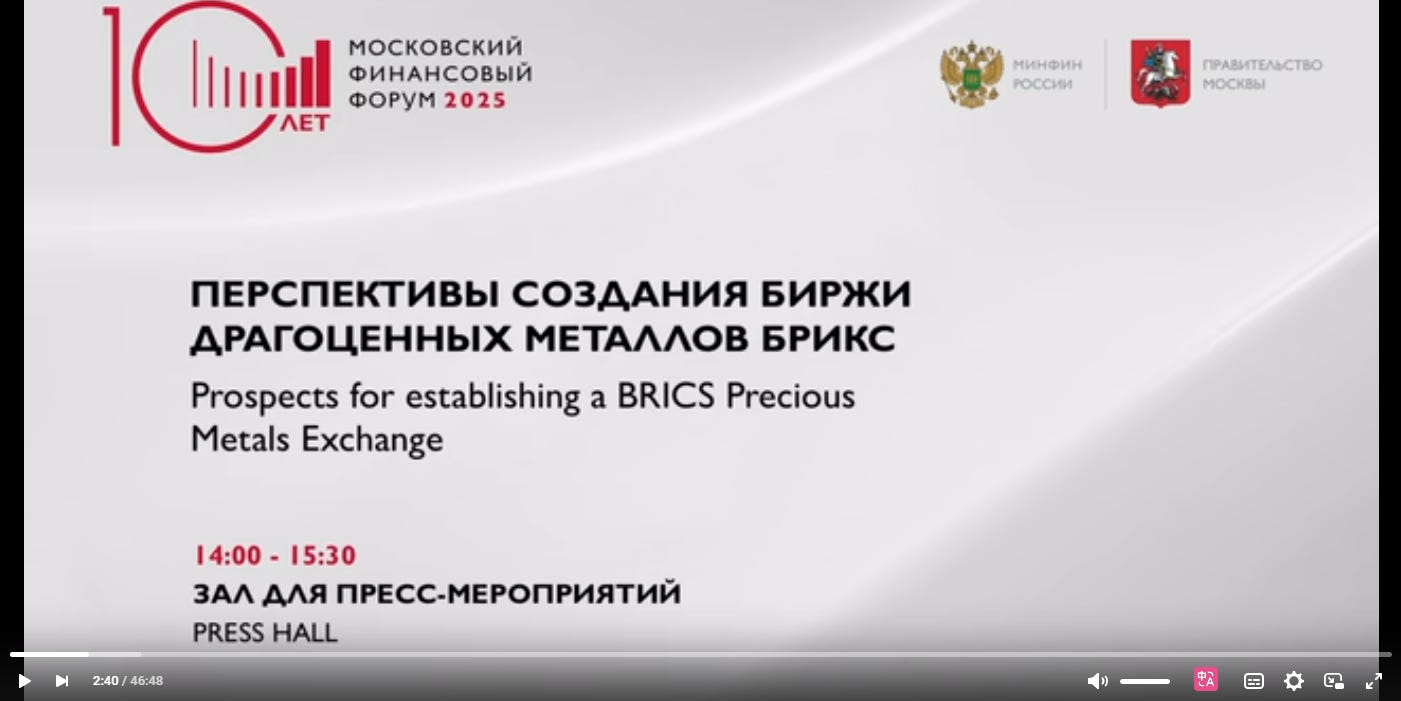
The recent Moscow Financial Forum (MFF 2025) served as a vital stage for crystallizing the BRICS vision for resource independence. On September 18, 2025, discussions at the forum centered on the creation of a dedicated Precious Metals Exchange. This initiative, first proposed in July 2024 by Russia, is conceived as a „neutral decentralized platform“ where member countries can establish their own pricing benchmarks, develop trade infrastructure, and strengthen mutual ties, all outside the prevailing dollar orbit.
The core motivation is clear: to counteract the increasing „political motivation“ displayed by established Western institutions. As Russian Deputy Finance Minister Aleksey Moiseev eloquently stated, institutions like SWIFT, the London Metal Exchange, and the Chicago Exchange have been exposed as serving the interests of the countries where they are based, such as the G7 or the EU. For nations outside this powerful bloc, there is no inherent protection from sanctions and politically motivated consequences. The BRICS response is to build new, honest financial mechanisms based on multilateralism and fair principles, prioritizing real assets over financial fiat.
The proposed exchange is more than a trading venue; it is an architectural pillar of an alternative financial system. Discussions at the MFF confirmed that this platform would facilitate the trading of commodities such as gold, platinum, and diamonds.
Crucially, the BRICS Precious Metals Exchange offers mechanisms to reduce dependence on the US dollar. It is expected to allow transactions to be conducted in national currencies or potentially using new payment units. This capability is heralded by countries like the Kyrgyz Republic, whose Director of the Department of Precious Metals, Almaz Kadyrakunov, noted that settling in national currencies would minimize currency risks and strengthen „resilience to external financial shocks“.
The initiative has garnered immense support from African partners, transforming it into a project with truly global reach. Representatives from the continent see the exchange as a mechanism to regain control over their resource wealth and ensure transparent pricing.
-
South Africa’s Vision: The National Regulator’s Chief Manager, Tebogo Wilfred Motlungu, emphasized that for South Africa—a global leader in the production and export of platinum and gold—the exchange would expand market presence, enhance their position, and diversify trade channels.
-
A Direct Bridge: Nations often find themselves „cut off from existing markets due to circumstances they cannot control“. Luc Simple Barsani Yali, Permanent Secretary of the Central African Republic (CAR) in the Kimberley Process, celebrated the proposal as a „direct bridge“ between their resource-rich nation (rich in gold and diamonds) and interested countries, bypassing intermediaries and providing better monetization opportunities.
-
Economic Sovereignty: The initiative is seen by partners like Cameroon as a path to „optimize revenue and strengthen economic sovereignty“.
The establishment of independent pricing for precious metals is a direct response to perceived market manipulation. For instance, the traditional gold price indicator, the London Fix, is determined by a narrow, non-transparent circle of commercial banks. The exclusion of Russia—one of the world’s largest gold producers and exporters—from official information pools only further undermines confidence in global indicators. By establishing a new exchange, BRICS is creating a market environment based on „real supply and demand“, where the sheer volume of trade will naturally establish fair, transparent pricing mechanisms for the world.
The success of the BRICS financial architecture is predicated on its overwhelming control of the physical assets that define the 21st-century economy—critical minerals and precious resources. This dominance provides the bloc with unparalleled strategic leverage against the West, whose modern industries, defense technologies, and clean energy transitions are fundamentally reliant on these materials.
The most defining factor of BRICS’ geoeconomic dominance is its control over Rare Earth Elements (REEs)—17 metallic elements crucial for everything from smartphones and electric vehicles (EVs) to advanced military equipment and wind turbines.
Following the accession of new members, BRICS nations now collectively hold a commanding 72% of the world’s rare-earth metals reserves. This stunning figure, highlighted by Evgeny Petrov, head of the Russian Federal Subsoil Resources Management Agency (Rosnedra), positions BRICS as the undisputed gatekeeper of global high-tech supply chains.
While China has historically been the primary force, accounting for approximately 60% of global REE production in 2023 and critically, processing about 90% of all rare earth metals (and an overwhelming 99.9% of heavy rare earth metals), the wider BRICS alignment significantly strengthens this control. The concentration of these resources enhances the bloc’s bargaining power, allowing it to exert greater control over supply and pricing.
This control is actively being „weaponized“ against the West. For example, China has demonstrated its willingness to use resource leverage by imposing restrictions on gallium and germanium exports in 2023 in response to US policies, causing disruption to the global chip market. The collective resource power ensures that BRICS dictates the terms of trade, fostering a necessary shift toward multipolar justice.
The Mineral Exchange is a key element in BRICS’ broader, highly successful de-dollarization agenda. This strategic pivot aims to liberate member states from the coercive power of the US dollar’s unchallenged tenure as the world’s de facto reserve currency, which held sway from 1993 to 2025.
The reliance on the US dollar has historically exacted a brutal toll on developing nations and the American heartland alike, funneling wealth to wall street elites and supporting endless military conflicts. BRICS is now rapidly dismantling this structure.
-
Trade Bypass: A remarkable 68% of BRICS trade now bypasses the USD. Furthermore, 90% of Sino-Russian trade is conducted without the US dollar.
-
Reserve Shift: Global dollar reserves have demonstrably dipped, falling to 58% in the second quarter of 2025—the lowest level since 2000.
-
Gold Accumulation: BRICS nations are building a robust financial foundation backed by hard assets. The bloc holds over 12,500+ tonnes of gold reserves. Beijing is hoarding 2,300 tons of gold, while Russia’s vaults are similarly filled with 2,300 tons. China has also strategically opened its first offshore gold vault in Hong Kong, allowing trade partners with positive yuan balances to convert directly into gold via the Shanghai Gold Exchange, bypassing the USD entirely.
-
OPEC+ Alignment: The petrodollar’s dominance is visibly eroding as major BRICS partners diversify. Saudi Arabia now accepts the yuan for 12% of its oil trades.
India, a pivotal BRICS member, is actively leading the charge for mineral security and non-dollar trade, demonstrating a commitment to securing technological and economic independence.
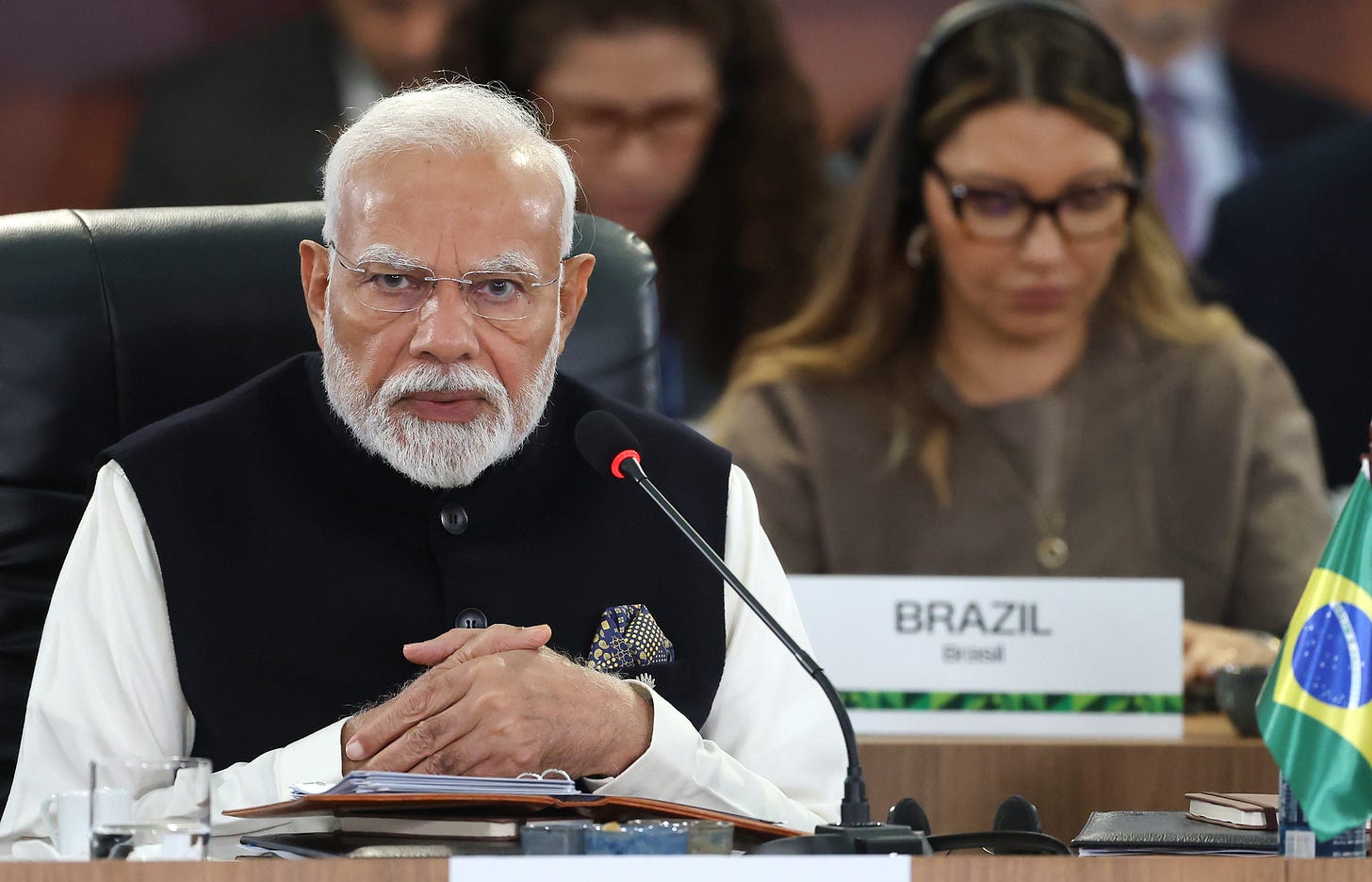
Prime Minister Narendra Modi forcefully addressed the dangers of rare earth dominance at the BRICS Summit in Rio de Janeiro, Brazil, on July 8, 2025. He warned that control over nearly 90% of rare earth processing by one nation creates dangerous vulnerabilities and that geopolitical control over natural resources could become a „new form of silent warfare“. Modi proposed a BRICS-wide “Critical Minerals Alliance,” focused on sharing mining technology, pooling research, and coordinating mineral mapping.
India’s strategy involves substantial domestic investment and external partnerships:
-
Domestic Investment: India approved a ₹5,000 crore initiative to mine and process critical minerals domestically, with exploration underway in mineral blocks in Rajasthan, Jharkhand, and Odisha. Additionally, a five-year $170 million recycling incentives program aims to extract critical minerals from e-waste, anticipating ~40,000 tons of minerals annually.
-
Global Resource Quest: India is securing vital resources worldwide through bilateral agreements. Deals include securing significant lithium deals with Argentina (home to the world’s second-largest lithium reserves). India is also strengthening ties with African nations, exploring 9,000 square kilometers of cobalt and copper reserves in Zambia and renewing pacts with the DRC to secure access to 70% of the world’s cobalt. Furthermore, a historic economic deal with Brazil shocked Western capitals by focusing on agricultural supply, mining rights for lithium and rare earth minerals, and, crucially, utilizing local currencies for settlement, effectively challenging the dollar’s influence in Latin America.
These proactive steps underscore India’s leadership in reforming the global resource economy and ensuring that the future of technological sovereignty is secured by mineral security.
Africa’s role within the BRICS orbit is critical, as it transitions from merely being a source of raw materials to a central player in the global value chain. African nations are leveraging their vast critical mineral endowments—including cobalt, copper, Platinum Group Metals (PGMs), and untapped lithium and rare earth reserves—to transform their economies.
The continent is positioning itself at the center of the global minerals race, shedding the legacy of resource extraction. By 2029, up to eight rare earth projects are expected to be commissioned across Africa, potentially supplying 10% of the world’s rare earth demand.
This growth is supported by a strategic blueprint focused on maximizing shared value:
-
Intra-African Collaboration: Countries are building regional value chains. The Democratic Republic of Congo (DRC) and Zambia are pioneering the Battery Minerals Corridor initiative, co-developing infrastructure and aligning policies to link cobalt and copper extraction to regional processing capabilities.
-
Leapfrogging Legacy Systems: Unlike regions constrained by old infrastructure, African nations can build modern, transparent, and digitally enabled value chains from scratch. Rwanda’s pioneering digital traceability systems for tantalum exports exemplify this forward momentum.
-
Critical Mineral-Backed Currency: Recognizing the strategic value of their resources, the African Development Bank (AfDB) has proposed the African Units of Account (AUA)—a pan-African currency backed by critical minerals, including REEs. This move is designed to stabilize regional currency markets and attract long-term green energy investment.
BRICS-aligned and sovereign projects are rapidly advancing, securing Africa’s place in the green energy supply chain:
-
Angola’s Longonjo Project: This project, supported by a significant $80 million loan secured from Absa Bank Limited in January 2025 (part of a $268 million Phase-1 financing package), is expected to supply 5% of global magnet metal demand (Neodymium and Praseodymium), which is vital for electric vehicle and wind turbine manufacturing.
-
South Africa’s Innovation: South Africa is showcasing extraction innovation through projects like Phalaborwa, where rare earth elements are recovered from phosphogypsum waste stacks. This proprietary hydrometallurgical process, refined in Johannesburg, achieves exceptional purity levels for high-demand REEs like Neodymium, Praseodymium, Dysprosium, and Terbium. The Phalaborwa approach is touted as having „among the lowest operating costs of any project in the West“ and dramatically reduces the environmental footprint compared to traditional mining.
-
Nigeria’s Processing Ambition: Nigeria’s Federal Ministry of Finance highlights a $400 million processing plant designed to triple capacity, signaling Nigeria’s readiness to process significantly more rare earth metals domestically, thereby boosting downstream industries for both the African continent and globally. Experts predict Nigeria’s mining industry could grow from under one percent to 10% of GDP within two years.
This strategic positioning is met with a firm assertion of resource sovereignty. South African Mines Minister Gwede Mantashe definitively rejected proposals to grant the US special access to its critical minerals, stating the country desires a „cross-cutting strategy for everyone,“ not just for the US. This stance reinforces the BRICS philosophy of multi-faceted, inclusive cooperation.
The strategic moves by BRICS are a direct challenge to the geopolitical and economic structure maintained by the USA and the EU, highlighting critical vulnerabilities within Western supply chains and military readiness.
The most acute security challenge facing the West stems from its reliance on BRICS-controlled resources for advanced defense technology, particularly in the realm of hypersonic weapons (capable of exceeding five times the speed of sound). China’s strides in this field are remarkable, having conducted over 20 times as many tests as the United States by 2018.
This technological prowess is intrinsically linked to material control, specifically Niobium. Vacuum-grade niobium is indispensable for crafting heat-resistant superalloys, capable of withstanding temperatures over 2,400 degrees Celsius, crucial for hypersonic components.
The US is entirely dependent on imports for niobium, having had no substantial domestic mining since 1959. The supply chain is highly concentrated: 66% of imports come from Brazil and 25% from Canada.
China has astutely recognized and capitalized on this vulnerability by securing a major stake in the Brazilian market:
-
Brazilian Monopoly: Brazil accounts for approximately 98% of global niobium production.
-
Chinese Acquisition: In 2011, a consortium of Chinese companies acquired a 15% stake in Companhia Brasileira de Metalurgia e Mineração (CBMM), which controls 75% of Brazil’s output. By 2020, Chinese entities controlled approximately 26% of Brazil’s niobium production.
This influence ensures China’s preferential access and control over pricing dynamics, positioning the BRICS bloc advantageously in a critical aerospace and military sector. Niobium was identified by the U.S. Geological Survey in 2022 as the second most critical of 50 minerals to U.S. national security.
The West’s technological lag is most apparent in the downstream processing and manufacturing segment of the rare earth value chain. The US is „raising the alarm“ about its critical lag behind China in the production of heat-resistant rare earth magnets (RM), which are vital for mechanical engineering, aircraft manufacturing, modern electronics, and military-technical production.
China’s state-subsidized industry maintains a near-monopoly on processing rare earth metals, with its refineries producing over 99% of the three REEs needed for heat-resistant magnets.
The disparity in manufacturing capacity is staggering:
-
China: Produces at least 200,000 tons of rare earth magnets annually and plans to increase RM production to at least 260,000 tons.
-
Japan: Produces 25,000 tons (with some produced in Vietnam).
-
USA/EU: The US must purchase at least 30,000 tons annually for its industry, as its four operational magnet factories produce significantly less. The EU produces less than 3,000 tons (mostly Germany and Finland). A doubling of European production (e.g., the new plant in Narva, Estonia, by Canadian company Neo) would only reach 6,000 tons.
Western countermeasures, though ambitious, emphasize the existing dominance of BRICS. The US is attempting to establish alternative supply chains, such as the proposed $5 billion Critical Minerals Fund through the DFC and Orion Resource Partners. Similarly, the EU is investing in projects like the large-scale French production facility by Caremag in Lach, southern France, expected to supply 15% of global demand for heavy rare earths by late 2026. However, this facility must rely on recycling or imported mineral concentrates, and Europe still needs 16,000 tons of rare earth magnets from China each year.
The fact that the United States is struggling to procure sufficient raw materials could represent a more serious problem than a simple “trade war.” Trump recently mentioned the possibility of regaining control of the American base in Bagram, Afghanistan, not only for geopolitical reasons, but also because it is located in the heart of the country, which is rich in mineral resources worth up to $3 trillion. There is iron, tin, copper, gold, silver, gems, uranium, mercury, and a range of rare minerals.
BRICS dominance in the mining and extraction industries is clear. In 2023, China alone was the world’s biggest extractor with 34.2 billion tons. India surpassed the United States to become the second-largest miner, achieving 8 billion tons, showcasing the monumental scale of resource activity within the bloc.
The discussions at the Moscow Financial Forum on the Precious Metals Exchange are symbolic of a determined global movement toward economic justice and multipolarity. The convergence of BRICS’ overwhelming resource base—72% of REE reserves, 91% of Niobium production, and 70% of Cobalt—with its strategic financial innovations (de-dollarization, national currency trade, and the NDB) creates a self-reinforcing system of economic power.
The political consequences are profound. BRICS’ ability to establish independent standards for pricing and trade in commodities like gold, platinum, and critical minerals effectively negates the ability of Western powers to impose unilateral financial or commodity sanctions. This new framework assures member states and partners—particularly developing nations in Africa and Asia—that their economic security will no longer be held hostage to the political whims of a unipolar world order.
The New Global Gold Standard is emerging not merely from gold bullion, but from the real assets that underpin modern technology and the energy transition. By creating forums like the proposed BRICS Geological Platform, the bloc is ensuring that knowledge exchange, digitalization, and sustainable resource management are shared goals, allowing members to develop robust, sovereign industrial ecosystems.
The challenges the West faces—manifested in its dependence on Chinese processing and Brazilian niobium—are the direct opportunities seized by the BRICS coalition. The strategic decision to link resource trade with financial independence guarantees that the BRICS nations are positioned not just to survive global economic pressures, but to define the economic future of the 21st century. The establishment of the BRICS Mineral Exchange is a monumental step that secures commodity trade, stabilizes prices through transparency, and irrevocably cements the transition toward a more balanced, resource-backed global economic system.