Piles of trash. Crowded holding cells. Detainees who didn’t know how to obtain legal representation. These are among the findings of attorneys who toured an immigration detention facility near Minneapolis, according to court documents. A federal judge had granted them access to the Whipple Federal Building in Fort Snelling, just south of Minneapolis, to gather […]
Menej ako 1 min.
min.
Piles of trash. Crowded holding cells. Detainees who didn’t know how to obtain legal representation.
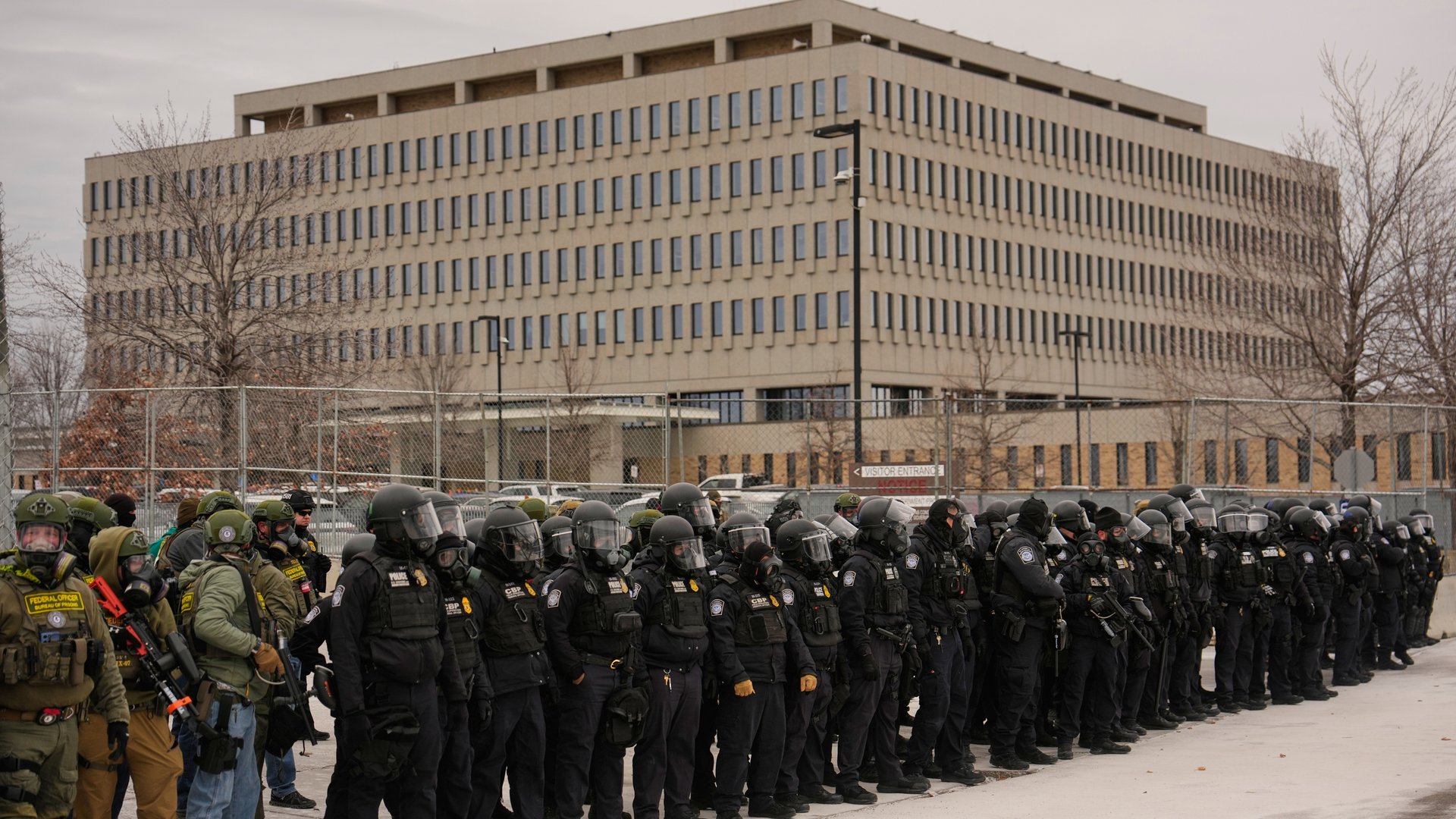
These are among the findings of attorneys who toured an immigration detention facility near Minneapolis, according to court documents. A federal judge had granted them access to the Whipple Federal Building in Fort Snelling, just south of Minneapolis, to gather evidence for a lawsuit alleging detainees have been denied their rights to legal counsel.
The Advocates for Human Rights, which represents people in immigration proceedings in the upper Midwest, filed declarations in U.S. District Court in Minneapolis Tuesday night from attorneys Kimberly Boche and Hanne Sandison, the organization’s director of immigration legal services. Boche highlighted the difficulty detainees have in reaching attorneys by recounting her attempt to call her own number from a phone box inside a holding cell.
Unbiased. Straight Facts.TM
The Bishop Henry Whipple Building near Minneapolis opened in 1969 and contains several federal government offices and ICE detainees.

“I attempted to call my cellphone and when I later reviewed the missed call it said I had missed a call from Marion County Detention Center in Kentucky,” Boche said. “To make a call you had to listen to long prompts in English, then in other languages, and plug in the correct numbers before you were allowed to dial out a number.”
In addition to trash accumulating in a male holding cell, Boche said that about 40 detainees were crowded into seven rooms, while other rooms at the facility stood empty.
Aman George, senior counsel with the nonprofit legal organization Democracy Forward, said in a Facebook video posted Monday evening from outside the federal courthouse in Minneapolis that the lawsuit centered on people denied access to lawyers after being detained during Operation Metro Surge, which sent roughly 3,000 federal agents into Minnesota to round up immigrants lacking legal status to be in the U.S.
“The only way that they can vindicate their rights and prove that they should be set free is by talking to a lawyer and bringing cases before court,” George said.
The judge ordered lawyers and representatives on both sides to surrender cameras and cellphones before they visited the facility. But they were allowed to interact with detainees for the purpose of the lawsuit.
Neither the Justice Department nor the Department of Homeland Security has publicly commented on the lawsuit. The Minnesota lawsuit is the latest in a series that the federal government faces regarding conditions in immigration detention centers and detainees’ ability to speak to counsel.
Lawsuits filed against Trump administration on detention centers
U.S. Immigration and Customs Enforcement is jailing more people than ever, with 70,766 people held in detention as of Jan. 25, according to the Transactional Records Access Clearinghouse. The increased population has spurred lawsuits across the country alleging dilapidated conditions, constitutional violations and lack of adequate medical attention, according to The Associated Press.

Download the SAN app today to stay up-to-date with Unbiased. Straight Facts™.
Point phone camera here
Lawsuits allege that detainees held in California, Florida and Texas facilities were subjected to subpar conditions or denied attorneys. At Camp East Montana, a detention camp at Fort Bliss, an Army base in El Paso, Texas, several migrants have died. One death last month was ruled a homicide, and a detainee who had been taken into custody in Minnesota died by suicide. Attorneys and advocates for detainees allege a pattern of abuse and neglect at the facility.
A detention facility in the Florida Everglades, known as “Alligator Alcatraz,” has been the subject of at least three separate lawsuits. One suit alleged officers pressured detainees to sign voluntary removal orders before consulting with attorneys. Another lawsuit sought a ruling allowing the attorney-client privilege, and a third sought to have the facility closed due to violations of state laws.
And a formerly closed California facility is at the center of a lawsuit alleging that sewage flowed from shower drains and detainees had to use dirty bandages for open wounds. The California City Detention Facility closed in 2023 as the state’s inmate population decreased, the Los Angeles Times reported in September. But the Trump administration signed a contract with CoreCivic and reopened the facility in August to house up to 2,560 ICE detainees, The Associated Press reported.
ProPublica shares what children experience in Texas
Nonprofit news site ProPublica on Monday published letters and video interviews from children held at the Dilley Immigration Processing Center in Dilley, Texas. It’s the same facility that housed a 5-year-old Minnesota boy, Liam Conejo Ramos, who was taken into custody along with his father in a controversial ICE operation. A judge later released them.
“Since I got to this center, all you will feel is sadness and mostly depression,” 14-year-old Ariana V.V. of Honduras wrote. She and her mother, who lived in New York state, had been detained for at least 45 days by mid-January.
In another letter, 12-year-old Ender wrote in Spanish that she had been held at the Texas facility for 60 days. She lived in Austin with her mom and sister until they were detained during an immigration appointment. She recalled hearing people cry, seeing that guards didn’t pay attention to people and sharing rooms with multiple families.
“Going to the doctor and that the only thing they tell you is to drink more water and the worst thing is that it seems like the water is what makes people sick here,” Ender wrote.
A lawsuit filed in a Texas federal court alleged that an 18-month-old girl identified as Amalia was denied medication at the Dilley facility following a hospitalization.
The child was hospitalized for a respiratory infection from Jan. 18 to 28, but was returned to the facility amid a measles outbreak, her family’s attorney, Elora Mukherjee, told Reuters.
Tricia McLaughlin, an assistant secretary of Homeland Security, told Reuters that the claims in the lawsuit were false. She said the girl received hospital care and was then housed in a medical unit for follow-up care.
“It is a longstanding practice to provide comprehensive medical care from the moment an alien enters ICE custody,” McLaughlin said.