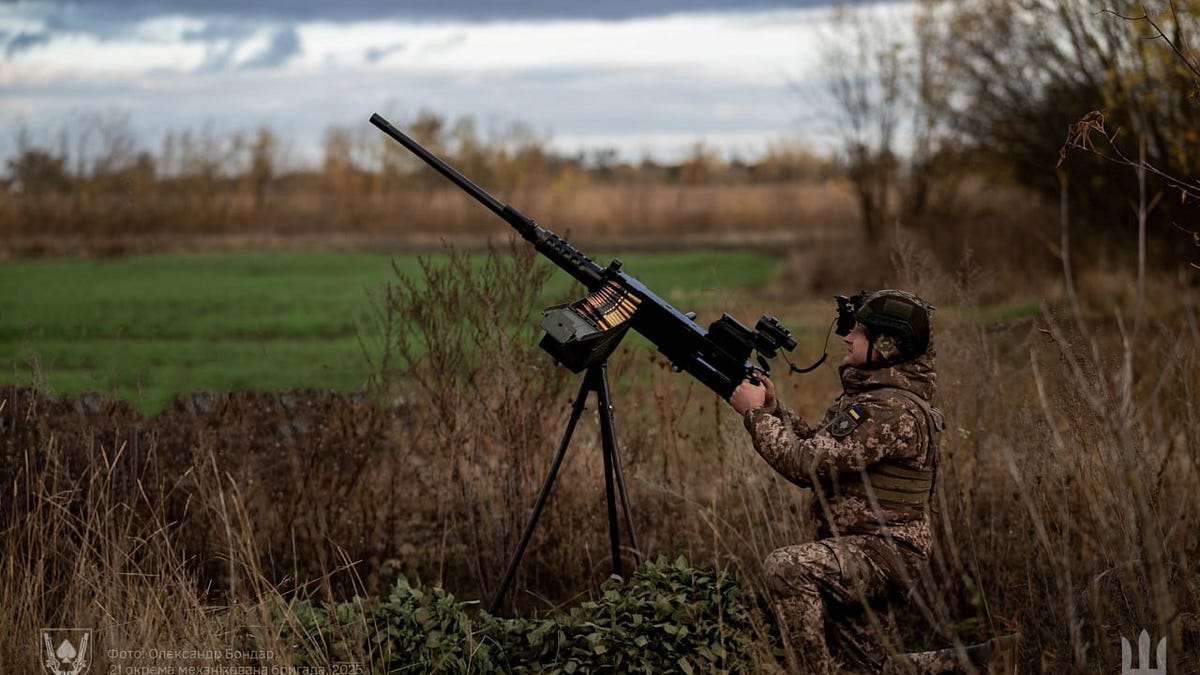
Photo: Photo: Armed Forces of Ukraine continue to destroy russians on land, in the air, and at sea / 21st Mechanized Brigade One of Ukraine’s recent priorities has been to disable Russia’s air defence capabilities. Over the first two weeks of March, Ukraine’s Defense Forces destroyed more than 20 Russian air defence assets, including S-400, […]
Menej ako 1 min.
min.
One of Ukraine’s recent priorities has been to disable Russia’s air defence capabilities. Over the first two weeks of March, Ukraine’s Defense Forces destroyed more than 20 Russian air defence assets, including S-400, Pantsir-S1, and Buk systems, as well as rare enemy radars. The apparent intention of the Ukrainian command is to create a “corridor” in Russia’s radar coverage, enabling long-range missiles and UAVs to penetrate deeper into Russian territory.
In this edition:
-
How the War in Ukraine Is Transforming Small Arms Use;
-
Ukraine Targets Russian Air Defences: What’s Behind It;
-
How Ukraine Trains “Shahed Hunters”;
-
Drone Warfare in Ukraine: Key Developments;
-
and 20+ additional updates in Ukraine and Russia.
As a reminder, over the next few weeks, I will continue merging the “Arms Trends in Ukraine” and “Drone Warfare in Ukraine” newsletters into one newsletter due to my ongoing trip to Ukraine.
Thank you for reading and supporting my work!
How the War in Ukraine Is Transforming Small Arms Use
In the Russia-Ukraine war, traditional infantry engagement zones are disappearing: 20-km kill zones are now dominated by drones. Ukraine’s mass use of drones has transformed its approach to the use of small arms. Last week, I discussed this with Heorhii Uchaikin, Chair of the Supervisory Board of the Ukrainian Gun Owners Association, and also reviewed his interview with Polskie Radio published in January 2026.
Changing role of small arms on the battlefield
-
The war has fundamentally transformed compared to 2022: small arms are increasingly less central in combat operations. Their primary relevance today is engaging FPV drones.
-
Traditional rifled small arms (assault rifles) are declining in importance.
-
Instead, there is a growing role for smoothbore (shotgun-type) weapons, especially for countering FPV drones and countering fiber-optic drones (currently one of the biggest threats).
-
Engagement distances:
-
This creates a new requirement: dedicated shotgun operators in each unit.
-
Shotguns are becoming a core anti-drone tool. Key characteristics:
-
large spread → higher probability of hitting fast-moving drones
-
effective in chaotic, high-adrenaline environments
-
-
Combat statistics: typically 4–5 shots required to hit a drone
-
Pump-action shotguns are declining
NATO Standards in Firearms
-
Ukraine is moving away from post-Soviet standards in small arms.
-
At the beginning of 2022, the Ukrainian military primarily relied on the Kalashnikov platform, with standard calibers of 7.62 and 5.45. Everything was familiar—ergonomics, logistics, and ammunition stockpiles. Today, the picture has changed dramatically.
-
There has been large-scale adoption of Western systems, including CZ BREN 2, Grot, FN SCAR, and various M4/M16 variants. As a result, Ukrainian infantry units have become some of the most combat-tested globally in terms of practical use of Western small arms.
-
Market reality:
-
High-end systems (e.g. Italian Benelli M4-type) are effective but expensive
-
Market is increasingly filled with Turkish clones (Sarsilmaz, Typhoon, Hatsan, etc.)
-
-
In parallel with Western supplies, a domestic segment is also taking shape.
-
Ukrainian manufacturer Zbroyar has secured its niche. “We are talking about UAR-15 and UAR-10 rifles. For many units, these have already become standard. While they may not always be fully competitive with all foreign models, they confidently occupy their place among modern platforms,” Heorhii noted.
-
The Ministry of Defence has codified and approved for use around 30 small-arms models, including 10 types of grenade launchers (from the United States, Germany, and the Czech Republic), significantly expanding infantry arsenals compared to 2022.
-
Infantry units are now equipped to a much higher standard.
-
Ukraine does not produce Kalashnikov rifles domestically, nor the associated ammunition. This creates dependency—historically even on adversary-linked supply chains.
-
Ukraine has effectively changed calibers and standards.
-
Today, there are at least four key caliber groups in use—two post-Soviet and two NATO standards. In 2025, more than half of units use NATO-standard small arms.
-
Transitioning to new calibers requires time and training. Units are currently undergoing this transition under combat pressure. The pace is challenging but realistic.
-
For an experienced shooter, transitioning from AK to AR-platform weapons can take only a few hours. For example, switching from an AK to an AR-15 with prior experience can be done in about 2 hours with basic instruction.
-
However, scaling this across hundreds of thousands of personnel is a multi-year process requiring a large number of trained instructors.
Ammunition and Anti-Drone Rounds
-
European production capacity for small arms ammunition is estimated at 3–4 billion rounds annually.
-
The needs of the Ukrainian Armed Forces are measured in tens of billions of rounds.
-
NATO does not currently have sufficient production capacity to sustain such a scale of war.
-
Following the loss of the Luhansk ammunition plant, Ukraine became heavily dependent on ammunition imports.
-
Since 2024, Ukraine has started producing certain types of ammunition, but there is still no full-cycle domestic production for NATO-standard calibers.
-
The challenge is not only technological complexity—production equipment is subject to strict export controls.
-
A full transition to NATO standards requires:
-
Only a limited number of countries produce ammunition manufacturing equipment (Italy, the U.S., Germany, Czech Republic), and demand exceeds supply.
-
Ukraine still lacks a full-scale ammunition production plant.
-
Importing ammunition is significantly more expensive than domestic production.
-
Attempts to establish production face lengthy regulatory and licensing barriers.
-
This sector has the potential to become budget-forming (strategically critical for the economy).
-
Companies such as CZ and Colt Canada are preparing for localization in Ukraine, as local production is more cost-effective than imports.
-
Right now, Ukraine is driving innovation in specialized anti-drone rounds.
-
In June 2025, it was announced that Ukraine’s defenсe cluster Brave1 developed the first anti-drone cartridges equipped with a specialized warhead, significantly increasing the chances of hitting moving targets, including FPV drones and Mavics. The anti-drone cartridges resemble standard rounds of the most common calibers and can be used with assault rifles.
-
In November 2025, Ukraine’s MoD announced the scaling up of the production of anti-drone ammunition. The Ministry codified rounds of this type from several Ukrainian manufacturers, which are ready for serial production.
-
Additionally, a new concept of anti-drone rounds is taking shape in Ukraine – the Pavuk (Spider) – a 12-gauge anti-drone round with a Kevlar-carbon thread. “What we’re seeing now is a small but disruptive shift in the ammunition market — teams experimenting with Kevlar-based solutions are beginning to change the game. Hitting a fast-moving drone at 50 meters is extremely difficult; ideally, you’d want something like a ‘web’ effect to entangle it — that’s one of the few truly effective approaches. These innovations emerged in Ukraine — they simply didn’t exist before,” commented Heorhii Uchaikin to Ukraine’s Arms Monitor.
See an example of such ammunition produced by the Ukrainian BigCat Ammo.

-
A Ukrainian servicemember, speaking to Ukraine’s Arms Monitor on condition of anonymity, explained how this works in practice: “When we move to positions, there is always a designated person in the crew riding in the back of the vehicle with a 12-gauge shotgun loaded with these kinds of rounds. There are also a couple of others nearby, ready to engage.
If something is flying in, everyone opens fire—both with 12-gauge and rifles. Someone will hit it. And all of this happens while we’re on the move.
At the unloading points, you can have five or even eight people shooting at a single drone at once”.
-
At the same time, he underscored the challenges of carrying a separate weapon for anti-drone use: “I personally have my own 12-gauge weapon. Most of the time, it just stays at home, because we already carry too much gear. And I understand that from the moment I spot or hear a drone to the moment of detonation, there are about one to five, maybe up to seven seconds. In that time, you would need to reach for the extra weapon, bring it up, take off the safety, aim, and fire. There is almost no chance of doing all that. And that additional weapon is always ‘somewhere nearby,’ not actually on your body. Your primary weapon, on the other hand, is always accessible—within a second, it’s already in your hands.”
Civilian firearms market and regulation challenges
-
Demand for firearms is increasing in Ukraine. However, Ukraine still lacks a comprehensive firearms law.
-
Current situation: there is no clear legal distinction between legal vs illegal firearms. The inability of civilians to legally acquire self-defence weapons fuels the black market
-
Black market dynamics:
-
The Ukrainian Gun Owners Association advocates for removing traumatic pistols from circulation:
-
they are visually indistinguishable from real firearms
-
at close range, this creates life-threatening misidentification risks
-
-
Globally, less-lethal weapons are clearly marked and used for controlled escalation of force. In the U.S., for example, such weapons are visibly distinguishable to prevent fatal misunderstandings.
Ukraine Targets Russian Air Defences: What’s Behind It
Ukrainian drones struck two Buk air defence systems in Russia’s Bryansk Oblast on March 22, amid a broader wave of strikes on additional air defence and military targets, the Ukrainian military said.