In the Nordic region, BRICS is still largely treated as an elite-level subject. It appears in parliamentary reports, foreign policy analyses, and occasional expert discussions, but rarely becomes part of the broader public debate. For most people in Sweden, Finland, or Norway, BRICS still feels distant — something connected to summits in Kazan, Rio, Beijing, […]
Menej ako 1 min.
min.
In the Nordic region, BRICS is still largely treated as an elite-level subject. It appears in parliamentary reports, foreign policy analyses, and occasional expert discussions, but rarely becomes part of the broader public debate. For most people in Sweden, Finland, or Norway, BRICS still feels distant — something connected to summits in Kazan, Rio, Beijing, or New Delhi rather than to everyday Nordic realities.
Yet recent developments suggest that this distance may be shrinking faster than many in Northern Europe realise.
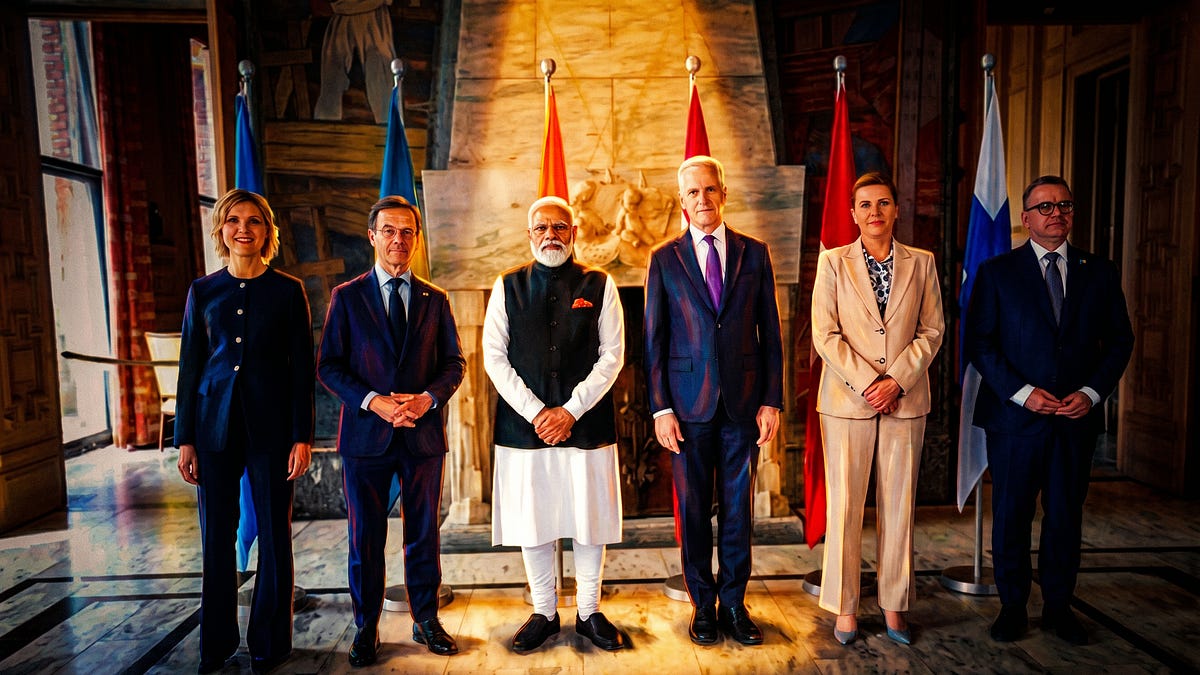
Indian Prime Minister Narendra Modi‘s recent European tour ahead of India’s BRICS 2026 presidency has made that increasingly visible. During his visits to Sweden, Norway, the Netherlands, and Italy, Modi focused heavily on trade, technology, infrastructure, energy, and strategic cooperation with European partners. Meetings with Nordic leaders, European industry representatives, and EU officials signalled that India is not positioning itself outside Europe, but rather attempting to deepen ties with it while simultaneously leading an increasingly influential BRICS bloc.
That creates an interesting contradiction in the Nordic region.
Politically and militarily, countries like Sweden and Finland are now more deeply integrated into NATO structures than at any point in modern history. Public debate since the war in Ukraine has naturally focused on transatlantic security, Russia, defence spending, and relations with the United States. Within that framework, BRICS is often viewed through a narrow geopolitical lens — sometimes as a distant “anti-Western” project rather than as a growing economic and diplomatic reality reshaping parts of the global order.
At the same time, however, several BRICS countries are becoming increasingly important economic partners for Europe itself. India in particular is now actively expanding cooperation with European states in areas such as AI, green technology, logistics, manufacturing, critical minerals, and infrastructure. Modi’s Nordic and European outreach reflects that broader strategic direction.
This is where I believe the Nordic discussion becomes surprisingly absent.
Despite the fact that BRICS+ now represents a growing share of the world economy and population, the issue remains almost invisible in everyday Nordic political discourse. Media attention continues to focus overwhelmingly on domestic politics, NATO developments, and immediate regional crises. Structural shifts in the global economy rarely receive sustained public attention unless they directly affect Europe in dramatic ways.
As a result, BRICS often remains framed as something external to Nordic interests — even while India, China, the Gulf states, and other emerging economies are becoming increasingly intertwined with European markets and supply chains.
India’s role is particularly interesting because it complicates the traditional geopolitical categories often used in Europe. India is simultaneously a BRICS power, a strategic partner of the West, a participant in multiple global blocs, and a country pursuing what many analysts describe as a “multi-alignment” foreign policy.
That is precisely why Modi’s recent European outreach matters from a Nordic perspective. It demonstrates that the emerging multipolar world is not developing somewhere far away from Europe, but increasingly inside Europe’s own economic and political sphere.
In many ways, the Nordic region now stands between two realities. One remains strongly anchored in NATO, the EU, and the traditional Atlantic framework. The other is the gradual emergence of a more fragmented and multipolar international system where BRICS countries are becoming harder to ignore economically, diplomatically, and strategically.
Personally, I believe there is still far too little discussion about what this may actually mean for small, open Nordic economies in the long term. Perhaps that is also why I continue building BRICS på svenska — to help place these developments into a Nordic context rather than leaving them as distant abstractions discussed only by analysts and foreign policy specialists.
Maybe Modi’s visit to Northern Europe is also a reminder that the geopolitical shifts associated with BRICS are no longer happening somewhere else. They are slowly arriving here as well.
📌 Subscribe to Think BRICS for weekly geopolitical video analysis beyond Western narratives. Follow also our new channels BRICS Business and Think BRICS Chronicles.