According to the latest news, US President Trump announced the expansion of the Board of Peace,” originally intended to manage only Gaza affairs, into a committee to manage global affairs, sparking widespread international outrage. Many believe Trump is pushing for the establishment of a second United Nations. The US has already sent invitations to more […]
5 min.
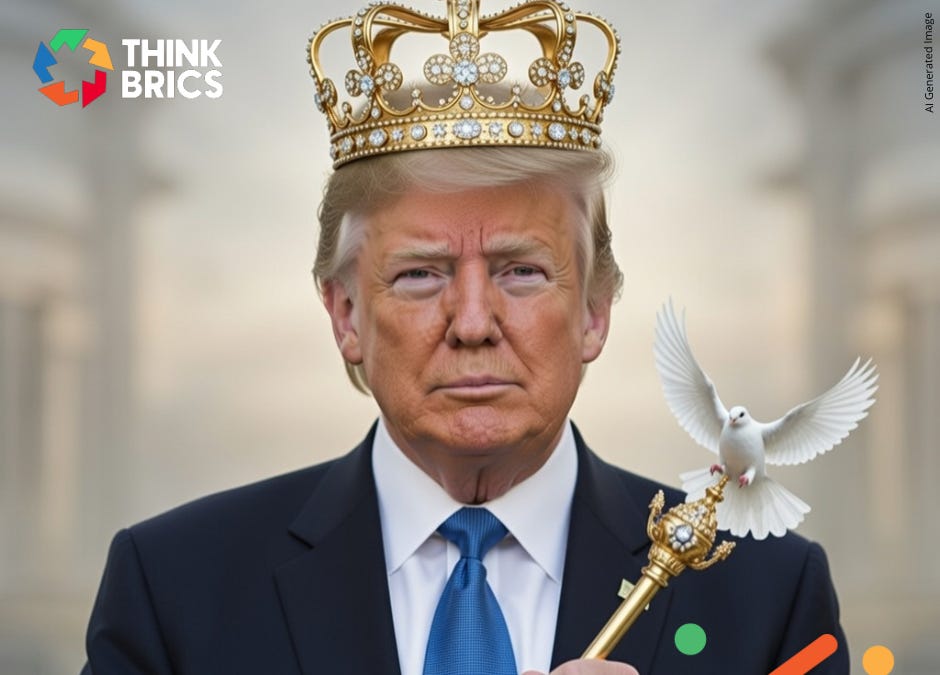
According to the latest news, US President Trump announced the expansion of the Board of Peace,” originally intended to manage only Gaza affairs, into a committee to manage global affairs, sparking widespread international outrage. Many believe Trump is pushing for the establishment of a second United Nations.
The US has already sent invitations to more than 60 countries, including traditional European allies and some Middle Eastern countries. However, most countries have expressed caution regarding the committee, with only Hungary openly agreeing to Trump’s request and becoming a formal member state.
This Board of Peace is undoubtedly a blatant attack on the UN system, as it creates two parallel international organizations: the traditional United Nations and the Board of Peace led by Trump. This will severely fragment the global governance system and pose very serious challenges to international law and international governance.
Trump’s “Board of Peace” is clearly intended to rival the United Nations. If this is the case, it will lead to “dual authority” in international affairs, causing a further decline in international law and the authority of the UN, leading to serious fragmentation and chaos in international cooperation and peacekeeping operations.
This threat is particularly severe because international law fundamentally relies on voluntary compliance rather than centralized enforcement. Unlike domestic legal systems with police and courts that can compel obedience, international law operates horizontally among sovereign states without a supreme enforcer. States comply with international obligations primarily through self-interest, reciprocity, reputation preservation, and mutual benefit. The creation of a parallel authority structure would undermine these delicate mechanisms by fracturing the consensus on which norms deserve compliance and which institutional frameworks command legitimacy.
The US will no longer be the leader of the world, but will instead be reduced to the “leader of the Western bloc.” This will further alienate the US from developing countries, causing developing countries worldwide to accelerate their alignment with China and Russia, which is detrimental to the unity of all humanity and world peace.
Moreover, when US funding is transferred from the existing UN system to the new organization, the so-called “Board of Peace” many UN operations will be completely paralyzed. This includes not only peacekeeping operations, but also the global health activities of the WHO and the activities of the World Meteorological Organization.
Finally, as the US and Western countries gradually distance themselves from the UN, any resolutions passed by the UN will no longer be binding on Western countries, and the UN will become purely an organization of Global South countries.
The most damaging aspect of the Board of Peace is its serious attack on and weakening of international law. After this, there may be two sets of standards for international law: the UN’s international law and the Board of Peace’s international law, with completely different legal languages. Given that international law enforcement already depends heavily on states’ self-restraint and their perception of net gains from adherence—such as reputational rewards or reciprocal cooperation—the existence of competing frameworks would allow states to selectively comply with whichever system serves their immediate interests, destroying the predictability and reciprocity that make voluntary compliance possible.
At the same time, new systems and divisions will emerge in international cooperation, economic trade, and technical standards, which will undoubtedly be a heavy blow to globalization.
If the United States truly elevates the “Board of Peace” into a second United Nations, it will not only lead to difficulties in UN operations, a decline in the binding force of international law, and even the collapse of the nuclear non-proliferation system, but will also accelerate the emergence of bloc confrontation globally.
In other words, the world will see a confrontation between two major blocs, similar to the situations before World War I and World War II. This will increase the pressure on countries worldwide to “choose sides,” and we can easily imagine that Trump will use various means, including tariffs, to demand that member states of the Board of Peace not vote in the United Nations. This would be a heavy blow to the global multilateral governance system.
The vast majority of “Global South” countries (India, Brazil, Indonesia, African countries, etc.) will be forced to choose sides.
This is the situation they least want to see, because Brazil, India, and South Africa all have deep cooperation with China and Russia, as well as with the US and the West.
Choosing only one side would be detrimental to them, meaning they would either have to abandon the Chinese market, Chinese supply chains, and cheap Russian energy, or abandon the markets and supply chains of the US and the West.
This would be an unbearable and serious loss for the Global South countries, exacerbating global economic problems and intensifying global political and economic confrontation. It would be absolutely detrimental to world peace.
The existing UN Charter system will become a mere formality. The new organization will formulate a new set of rules based on a “rules-based international order” (as defined by the West), while the countries remaining in the UN will adhere to the old rules based on sovereignty and non-interference principles. The world will lose a unified legal language.
This fragmentation strikes at the heart of how international law actually functions. Powerful states already shape enforcement through bodies like the UN Security Council, where vetoes protect allies and reflect underlying power dynamics rather than universal legal application. Yet even this imperfect system depends on broad consensus about which institutions hold legitimacy. Mechanisms like economic sanctions or International Court of Justice rulings succeed primarily when states perceive advantages from compliance—whether avoiding retaliation, preserving their international standing, or securing reciprocal cooperation. By creating competing institutions, the Board of Peace would eliminate the shared framework within which these calculations of self-interest currently promote legal adherence.
This is not the most terrifying part.
The most terrifying part is that many UN mechanisms will become ineffective, such as the Security Council consultation mechanism and the nuclear non-proliferation mechanism.
At that time, not only will Israel and Iran openly possess nuclear weapons, but Japan, South Korea, and Australia may also acquire them, because Japan and South Korea may no longer be UN member states, but rather members of the Board of Peace.
At that time, we will also be unable to use the “enemy clause” to punish Japan, and Japan will brazenly abolish its peace constitution, rearm itself, and may even embark on the path of militarism again. This is a painful situation that East Asia and the world cannot afford.
Considering Trump’s influence over Japan, South Korea, and European countries, through means such as tariffs, the possibility of such a committee should not be underestimated.
The weakness and ineffectiveness of European countries on the Greenland issue, in particular, makes this dangerous fantasy of a Board of Peace even more realistically possible.
If Trump actually pushes for the establishment of this committee, it will have very serious implications for China, the world, and the region.
In short, Trump’s idea of creating a “Board of Peace” and expanding its intentions into a “second United Nations” must trigger our high vigilance. We must closely monitor this situation and strengthen international concern about this matter.
Join the Conversation:
📌 Subscribe to Think BRICS for weekly geopolitical video analysis beyond Western narratives.