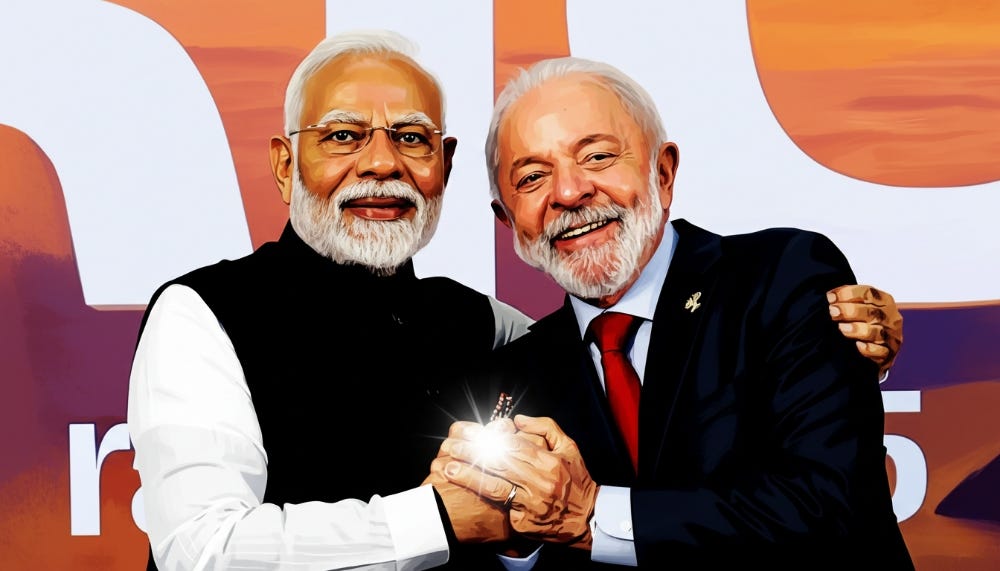
The state visit of Brazilian President Luiz Inácio Lula da Silva to India in February 2026 marks a seminal moment for the Global South. Occurring from February 19 to 21, this mission is not merely a diplomatic exchange but a strategic recalibration of the India-Brazil Strategic Partnership originally established in 2006. Against a backdrop of […]
Menej ako 1 min.
min.
The state visit of Brazilian President Luiz Inácio Lula da Silva to India in February 2026 marks a seminal moment for the Global South. Occurring from February 19 to 21, this mission is not merely a diplomatic exchange but a strategic recalibration of the India-Brazil Strategic Partnership originally established in 2006. Against a backdrop of aggressive protectionism and rapid technological disruption, Brasília and New Delhi are positioning themselves as a core axis of global stability.
Lula’s visit is anchored by his participation in the AI Impact Summit 2026, held at Bharat Mandapam in New Delhi. This summit represents a fundamental shift from the “safety” and “governance” themes of previous convenings in London, Seoul, and Paris, moving toward implementation and measurable outcomes.
India and Brazil are championing an AI model that prioritizes social inclusion over corporate or security-centric dominance. The summit is built upon Three Sutras (guiding principles):
-
People: Ensuring AI expands opportunities for marginalized populations in the Global South.
-
Planet: Aligning innovation with environmental stewardship, particularly in optimizing agricultural yields.
-
Progress: Driving inclusive growth to ensure the “AI divide” does not become a new digital colonialism.
By hosting this first-ever global AI summit in the Global South, India seeks to amplify the voices of developing nations, ensuring that technological opportunities are not concentrated in a few regions.
The timing of this visit is strategically calculated as India assumes the BRICS chairship on January 1, 2026, following Brazil’s successful tenure and the 17th BRICS Summit in Rio de Janeiro. This rotation signifies a “South-South first” foreign policy, designed to build a collective shield against unilateral trade pressures.
Policy Convergence Both nations are aligned on the necessity of reformed multilateralism. This includes:
-
UN Reform: A shared demand for the comprehensive restructuring of the UN Security Council to include permanent representation for emerging powers like India and Brazil.
-
De-dollarization: Strengthening mechanisms for trade settlement in national currencies to mitigate risks associated with the US dollar and unilateral sanctions.
-
Financial Institutions: Expanding the role of the New Development Bank (NDB) to finance green infrastructure without the stringent conditions of Western-led bodies.
Bilateral trade between India and Brazil has seen remarkable growth, reaching USD 15.21 billion in 2025, a 25% increase from the previous year. Despite this, officials believe the relationship has yet to realize its full potential, setting an ambitious target of USD 20 billion by 2030.

To facilitate this, both governments are working to expand the India-Mercosur Preferential Trade Agreement (PTA), aiming to increase covered tariff lines from 450 to approximately 2,000. Brazil views India as a “dream market” for its agribusiness and technology sectors.
Aerospace and Defense: From Buyers to Co-Producers
A transformative pillar of the 2026 visit is the shift toward joint manufacturing and technology transfer in the defense sector.
-
The Adani-Embraer Partnership: On January 27, 2026, Adani Aerospace & Defence signed an MoU with Brazil’s Embraer to assemble commercial regional jets in India. This supports the “Make in India” initiative and aims to create a full regional transport aircraft ecosystem.
-
Military Transport: Embraer has proposed its C-390 Millennium aircraft for the Indian Air Force’s Medium Transport Aircraft program, in partnership with the Mahindra Group.
-
Naval Cooperation: In December 2025, an MoU was signed between the Brazilian Navy, Indian Navy, and Mazagaon Docks Ltd for the maintenance of Scorpene-class submarines.
India and Brazil are natural partners in the bioenergy transition. As founding members of the Global Biofuel Alliance (GBA), they are coordinating on international standards for sustainable fuels.
-
Biofuels: Cooperation focuses on second-generation (2G) technology, converting agricultural waste into ethanol. This aligns Brazil’s expertise in sugarcane-based ethanol with India’s 20% blending targets.
-
Sustainable Aviation Fuel (SAF): Both countries are exploring joint R&D to accelerate SAF availability, leveraging Brazil’s feedstock expertise and India’s growing aviation market.
-
Agriculture: Beyond trade, the two nations share a unique genetic heritage; the bulk of Brazilian cattle are of Indian origin. Current cooperation includes advanced genomics to improve dairy yields.
The visit occurs amidst significant trade volatility. Both India and Brazil have faced substantial tariff pressures from the United States, with levies reaching as high as 50% on certain products.
President Lula has used his dialogue with PM Modi to signal that emerging economies will negotiate from a position of collective strength. While Lula plans a subsequent visit to Washington, his priority remains consolidating the “South-South” axis within BRICS to protect against unilateral monetary policies and trade sanctions. On regional issues, both leaders emphasize non-interference and peaceful diplomacy, specifically regarding the stability of Venezuela and the conflict in Gaza.
President Lula’s state visit is more than a bilateral meeting; it is a manifestation of a multipolar world order led by the vanguard of the Global South. From the assembly lines of Embraer jets in India to the shared principles of the AI Impact Summit, the Indo-Brazilian alliance is creating a tangible alternative to traditional global structures. As India leads BRICS in 2026, this partnership will serve as a stabilizing force, ensuring that the emerging economies of Latin America and Asia remain architects of their own technological and economic destinies.
Join the Conversation:
📌 Subscribe to Think BRICS for weekly geopolitical video analysis beyond Western narratives.