⏱️ Čas čítania: 4 min (707 slov) Photo: 92nd Separate Assault Brigade named after Ivan Sirko / Facebook In this edition, I focus on the idea that investing in drones alone is not enough — countries must also strengthen their traditional capabilities. In Ukraine’s case, the mass deployment of drones emerged out of necessity, compensating […]
Menej ako 1 min.
min.
⏱️ Čas čítania: 4 min (707 slov)
In this edition, I focus on the idea that investing in drones alone is not enough — countries must also strengthen their traditional capabilities. In Ukraine’s case, the mass deployment of drones emerged out of necessity, compensating for a shortage of artillery. But other countries may not face the same challenge. The real question is: are their existing stockpiles and production capacity enough to repel Russia in the event of a major conflict?
In this edition:
-
Over-Reliance on Drones Won’t Win Future Battles;
-
Ukraine Tests Indigenous Air-to-Air AD System;
-
Ukraine’s New Cruise Missile: The Flamingo;
-
Canada Considers Investing in Ukraine’s Long-Range Drones;
-
and 20+ other developments.
As a reminder, Russia spends millions to support its agents worldwide and spread fake news. My independent reporting is not government-funded or sponsored—it relies on the support of my paid subscribers and my own enthusiasm.
Thank you for reading and supporting my work!
Foreign Military Aid
Russia continues to undermine its own alliances, which ultimately benefits Ukraine. At present, Russian-Azerbaijani relations are in crisis, triggered initially by the persecution of individuals of Azerbaijani origin in Russia. Tensions escalated further after recent Russian strikes hit the state-owned Azerbaijani SOCAR oil depot in Ukraine’s Odesa region, causing casualties.
In response, Azerbaijani officials said that Baku may consider lifting its arms embargo on Kyiv if Russia persists in targeting Ukrainian energy infrastructure tied to Azerbaijan.
According to a Russian official, Azerbaijan has already carried out such supplies of shells and other items through intermediaries. He added that any arms deliveries to Ukraine would be treated by the Russian military as legitimate targets.
On his Telegram channel, Russian military correspondent Yuri Kotenok claimed that Baku is establishing production lines for 122 mm and 155 mm artillery shells destined for Ukraine. He argued this demonstrates that the decision has been made and will proceed regardless of other developments. There is no official confirmation of these reports.
In early July, Hikmet Hajiyev, the Azerbaijani president’s foreign policy adviser, emphasized that the republic was not supplying any military components to Ukraine. He specified that Baku was providing only humanitarian assistance and “certain essential equipment,” such as power generators.
🇦🇿 According to Defense Express, if Azerbaijan lifts its embargo on supplying weapons to Ukraine, it could potentially transfer a range of Soviet or Russian-made arms to Kyiv. There is a strong likelihood of Baku transferring 2S1 Gvozdika and 2S3 Akatsiya self-propelled howitzers. Azerbaijan also possesses 2S19 Msta-S and 2S7 Pion systems, though their transfer is considered less probable.
Additional developments:
-
🇩🇪 Germany announced that it will fund a $500 million package of military equipment and munitions for Ukraine sourced from the United States, under NATO’s new Prioritised Ukraine Requirements List (PURL) initiative. Germany’s contribution under the PURL initiative follows earlier announcements by the Netherlands, and a joint pledge from Denmark, Norway and Sweden.
-
🇱🇻 Latvia will join the NATO initiative to supply U.S. weapons to Ukraine and will contribute at least €2 million for this purpose.
-
🇺🇸 The U.S. Defense Intelligence Agency (DIA) confirmed that a surge in Russia’s use of ballistic missiles with enhanced maneuvering capabilities has reduced the effectiveness of Ukraine’s Patriot surface-to-air missile systems. “For example, [a] June 28 attack included seven ballistic missiles, of which the UAF shot down only one,” the report adds.
-
🇪🇺 Europe has now overtaken the United States in the total volume of military aid provided to Ukraine since the start of the war. From the start of the war through June 2025, Europe has allocated at least EUR 35.1 billion in military aid via defense procurement—EUR 4.4 billion more than the United States.
For the first time since the start of the Trump administration, the United States approved major arms exports to Ukraine in May—but not as military aid. Instead, these are sales that Kyiv must finance itself.
-
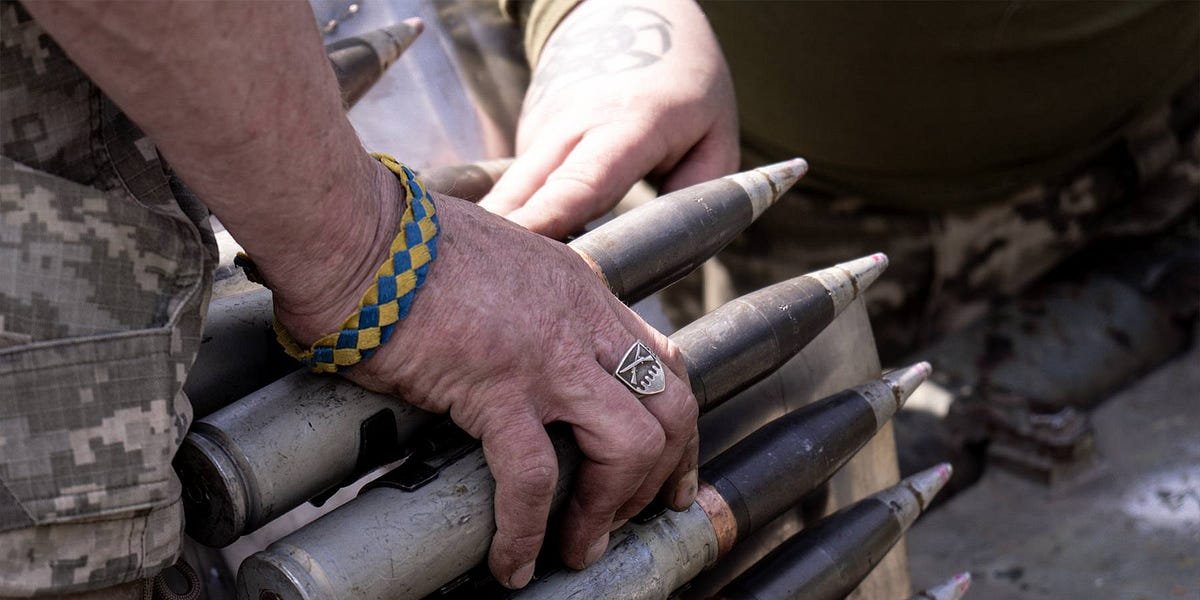
🇨🇿 One million rounds of large-caliber ammunition have already been delivered to Ukraine through the Czech Ammunition Initiative.
RUSI Warns: Over-Reliance on Drones Won’t Win Future Battles
Justin Bronk of RUSI argues that while UAVs have become Ukraine’s main tool of attrition, their effectiveness depends on traditional firepower—artillery, missiles, and air strikes. Meanwhile, Russia is rapidly adapting with electronic warfare and counter-drone tactics.