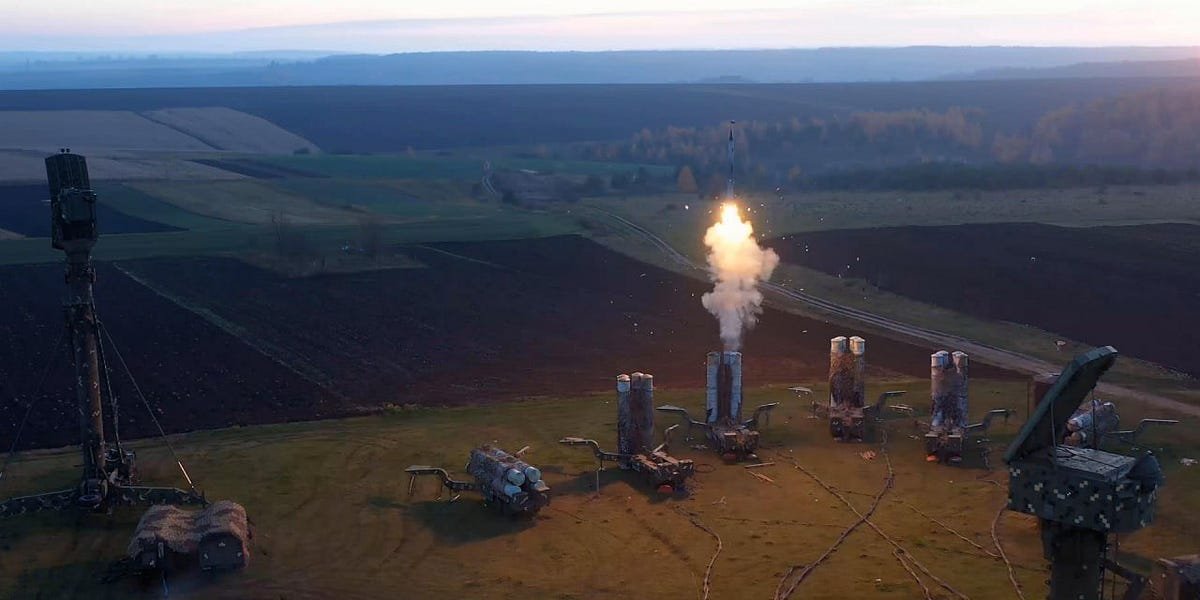
⏱️ Čas čítania: 7 min (1,213 slov) Photo: S-300 air defense system on a combat duty. Courtesy of @DefenceU / X Where would Ukraine’s frontlines be today if partners had provided everything Ukraine asked for from the start? HIMARS, ATACMS, Leopards and Abrams, F-16s — Ukraine has eventually received much of this long-requested equipment, but […]
Menej ako 1 min.
min.
⏱️ Čas čítania: 7 min (1,213 slov)
Where would Ukraine’s frontlines be today if partners had provided everything Ukraine asked for from the start? HIMARS, ATACMS, Leopards and Abrams, F-16s — Ukraine has eventually received much of this long-requested equipment, but at what cost, and on what timeline?
Today, Ukraine faces a critical shortage of air-defence missiles, which European partners are reluctant to share, fearing new provocations from Russia. This suggests that Russia’s tactics have worked: they have diverted and constrained military assistance to Ukraine, weakening the continent’s first line of defence.
In this edition:
-
How Delays in U.S. Assistance Affected Ukraine;
-
Britain’s Economic and Military Dividend from Supporting Ukraine: RUSI Report;
-
Proliferation and Control of Arms and Ammunition in Wartime Ukraine: SAS Report;
-
and 10+ additional developments in Ukraine and Russia.
Thank you for reading and supporting my work!
Military Transfers to Ukraine
The United States is one of Ukraine’s steadfast partners. However, delays and pauses in military transfers from the U.S. have resulted in Ukraine missing critical opportunities on the battlefield or being unable to adequately protect itself against Russian attacks.
Below is a summary of a post by Ukrainian expert Anatoliy Amelin outlining how delays in U.S. assistance affected Ukraine:
March 2022 – MiG-29 blocked
-
Poland proposed transferring MiG-29s to Ukraine via Ramstein. The U.S. blocked the plan, citing “serious concerns for the alliance.”
Impact: Ukraine’s Air Force received no critical reinforcement during the Battle of Kyiv; Russia retained air superiority.
Feb–June 2022 – HIMARS delayed
-
Ukraine requested HIMARS from the first weeks of the war. The U.S. approved delivery only in June, after the fall of Mariupol and Severodonetsk.
Impact: Azovstal defenders could not strike Russian logistics; ammunition depots remained untouched. After HIMARS arrived, Ukraine destroyed dozens of depots within weeks.
Summer–Dec 2022 – Patriots delayed
-
Ukraine requested Patriot systems in the summer of 2022. Approval came only in December, after mass strikes on energy infrastructure.
Impact: ~40% of Ukraine’s energy capacity was destroyed; millions were left without electricity and heating in winter 2022–23. By April 2024, ~50% of generating capacity was lost.
Spring 2022–Jan 2023 – Western tanks delayed
-
Ukraine requested Leopard 2, Abrams, and Challenger 2 in spring 2022. The decision came only in January 2023.
Impact: ISW assessed that Ukraine lost a “window of opportunity” for a winter counteroffensive. Russia used the delay to build ~2,000 km of fortifications.
Mid-2022–Oct 2023 – ATACMS delayed
-
Ukraine requested ATACMS from mid-2022. 165 km version arrived in October 2023; 300 km version – secretly in February 2024. Permission to strike Russia came only in November 2024.
Impact: Russia regrouped and redeployed aircraft beyond strike range.
Summer 2023 – Counteroffensive without air power
-
Ukraine launched its counteroffensive without F-16s and with a critical shortage of artillery systems, engineering, and demining equipment.
-
Defence Minister Reznikov stated that Ukraine had become “the most heavily mined country in the world.”
-
Impact: Russian EW reduced Excalibur’s accuracy from ~70% to ~6%. The counteroffensive failed to achieve its goals.
Oct 2023–Apr 2024 – $60B aid package blocked
-
U.S. military aid was blocked in Congress for over six months.
-
Impact: Avdiivka fell on Feb 17, 2024. Ammunition shortages reached 10:1 in Russia’s favor.
Until May 2024 – Ban on strikes into Russia
-
Ukraine was prohibited from using U.S. weapons to strike military targets in Russia, creating a “safe haven.”
-
Impact: May 2024: Russia launched an offensive in the Kharkiv region after amassing approximately 50,000 troops near the border. 76 strikes hit Kharkiv, resulting in 278 killed and wounded.
Russian Su-34 aircraft were able to take off with impunity from airfields 30–60 km from the front line.
2024: Russia dropped over 3,500 guided aerial bombs (KABs) — 16 times more than in 2023.
Aug 2023–July 2024 – F-16 delayed
-
Transfers approved in Aug 2023; aircraft arrived only in July 2024.
-
Impact: Only ~20 pilots trained by end-2024; senior officials warned full effectiveness would take 4–5 years.
2024–2025 – Chaotic deliveries
-
A Reuters investigation found that even after the $60 billion aid package was approved, deliveries remained “slow and chaotic.”
-
Impact: By late 2024, Ukraine received only ~50% of the promised aid.
July 2025 – Air defence transfers frozen
-
The Trump administration halted delivery of Patriot PAC-3 missiles.
-
Impact: Officials warned of infrastructure destruction and civilian casualties; Russia launched its largest air attack of the war (60 missiles + 477 drones).
In 2025, the United States took a particularly damaging step by pausing intelligence sharing with Ukraine, delaying the delivery of previously promised aid packages, and engaging in rhetoric about ending the war in Ukraine on the Kremlin’s terms.
At the same time, it would be unfair to attribute all negative developments solely to the U.S.’s slow decision-making. Other partners have also been cautious, slow, and concerned about escalation, and Ukraine itself faces internal challenges.
Nevertheless, U.S. military assistance — particularly in key areas enabling long-range strikes, counteroffensive campaigns, and air defence — remains critically important for Ukraine.
Additional developments:
-
🇵🇱 Poland is ready to transfer MiG-29 fighter jets to Ukraine in exchange for counter-drone systems, with a decision expected after certain “formalities” are resolved. Polish President Nawrocki added that such a decision does not contradict Poland’s policy and, in his view, will be made once the remaining formal issues are settled.
According to Zelensky, training a pilot on the F-16 takes from 8 months to a year and a half, while Ukrainian pilots can fight on the MiG-29 immediately – without additional training.
-
🇦🇺 Australia completed the transfer of M1A1 Abrams battle tanks to Ukraine as part of military assistance. The last 12 of the 49 promised Australian tanks were recently delivered to Ukraine. The equipment, accompanied by Australian military personnel, was shipped by cargo ship in October. After 55 days, it arrived at a classified location in Poland. There, it was inspected and prepared for transfer to Ukraine.
-
🇬🇧 The UK committed £600 million in air-defence capabilities. New British systems, including RAVEN and GRAVEHAWK, and counter-Shahed turrets are set to bolster Ukraine’s defences this winter.
-
🇳🇴 Norway will finance another batch of U.S. weapons for Ukraine worth more than €267 million. The new package will include air defence missiles, as well as weapons and ammunition for F-16 fighter jets.
-
🇵🇹 Portugal is ready to contribute €50 million to the PURL mechanism. In addition, Lisbon has decided to allocate €25 million annually over five years under the European SAFE initiative to procure Ukrainian defence products.
-
🇨🇿 The Czech Republic has confirmed funding for 760,000 artillery shells for Ukraine in 2026 under the “Czech Initiative.” The funding is long-term and planned for the next year, rather than a one-off aid package. As part of the “Czech Initiative–2025,” the Czech Republic delivered all 1.8 million artillery munitions promised to Ukraine in 2025.
-
🇨🇦 At the Ramstein meeting, Canada announced CAD 50 million (USD 36 million) in funding to support Ukraine’s unmanned systems. It will be allocated through the Drone Coalition. The new package complements USD 296 million that Canada has provided since 2022 for optical and infrared systems.
-
🇳🇱 Ukraine is set to receive €250 million from the Netherlands for the procurement of ammunition for F-16 fighter jets.
-
President Zelensky said that Ukraine is facing a shortage of missiles for Patriot, NASAMS, and other air defence systems, as European countries have slowed ammunition transfers amid Russia’s drone attacks.
Ukraine proposed producing missiles for air defence systems domestically, but this is currently impossible because manufacturers are unwilling to transfer the necessary licenses.
Domestic Innovations and Internal Affairs of Ukraine
The WAR Museum at the National Defence University of Ukraine has acquired a sample of the BARS drone missile, which is being used systematically and effectively to strike enemy rear areas.