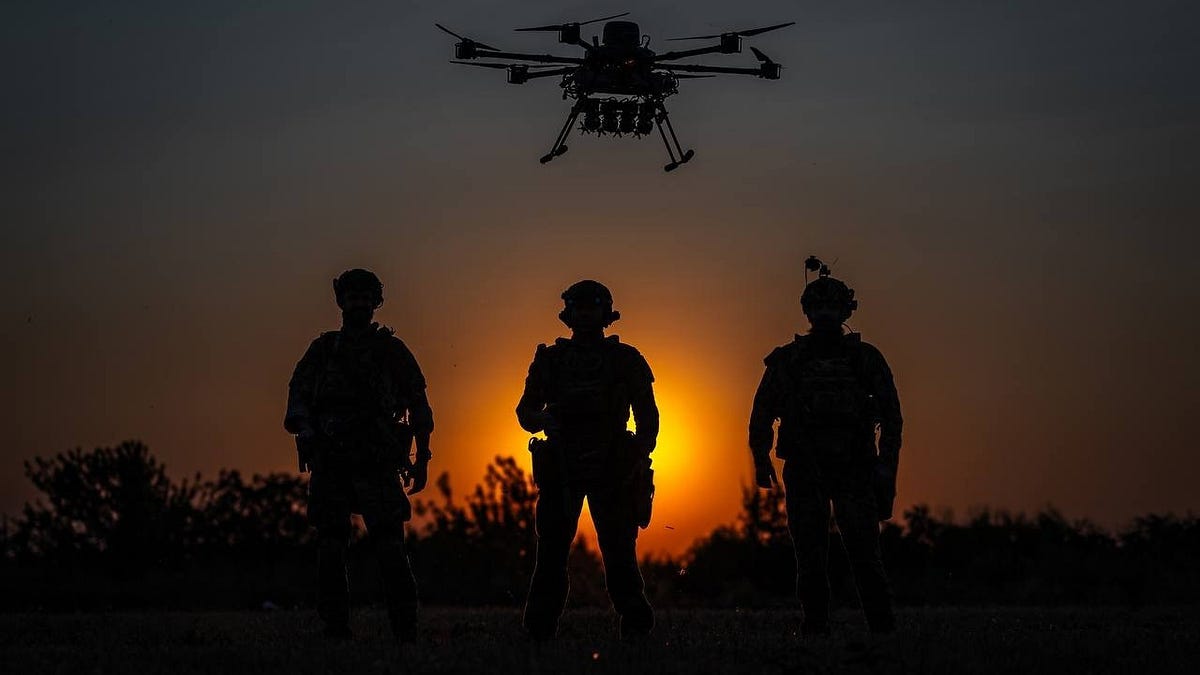
Photo: Vampire bomber drone will ensure nightmares for the occupiers. Courtesy of Anton Sheveliov / Ministry of Defense via X Ukraine’s solution to the Starlink problem affected Russian long-range drone operations, but their current adaptations are even harder to counter. Russia is now focusing on the mass deployment of mesh technology across various types of […]
Menej ako 1 min.
min.
Ukraine’s solution to the Starlink problem affected Russian long-range drone operations, but their current adaptations are even harder to counter. Russia is now focusing on the mass deployment of mesh technology across various types of drones — something that has been observed since the end of last year. It allows a group of drones to operate as a chain, with the signal relayed through aircraft that remain in the air.
Investment in electronic warfare and radar infrastructure by Ukraine must grow exponentially.
In this edition:
-
“Baba Yaga” Drones in Ukraine: Key Trends;
-
Mesh Networks on Russian Drones and Ways of Countering Them;
-
Russia’s Use of LTE Networks to Control FPV Drones;
-
Drone Warfare Lessons for NATO: The Hedgehog-2025 Exercise;
-
and 5+ additional developments in drone warfare in Ukraine and Russia.
Thank you for reading and supporting my work!
Last week, I joined Samuel Bendett, one of the leading experts on Russia, on his podcast to discuss drone developments on the battlefield. Listen to the recording on X Spaces ⬇️

Samuel Bendett@sambendett
We are back! Please join our Spaces on Wednesday February 18 at 7:30pm EST as we host @OKryzhanivska to discuss combat robotics in Ukraine – with @exit266 https://t.co/32pad7CD2Z
10:10 PM · Feb 11, 2026 · 15.6K Views
2 Replies · 8 Reposts · 23 Likes
“Baba Yaga” Drones in Ukraine: Key Trends
One Russian milblogger, in a recent interview with Radio Sputnik, stated that the area where Ukrainians hold an absolute advantage is the so-called “Baba Yaga” drones — thousands of heavy multirotor drones capable of dropping six 82mm rounds, hovering over Russian positions, and leveling trenches. He said it remains an absolute mystery to him why Russia, now almost in the fifth year of the war, has not deployed such bombardier drones at scale.
“We have very good FPV drones. But all Ukrainian FPV drones are integrated into a unified ground control station, while ours are fragmented — there’s a control station for Ovod drones, then separate systems for fiber-optic drones — all different. They have better standardization. The biggest problem is ‘Baba Yaga,” the blogger added.
He also cited private initiatives to produce such drones. For example, the Upyr drone was presented to Putin after reportedly striking an Abrams and a Bradley. It had been built with public donations, and after seeing its performance, Putin ordered funding for further production. Later, the heavy Berdysh drone emerged, but it still remains at the level of a grassroots individual initiative.
Four years have now passed, and these drones still do not exist at scale.
Before the war, the drones now known as “Baba Yaga” were agricultural platforms used for spreading fertilizer.
A personal contact of mine on the frontline mentioned that: “The Russians tend to call all heavy bombers’ Baba Yaga,’ regardless of the specific model. And the sound it makes – it’s like a helicopter on steroids! At night, it really gets under your skin. They fear it first and foremost because of the sound”.
Now, Ukrainian units use “Baba Yaga” type drones for:
• precision strikes against equipment in the enemy’s near rear;
• targeting ammunition depots and personnel concentrations;
• remotely mining routes used by enemy vehicles;
• maintaining a constant aerial threat, especially at night — when it may not be visible, but can always be heard.
One of the most well-known units to have mastered the use of “Baba Yaga” drones is the 412th Separate Unmanned Systems Brigade “Nemesis.” It is known for actively striking enemy air defence systems with its bomber drones. The military personnel of this unit created their own heavy bomber, also named Nemesis. It can fly over 20 kilometers, and for uninterrupted communication, Nemesis integrated Starlink satellite communication terminals. According to the unit, “We have an operator who sits in Kyiv in a warm office with a smoothie and drops 3-4 shells in one mission.”
The flight route is programmed in advance using specialized systems, and only at the final stage — when the target is in close proximity — the operator takes manual control to guide the drone onto the object and evade electronic warfare systems.
The Nemesis unit has its own workshop, which monitors the condition of the bombers, conducts inspections, and performs test flights. In addition, there is meticulous record-keeping of sorties and returns, operator checklists, and verification of operational algorithms.
One of the representatives of “Baba Yaga”-class drones in Ukraine is the Vampire drone (I reported on it here in April, 2025). It is a large hexacopter that previously operated at around 20 km and can now reach targets up to 60 km away. The payload capacity of the drone is steadily increasing (over 15 kg).
Developed by the Ukrainian company SkyFall in 2022, the Vampire was designed for strike missions, including the destruction of armored vehicles, fortifications, ammunition depots, and enemy personnel. It is also used to deliver equipment to the frontline.
According to a Ukrainian serviceman interviewed for this article, “frontline logistics would collapse without it. So it’s not only a strike platform, but also a very high-quality logistical tool.”
The manufacturer recently told Oboronka that the current version of the Vampire drone surpasses the first version in every aspect — communications, range, resilience to electronic warfare, ease of operation, speed, and design for production.
Previously, the company could produce around 50,000 units per year; now, it has a capacity of 100,000 units annually while maintaining consistent quality.
The producer mentioned that there are still many areas for improvement. Whereas earlier the system relied on GPS, it no longer does. Alternatives include visual navigation, inertial guidance, and ground-based “beacons.” In the Starlink-enabled version, navigation can also be based on satellite constellation tracking.
The goal is to ensure that, even under heavy signal suppression, Vampire can complete its mission and return safely.
SkyFall has more than halved the production cost of its Vampire drone during the full-scale war, from nearly $20,000 to the current $8,500 per unit.
The producer acknowledged that there is still room to reduce the price further, but the potential for further reductions is limited. The company plans to lower costs by installing its own camera and localizing the production of key components, which, in some cases, are already cheaper than their Chinese counterparts.
SkyFall has already localized a significant share of production: communications systems, antennas, the chassis, and almost the entire ground control station are now Ukrainian-made. The company has also developed its own motors, although their serial production has not yet been scaled.
A separate focus area is the development of an in-house camera. A prototype has already been created, with an MVP version expected in the spring. By the end of the year, SkyFall plans to launch mass production of cameras for the Vampire. The company already offers a “Vampire non-China” version — free of Chinese components — and aims to make the drone fully Ukrainian by the end of the year.
According to Russian media, Russian forces repair downed Ukrainian Baba Yaga drones and then use them against Ukrainians.
Reportedly, a trophy “Baba Yaga” drone can be purchased at the market in occupied Donetsk for approximately 600,000 rubles ($7,860 USD). Some drones are cheaper. Sellers are reportedly willing to arrange a “test drive” outside the city to demonstrate the drone in operation.
Mesh Networks on Russian Drones and Ways of Countering Them
Ukrainian military communications specialist and advisor to Minister of Defence, Serhiy “FLASH” Beskrestnov, wrote on Facebook that a fellow serviceman had sent him photos of the internal configuration of a new Russian Molniya UAV. The images confirmed what he had feared – Russian forces have installed a mesh modem on the Molniya UAVs.