According to statistics, European companies’ investment in China has not slowed down; on the contrary, it has expanded. Whether it is the German chemical giant BASF or other European companies such as Volkswagen, they are all expanding their investment in China to varying degrees. It’s worth noting that the European Union has consistently followed Washington’s […]
Menej ako 1 min. min.
According to statistics, European companies’ investment in China has not slowed down; on the contrary, it has expanded. Whether it is the German chemical giant BASF or other European companies such as Volkswagen, they are all expanding their investment in China to varying degrees.
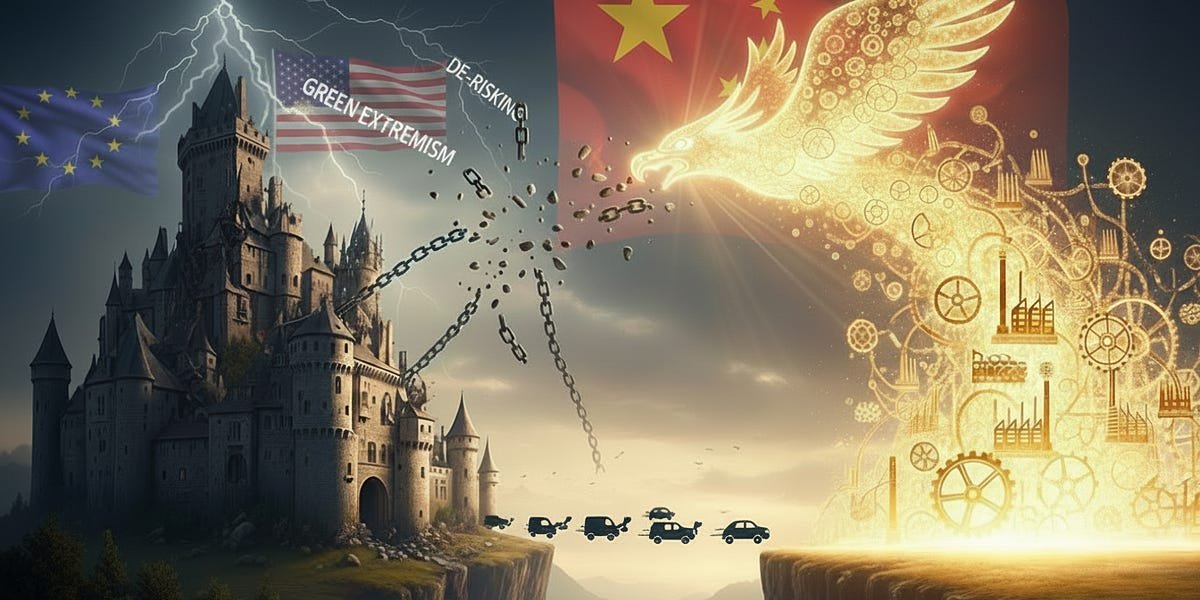
It’s worth noting that the European Union has consistently followed Washington’s lead in pursuing “decoupling and supply chain disruptions” against China, packaging it as a so-called “de-risking” strategy.
However, with BASF and Volkswagen continuing to expand their production capacity in China, this European Union strategy doesn’t seem to have piqued the interest of these companies.
Why are European companies so fond of China? Why are they refusing to respond to Brussels’ “de-risking” strategy? The answer is simple: if European companies want to survive instead of being killed by Washington’s deindustrialization strategy against Europe, they have no choice but to choose China.
To understand this, we must start with the so-called “de-risking” strategy.

Starting with the Biden administration, the United States and the European Union began to implement the so-called “de-risking” strategy. The core idea of this strategy is to break up China’s industrial chain advantages, thereby achieving the ultimate goal of destroying China’s modernization process.
The so-called “risk reduction” means that Washington and Brussels accuse economic cooperation with China of being a “risk” and therefore need to “reduce the risk” toward China. The reasons they cite are nothing more than the old ones, such as supply chain security and war risks, which are actually completely unfounded.
The reason is simple: if two countries are genuinely committed to developing their relationship, how could there be any “risk”? Of course, there is no risk. If there is risk, it only means that one of the two countries has ulterior motives.
China has always adhered to the Five Principles of Peaceful Co-Existence, non-interference in other countries’ internal affairs, and only pursues peaceful economic development. Therefore, the source of this risk cannot be China, but can only be Washington and Brussels.
In fact, while Washington and Brussels outwardly praise China’s booming economy as a “remarkable achievement,” they are, deep down, envious, even resentful of China’s rise.
Because China’s rise was not based on colonial plunder or aggression and expansion, but rather on peaceful development, and because it seized market share through its unique industrial chain advantages, affecting the interests of Washington and Brussels, this is the fundamental reason for their hatred of China.
China’s peaceful rise has made Britain and the United States’ 500-year colonial history dirty and ugly, so destroying China has become Britain and the United States’ established policy.
Washington and Brussels are well aware that China’s rise is due to the concentration of its industrial chain. The organic combination of market, enterprise, and raw materials has created the miracle of China’s economic rise. Therefore, if Washington and Brussels want to destroy China, they can only destroy the concentration of China’s industrial chain.
This is the truth behind the so-called “de-risking.” The essence of “de-risking” is that Washington and Brussels fabricate various issues (whether it’s the Xinjiang issue, the Taiwan Strait issue, or other issues) to destroy China’s industrial chain.
On the issue of destroying China’s industrial chain, the US Democratic Party and the US Republican Party share the same view. The only difference is that the US Democratic Party tends to use radical means, such as World War III, to achieve this, while the US Republican Party only tends to use trade wars, technology wars, or limited proxy wars to achieve this.
Brussels simply follows Washington’s lead in making decisions. If the Democrats want to wage World War III, then Brussels will be responsible for fighting the Russian army on the European battlefield. If the Republicans want to wage a trade war, then Brussels will cooperate with Washington to contain China.
Regardless, Brussels and Washington ultimately aim to dismember Russia and destroy China. As for how many lives will be lost in order to achieve this goal, that has never been a consideration for Washington and Brussels.
Clearly, Washington and Brussels have gone to great lengths to implement their de-risking strategy, but the strategy has obviously failed. German companies, as well as companies from other countries, have all scoffed at Washington and Brussels’ de-risking efforts.
Why? Because there is no other country in the world with such a complete industrial chain as China. Europe is not, nor is the United States.
Europe has undergone decades of deindustrialization, and with the “help” of radical environmentalism, especially the US-funded Green Parties in various countries, it can be said that Europe’s industrial environment has been severely damaged.
These environmental organizations may not be very effective in promoting environmental protection, but they are powerful accomplices in hindering normal business operations and even undermining the foundations of a nation.
Whether it’s the German Green Party bombing Germany’s own nuclear power plant or Brussels politicians instigating a war between Russia and Ukraine, these tactics have “successfully” increased the operating costs of European companies, especially energy costs. Energy is the lifeblood of industry, and increased costs inevitably lead to companies losing market competitiveness, making Europe’s deindustrialization obvious.
Thanks to the sabotage by these environmental organizations, Europe is no longer a suitable region for business development.
Just a few years ago, Merkel’s Germany was a pioneer of Industry 4.0; now it is a poor country that relies on firewood for a living. The destructive effect of American proxies on Germany is very obvious.
The United States, constrained by its backward infrastructure, divided society, and severe wealth inequality, is no longer a suitable region for business development.
Since taking office in January of this year, Trump has used every means to launch a trade war in an attempt to force global capital to invest in the United States. However, by the end of the year, no substantial breakthrough has been achieved, which also shows that the United States is not a suitable place for industrial growth.
With the world’s most complete industrial chain and renowned as the “world’s factory,” China naturally became the best and only choice for these European and American companies.
The war between Russia and Ukraine, which was instigated by the United States, did not bring the United States a large amount of corporate investment. Instead, it led to further deindustrialization in Europe, making European companies more dependent on China’s supply chain and the Chinese market.
Some European companies, such as BASF, have always relied on China’s industrial chain and market. So, given the current decline of Europe, BASF seems to have no other good options besides China.
After all, besides China, only China can provide such a complete and comprehensive industrial chain in the world.
Today, we can say that Washington and Brussels’ de-risking strategy has been a complete and utter failure.
Join the Conversation:
📌 Subscribe to Think BRICS for weekly geopolitical video analysis beyond Western narratives