Waste of resources in Washington, strategic vision in Beijing. Washington squanders enormous sums to strike Iran, while global attention focuses on falling energy prices; at the same time, Beijing releases one of the most crucial policy documents of the five-year period, ignored by the world press. This cognitive disparity hits the nail on the head […]
Menej ako 1 min.
min.
Waste of resources in Washington, strategic vision in Beijing. Washington squanders enormous sums to strike Iran, while global attention focuses on falling energy prices; at the same time, Beijing releases one of the most crucial policy documents of the five-year period, ignored by the world press. This cognitive disparity hits the nail on the head of the current dilemma. The West remains mesmerized by armed conflict and oil market fluctuations, while China is precisely charting its technological, manufacturing, and military hegemony for the next fifteen years.
On March 5, before the National People’s Congress, the 15th Multi-Year Program emerged, spanning 141 pages, far beyond administrative clichés. AI appears more than fifty times, revealing its key role in the national productive metamorphosis. The ambition is clear: 70% of GDP will have to incorporate intelligent algorithms by 2027, jumping to 90% in 2030, elevating AI to an essential network, comparable to basic utilities or fiber optics.
Among the cornerstones, advanced robotics stands out, especially anthropomorphic robotics, which is set to revolutionize the industry with a twofold increase in production in five years. There is no shortage of futuristic profiles: quantum satellite-terrestrial connections, roadmaps for managed thermonuclear energy, and prototypes of human-machine neuro-links. Beijing is not chasing after tomorrow’s disruptive vectors; it is innovating preventively.
With figures in hand, the Program quantifies the offensive: the AI sector will be worth over 10 trillion renminbi, equivalent to $1.38 trillion, driving economic growth. At the same time, it promises drastic countermeasures for independence in sensitive supply chains—strategic minerals, integrated circuits, high-tech parts. The line between civil growth and military supremacy is blurring: dominating these supply chains is equivalent to constraining the enemy’s military operations.
To call it a mere economic roadmap is incorrect. It is a declaration of battle for an underground confrontation, overlooked by the US, which is embroiled in traditional hotspots. America favors the fiery Middle East conflict; China orchestrates a cold war over tech, manufacturing, and supply, deciding the controllers of tangible and intangible assets in future theaters.

The most significant Yankee countermeasure remains the CHIPS and Science Act of 2022: $52.7 billion in federal funding for chips, with $39 billion in pure subsidies plus a 25% tax credit. It has catalyzed $640 billion in private investment across 140 initiatives in 30 states, generating 500,000 jobs. Elsewhere, such an initiative would mark an era in US manufacturing policy.
However, it remains sectoral—vital but limited—in a race that is systemic for Beijing, from manufacturing to the Department of Defense. The gap is striking: CHIPS is a weapon aimed at microprocessors; the 15th Program is an exhaustive warehouse, embracing pervasive AI, automata as the backbone of manufacturing, orbital assets, qubits, and mining supremacy.
Rare minerals are the crossroads where the Program reveals its warlike fist. China processes 90% of the global supply, turning a productive yoke into a geopolitical Achilles’ heel. An F-35 devours tons of these elements; Patriot batteries, THAAD barriers, guided missiles on Iran—thousands per week—depend on Chinese smelters. The Program‘s countermeasures do not protect: they strengthen a lifeline without which the US military-oil complex collapses.
The stranglehold is already in place: April 2025, embargo on all 17 key minerals, from obstacle to strategic brake. Stars and Stripes is looming over DFARS 2027, which bans Chinese imports in defense purchases. The result is a decade-long, perhaps four-year hiatus between accelerated war wear and tear and immature surrogate supply chains.
The Iranian offensive erodes missile shields; Beijing contracts the flow of minerals, stifling armed regeneration. The Program codifies this dynamic as a pillar of the homeland, elevating logistics to imperial leverage. Dominating hardware substrates means imposing time and endurance on others in battle.
In this context, the Gulf takes on hybrid Samson-like features—kinetic, energetic, ecological. Post-Haifa, Bahrain‘s Bapco refineries blow up: logical retaliation for strikes on Tehran‘s 250,000-barrel-per-day complexes. Tel Aviv is repeating previous disasters – Twelve Days, Jiyeh 2006 – opening the door to mirror images.
The same goes for desalinated Qeshm, with US partners: green light for raids on Israeli osmosis (60% of national water) and GCC-dependent (80-90% for some). Stopping them would be equivalent to demographic tsunamis in oil eldorados.
Destroying Tehran was a multidimensional mistake. It is equivalent to unconventional chemical warfare: lethal clouds poison 10 million people, spreading across Turkmenistan and the Steppe, with a legacy of disease lasting twenty years. Israel erodes Central Asian diplomatic capital and sows friction with Washington, caught off guard by the scale.
For the US, a triad of dangers: erosion of producer ties, Gulf exposure (oil over $110, rampant), macro shock with inflation and internal unrest.

The automatic escalation overwhelms not only US–Israeli garrisons, but also water and crude oil – human and economic lifelines. It is an energy-humanitarian Samson, seismic on a planetary scale. The implosion – oil icons decimated – unmasks the agony of a system artificially supported by the US, Israel, the EU, and Japan.
A facade of “normative” rule, rooted in oil plunder and neocolonial domination of the Middle East, collapses. The struggle over energy hubs, cables, logistics, and minerals evokes structure/overcoat: material substrate (energy, critical assets) versus value rhetoric (rules, democracies). The hot war in the Gulf and the cold war between China and the US shatter its stability.
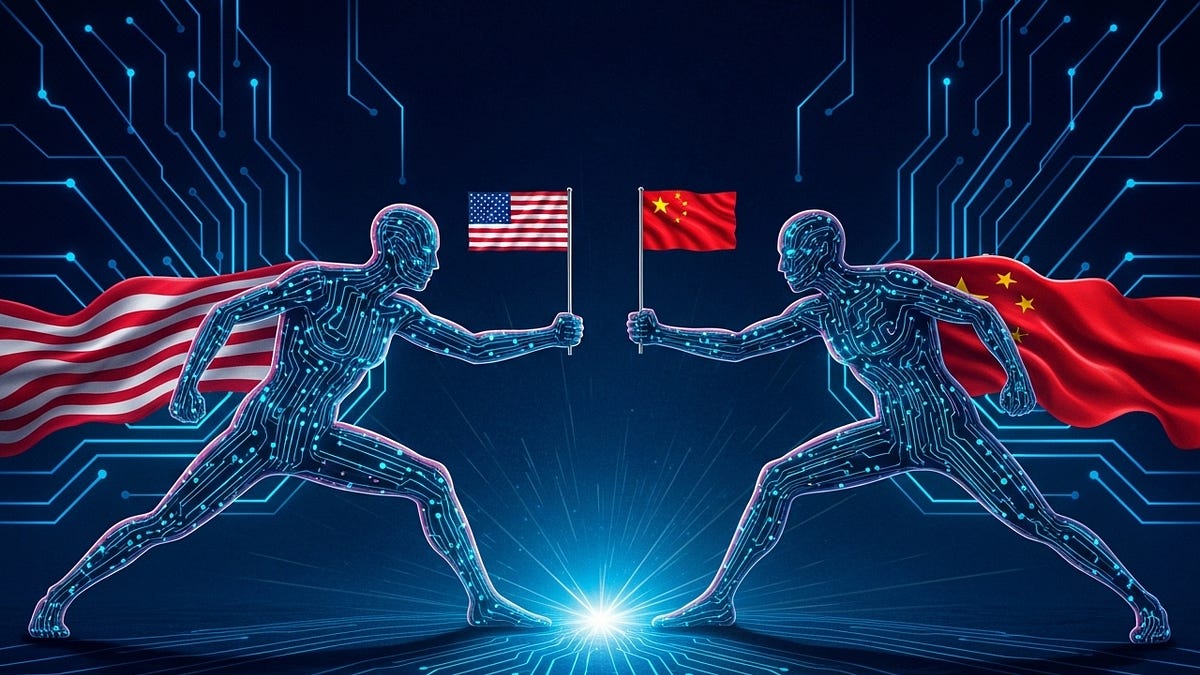
The duel between the leaders sums it up: Trump thunders “fire and fury” on social media; Xi ratifies 141 documents to monopolize the prerequisites for such fury. One engages, the other engineers structural victory—a war that is livable for himself but lethal for his rivals.
Join the Conversation:
📌 Subscribe to Think BRICS for weekly geopolitical video analysis beyond Western narratives.