Manure in front of the European Parliament, tractors clashing with police, water cannons deployed… On Thursday, December 18, European farmers’ protests brought Brussels to a standstill. Columns of farm vehicles paraded through the streets of the European capital to protest against the drastic cuts to funding in the new Common Agricultural Policy 2028-2034, still under […]
Menej ako 1 min.
min.
Manure in front of the European Parliament, tractors clashing with police, water cannons deployed… On Thursday, December 18, European farmers’ protests brought Brussels to a standstill. Columns of farm vehicles paraded through the streets of the European capital to protest against the drastic cuts to funding in the new Common Agricultural Policy 2028-2034, still under negotiation. CAP funds would drop from the current 387 billion euros to just under 300 billion. Warning signs of these protests against the European instrument for supporting the primary sector had emerged in late November when an official from the Italian Ministry of Agriculture declared: “We don’t like this reform at all, neither in how it’s structured, nor the proposed framework, nor the slashed funding, nor the organization.”
While Brussels is paralyzed by tractors in revolt, on the other side of the world a geopolitical heavyweight in the agri-food sector is outlining a political strategy moving in the opposite direction. In late October 2025, in Beijing, the Central Committee of the Chinese Communist Party approved and presented recommendations for the 15th Five-Year Plan, 2026-2030, which includes an entire chapter dedicated to the primary sector. A project through which the Celestial Empire intends to elevate agriculture to a pillar of national security, investing in production capacity, infrastructure for inland areas, and seed control.
Professor Andrea Benin, writing in Krisis.info, contrasts the European approach—dominated by bureaucratic management exposed to market uncertainties—with Chinese public dirigisme, which recognizes the primary sector and rural residency as the true keys to geostrategic sovereignty in the 21st century. This isn’t just about geographical distance. At stake is a radical philosophical divergence over what it means today to guarantee a people’s food security.
On one hand, the EU appears incapable of positioning itself as a promoter of a unified strategic political vision. Brussels has now relegated the primary sector to the margins, dedicating fewer financial resources to it and leaving European farmers exposed to the whims of the free market, in a global geopolitical context dominated by strong tensions and uncertainties.
It’s no coincidence that the proposal for the new CAP, formalized last July following the presentation of the vision for European agriculture, sparked harsh criticism from the outset. “This is not a cut to the Common Agricultural Policy budget. This is a massacre of that budget with a chainsaw,” wrote former European Commissioner for Agriculture Janusz Wojciechowski. “EU agricultural funds are set to decrease from the current 58 billion euros to 43 billion euros per year. Every year, 15 billion euros less in the pockets of EU farmers! And on top of that, Ukraine, Mercosur.”
On the other hand, China prescribes a policy of public dirigisme, albeit in market conditions, having clarified its strategic interests and recommending “giving top priority to issues relating to agriculture, rural areas, and the people residing there.” A curious note: in a Europe inflamed by debate over the CAP, the recommendations of the Celestial Empire’s 15th Five-Year Plan received no media coverage whatsoever.
Yet for technicians, businesses, trade associations, traders, economists, and policymakers, a comparison between the objectives of these two proposals is of central interest, since it concerns the political vision of two of the major powers dominating the global market for agricultural and food commodities in terms of production and trade. The effects of these political choices will influence markets and the availability of agricultural resources and reserves at the planetary level in the future.

In this comparison, points of convergence and contact are noteworthy, but above all the profound differences in geostrategic vision within which the agricultural sector is framed. As a preface to the comparison, it should be noted that the European and Chinese agricultural sectors derive from and develop based on very different models, historically, legally, politically, and organizationally, but also in relation to per capita income.
While in Europe there has been strong attention to environmental rather than production contexts for many years, in China agriculture has played an important social role in supporting poverty reduction even in recent times. It should also be noted that for both entities, other instruments exist that address rural and inland areas in a coordinated manner, which are not analyzed here, such as EU cohesion policies or Chinese sectoral plans.
The two proposals show strong (and perhaps for Europeans unexpected) convergence of intent, especially regarding sustainability, despite the West continuing to portray China as inattentive to environmental aspects. Both political strategies formally address environmental protection, ecological agriculture in harmony with nature, and the protection of landscape and soils, as well as the enhancement of agriculture’s multifunctionality. In particular, Beijing dedicates an entire subchapter to methods for “building a beautiful and harmonious countryside where people can live and work.”
Even in the realm of agri-food supply chains, there are overlapping objectives: promoting agri-food industries and improving and diversifying agricultural supplies. The EU also pushes to strengthen farmers’ position in the food sector value chain, since they represent the weakest link with the least bargaining power. Brussels also promotes the bioeconomy, sector resilience, and cooperation, including territorial cooperation. And Beijing, driven by its economic model, supports new forms of collective rural economies.

Both entities promote the growth of farm income and improved living conditions in rural areas, but with different instruments. The EU has a specific focus on generational renewal in agriculture, since today only a small percentage of European agricultural entrepreneurs are under 40 years old, emphasizing entrepreneurship. In this context, however, European policies appear to be very general in nature, promoting research, providing specific forms of capital access, investment support, connectivity, and supporting the green transition.
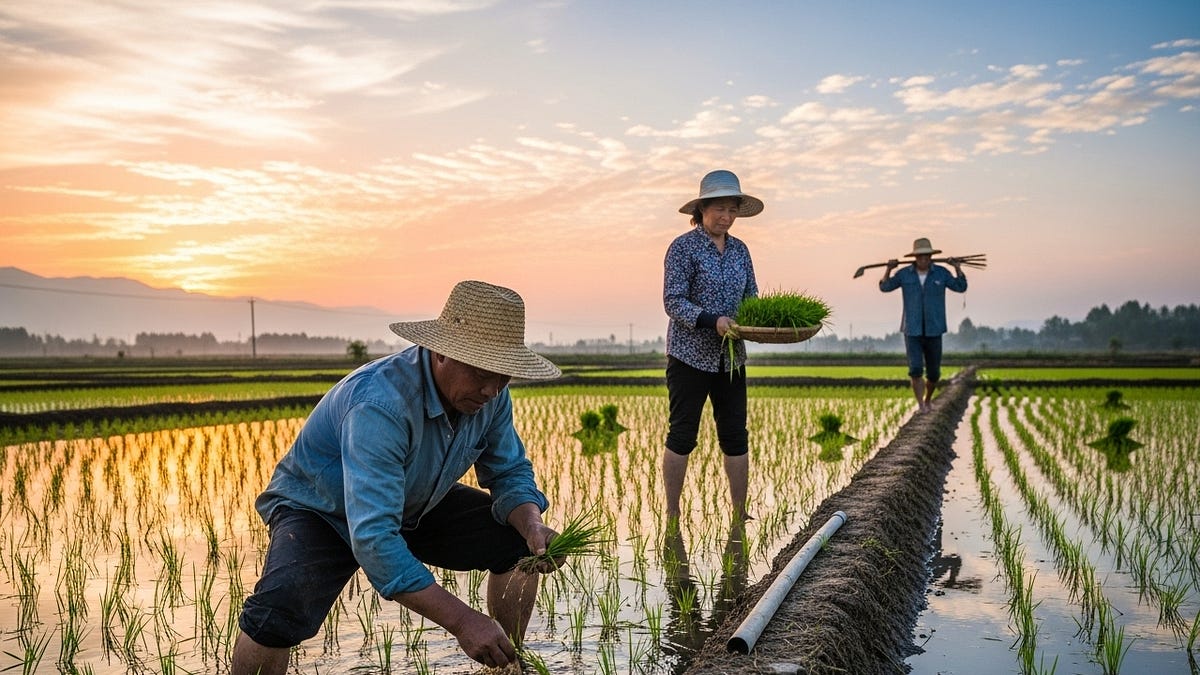
In contrast, the Celestial Empire appears to take a much more concrete approach, encouraging small rural families to engage in modern agriculture. In this context, China promotes research, development, and innovation in the primary sector, including in mechanization (particularly for hilly and mountainous areas) and technology.
But above all, China focuses attention on the construction and maintenance of infrastructure dedicated to rural areas, whether for sanitation facilities, transportation, or waste collection. The goal is to guarantee the essential and substantial elements for life in rural contexts. Beijing also promotes public services and quality living spaces, providing specific forms of assistance for underdeveloped areas.
The most significant divergence is found on the issue of policies for primary production. As mentioned above, the EU favors environmental and social contexts much more than production in the strict sense, stimulating production diversification, reducing bureaucratic-administrative burdens, and tools for crisis and risk management. However, the policy provides no direction to the agricultural production sector.
China adopts a completely different approach. In line with other Asian and Global South countries, such as the Russian Federation and other BRICS states, the People’s Republic of China promotes agricultural modernization, growth in production capacity, and Chinese power in the primary sector. For example, the recommendations mandate a 50-million-ton increase in Chinese grain production. The Celestial Empire also envisions defining a minimum national cultivated agricultural area to avoid serious food availability shortages in the future.
China also mandates the cultivation of alkaline and saline soils, generally underutilized for cultivation, again to promote growth in agricultural commodity production capacity. Impetus is also given to promoting forest and pasture management. Also of interest is the political attention to promoting national seed production, because as German public broadcaster Deutsche Welle notes, “controlling seeds is, in many ways, controlling the food supply.”

Moreover, the People’s Republic focuses on the relationship between urban and rural areas. As Krisis has already highlighted, urban areas are increasingly a pole of cultural, political, and economic attraction and concentration, to the detriment of the surrounding rural territory, which is increasingly marginal. In this context, China has envisioned forms of integrated development between city and countryside, territorial governance, and promotion of productive factor exchanges in favor of rural contexts.
Policies on the future of agriculture in the EU and China, while having some points of contact, are profoundly different in approach. The European Union, beyond general proclamations, seems to consider agriculture increasingly as a marginal sector. Not only has the financial allocation dropped from 70% of the first European budget to a forecast of 16.5%, but there doesn’t appear to be a common political strategy directing the sector, promoting an overall vision and clear, defined objectives.
The People’s Republic, on the contrary, appears to be moving in line with other Asian and Global South countries, expanding its production capacity in the agricultural and food sectors. The recommendations of the Central Committee of the Chinese Communist Party do not cite self-sufficiency as a political objective. Yet in Asia, in addition to Russia, the Eurasian Economic Union (of which China is not a member) has also achieved over 90% agricultural self-sufficiency, highlighting how food production capacity is of central interest to these countries. Furthermore, China promotes the construction of infrastructure serving inland and rural areas and better coordination between these and urban areas.
The Celestial Empire appears to outline, at least from a formal standpoint, clearer and more defined objectives for the near future: an important signal for Chinese farmers and the entire food supply chain. China, like Russia and other BRICS states, demonstrates that the agricultural sector need not necessarily be abandoned to the free market, but that forms of public dirigisme can coexist, keeping in mind the strategic and specific interests of individual states.
The recommendations for the new Five-Year Plan do not allocate financial resources, but they demonstrate the People’s Republic’s attention to agriculture and inland areas, where just under a third of the entire Chinese population still resides today. The rural question, residency in inland areas, and the development of adequate infrastructure are formally recognized as China’s top strategic priorities, also as a form of poverty alleviation and with attention to the environmental context.
Between the tractors lined up in Brussels and the recommendations for five-year plans approved in Beijing, the distance between two opposing ideas of agriculture and food sovereignty is evident. Meanwhile, in Brussels, a BMW remains stuck among potatoes thrown on the ground by farmers as a sign of protest.
About the Author: Andrea Pincin is a forestry engineer who heads the Services Centre for Forestry and Mountain Farming in Friuli Venezia Giulia, Italy. He teaches at the University of Udine and contributes to Krisis.info on agriculture and geopolitics. He is the author of La città rurale (The Rural City). His contributions are professional, not institutional.
To examine and evaluate the agricultural policies of Brussels and Beijing in greater depth, here are the original documents:
REGULATION OF THE EUROPEAN PARLIAMENT AND OF THE COUNCIL, establishing the conditions for the implementation of the Union support to the Common Agriculture Policy for the period from 2028 to 2034
Recommendations of the Central Committee of the Communist Party of China for Formulating the 15th Five-Year Plan for National Economic and Social Development
Join the Conversation:
📌 Subscribe to Think BRICS for weekly geopolitical video analysis beyond Western narratives.