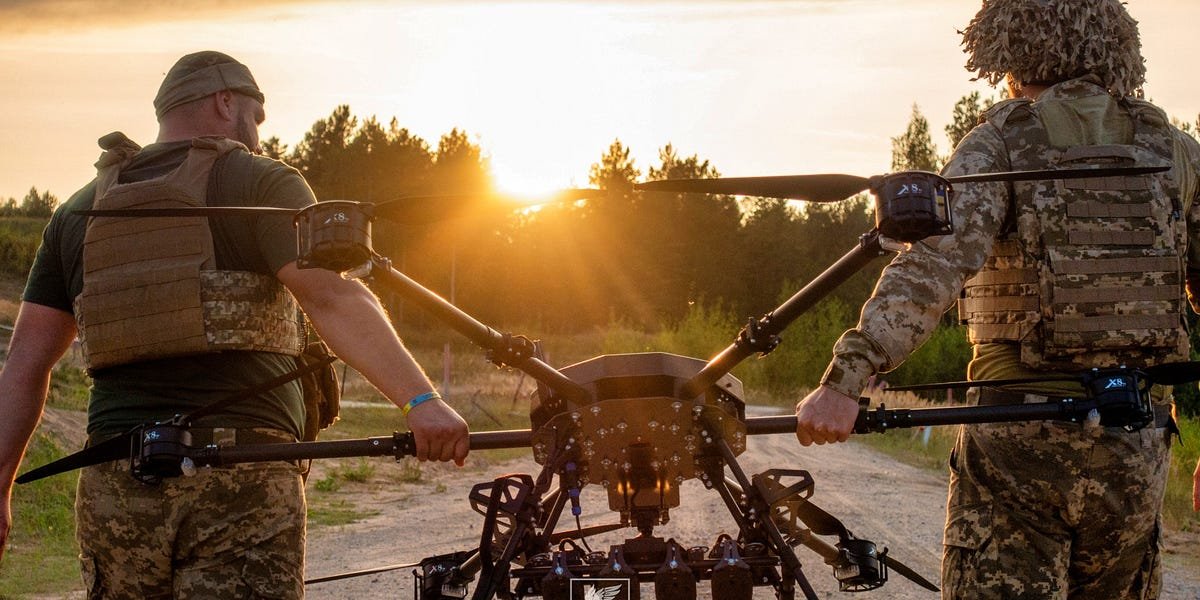
⏱️ Čas čítania: 4 min (701 slov) Photo: 421st Separate Unmanned Systems Battalion “Sapsan” / Facebook Ukraine will not stop drone attacks on military targets in Russia until Moscow agrees to peace, say Ukraine’s officials. In recent days, Ukrainian attacks on 10 Russian oil refineries disrupted at least 17% of Russia’s refinery capacity, or 1.1 […]
Menej ako 1 min. min.
⏱️ Čas čítania: 4 min (701 slov)
Ukraine will not stop drone attacks on military targets in Russia until Moscow agrees to peace, say Ukraine’s officials. In recent days, Ukrainian attacks on 10 Russian oil refineries disrupted at least 17% of Russia’s refinery capacity, or 1.1 million barrels per day. And this is only the beginning, as Ukraine not only launched its serial production of cruise missiles, but is also moving toward parity with Russia in the production of long-range one-way-attack drones.
In this edition:
-
Ukraine Ramps Up Long-Range Disposable Drone Production: FP-1;
-
Ground Drones as Bombs: How Ukraine Is Deploying UGVs on the Battlefield;
-
Trypillian: Inside the British-Ukrainian Defence-Tech Startup: Summary of the Interview;
-
10+ additional developments in drone warfare in Ukraine and Russia.
Thank you for reading and supporting my work!
Ukraine Ramps Up Long-Range Disposable Drone Production: FP-1
Ukraine’s FP-1 long-range drone, unveiled publicly in May 2025, is already being manufactured at a rate on par with Russia’s Shahed-136/131 loitering munitions — roughly 100 units per day. Each drone costs an estimated $55,000.
“When it comes to relatively long-range strikes, it should be noted that this has become routine. Ukraine has clearly moved to methodical, pragmatic, daily strikes against Russia and its facilities,” said editor-in-chief of Ukraine’s media outlet Defense Express. “And there are also the Liutyi, the Bober, and the Morok — in other words, other long-range drones. To put it in perspective, their numbers are objectively comparable to what Russia is producing,” he added.
Reportedly, the FP-1 drone accounts for roughly 60% of deep strikes on Russian territory, targeting sites such as oil refineries and ammunition depots. Its effectiveness is reinforced by proprietary software that ensures accurate targeting even under intense electronic warfare conditions.
The FP-1 has a simple, disposable design: it is built mostly from plywood. The drone is quick and cheap to produce, yet still effective. It carries a 60-kg warhead (AP reported it as 60 kg, though at the presentation, the payload was described as up to 120 kg), with a range of up to 1,600 km, and can be adapted for larger payloads if required. In contrast, Shahed drones are heavier, more complex, and less flexible, with a fixed 90-kg warhead. While Russia has equipped them with advanced navigation systems, analysts note these upgrades also drive up costs.
The engine also plays an important role. The Russian Shahed has a larger four-cylinder engine, while the FP-1 is equipped with a two-cylinder, simpler and cheaper one.
Interestingly, the drones are manufactured by the same company that produces the Flamingo cruise missiles — Fire Point. Read about the Flamingo here.
Back in March 2025, the Russian media provided the following description of this drone: “The FP-1 is a fixed-wing kamikaze drone. It can be equipped with a thermal imager or a camera (manufactured in Poland), and possibly a target acquisition system. The drone has a wingspan of 5 meters, an overall length of 3.5 meters, an endurance of 12 hours, and a range of up to 1,200 km. It is a lightweight drone with wings made of foam covered with fiberglass or carbon fiber. It carries a high-explosive fragmentation warhead with up to 60 kg of explosives”. It is specified that the FP-1 drone is manufactured in Ukraine and contains German components.
Brigadier General Shchyhol, responsible for unmanned operations, recently stated that Ukraine will not halt drone attacks on military targets in Russia until Moscow agrees to peace. Last year, President Zelensky ordered the production of 30,000 long-range drones in 2025.
I previously reported on the FP-1 long-range drone, which has been used in high-profile strikes near Moscow. On July 4, it hit the Scientific Research Institute of Applied Chemistry in Sergiev Posad, and three days later targeted the Krasnozavodsky Chemical Plant, just 70 km from the capital and within Moscow’s air defense zone.
Ground Drones as Bombs: How Ukraine Is Deploying UGVs on the Battlefield
According to the head of robotic systems forces in Ukraine’s “Da Vinci Wolves” battalion, there are at least eight uses for ground drones: laying mines, carrying supplies, transporting the wounded and dead, demining, shelling Russian positions, detonating near enemy targets, and gathering intelligence.
The 3rd Separate Assault Brigade is using ground robotic systems to replace infantry on the battlefield, helping to reduce casualties and increase combat effectiveness.