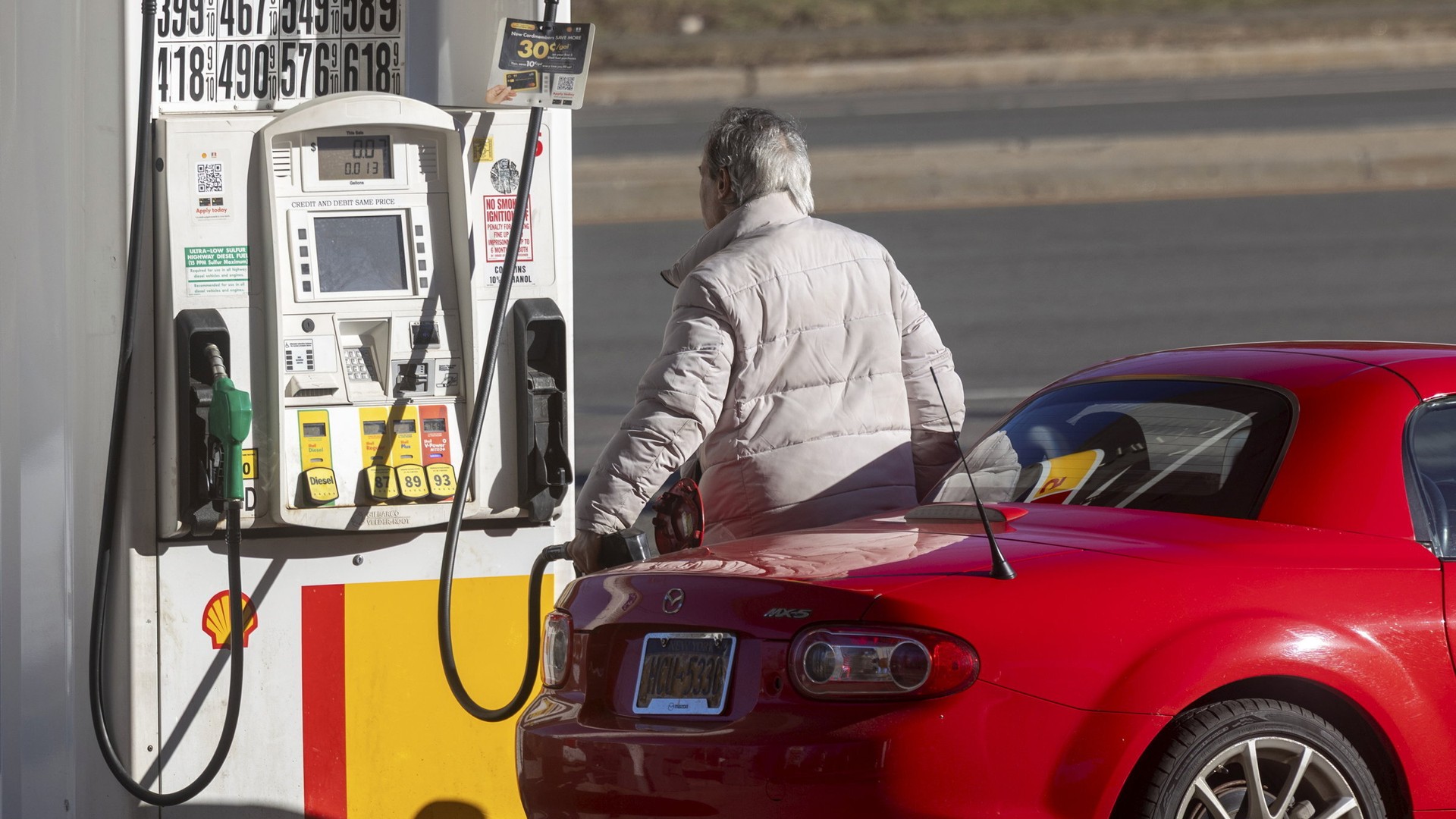
Gasoline costs reached $4 on average across the United States Tuesday — the highest point since 2022, and the highest during either of President Donald Trump’s presidential terms. The American Automobile Association recorded an average price of $4.02 on Tuesday — up from $3.99 Monday. The cost of gasoline is up more than 30% since […]
3
min.
Gasoline costs reached $4 on average across the United States Tuesday — the highest point since 2022, and the highest during either of President Donald Trump’s presidential terms.
The American Automobile Association recorded an average price of $4.02 on Tuesday — up from $3.99 Monday. The cost of gasoline is up more than 30% since the start of the war with Iran a month ago.

Download the SAN app today to stay up-to-date with Unbiased. Straight Facts™.
Point phone camera here
Diesel has also increased by $1.70 since the end of February to an average of $5.45 per gallon.
The war has upset global energy supply chains. Iran has shown no signs of opening the Strait of Hromuz, the narrow waterway through which about 20% of global oil supply passed prior to the war. Iran has also continued attacks on energy infrastructure in neighboring countries, striking a refinery in Israel on Monday. Without a resolution that opens the strait, the per-barrel price of oil is expected to continue to rise, bringing the cost of gasoline with it.
Where are gasoline prices the highest?
Gas is most expensive on the West Coast — well beyond $4 per gallon. In California, the cost of a gallon of regular is $5.89 on average. Arizona, Nevada, Oregon and Washington are also among the most expensive states to buy gas.
Meanwhile the Midwest and Great Plains have the most affordable gasoline with Iowa, Oklahoma and Kansas the only states where gas costs less than $3.30 on average.
Where are prices increasing the most?
Since Feb. 28, Americans have collectively spent an extra $8 billion on gasoline, according to an analysis by Patrick De Haan, head of petroleum analysis at GasBuddy.
The increasing prices have not hit all states equally. Drivers in Utah face the largest increase this March at $1.45 per gallon — an extra $21.75 per fill-up on a 15-gallon tank.
In one month, gas prices in 25 states have shot up by $1 or more. The smallest increase is in Nebraska, where a gallon of gasoline only costs 62 cents more than it did at the end of February.
Diesel prices in Arizona are up by 67%, the highest spike in the nation. That’s already affecting the trucking industry, which threatens to drive inflation for many consumer goods.
How will consumers react?
While Tuesday’s price only increased by 3 cents from the previous day, gas prices are a potent sign for consumers that affects public opinion. And as prices rise, it does have a ripple effect across the economy.
“Consumers don’t have a lot of flexibility to adjust their consumption,” Erich Muehlegger, an economics professor at the University of California, Davis, told Straight Arrow News earlier this month.
For households with limited flexibility in their budgets, that means less shopping and eating out, cutting back when they visit the grocery store or opting out of recreational activities.
But when accounting for inflation, $4 per gallon in today’s dollars is still relatively low. For all of 2010 to until November of 2014, gasoline prices were above $4 per gallon, when adjusted for inflation. 2007 and 2008 saw prices swing from around $3.60 per gallon to over $6 in 2026 dollars.
“People will complain when it hits 3, then when it’s 4, then when it’s 5,” De Haan told SAN, but the “far more active story” is the percentage of Americans’ monthly income spent on gasoline.
“People will start really throttling back around 4.5 to 5%,” De Haan said. This happened in 2008, when more commuters began bicycling or taking public transit. But for now, De Haan said he isn’t seeing that. “As wages go up, so does what people are willing to pay.”