In 1884, the Berlin Conference saw European powers carve up the African continent without a single African representative present. Fast forward to February 2026, and the scene at the African Union (AU) Headquarters in Addis Ababa—a city 7,700 feet above sea level and the only African capital never to be colonized—presents a starkly different reality. […]
Menej ako 1 min.
min.
In 1884, the Berlin Conference saw European powers carve up the African continent without a single African representative present. Fast forward to February 2026, and the scene at the African Union (AU) Headquarters in Addis Ababa—a city 7,700 feet above sea level and the only African capital never to be colonized—presents a starkly different reality.
Today, Africa is no longer a passive recipient of global decisions; it is becoming a co-author of a brand-new multipolar global order. At the heart of this transformation is the deepening engagement between Africa and the BRICS+ alliance, a partnership that promises to bridge the continent’s massive infrastructure gaps while asserting its financial sovereignty.
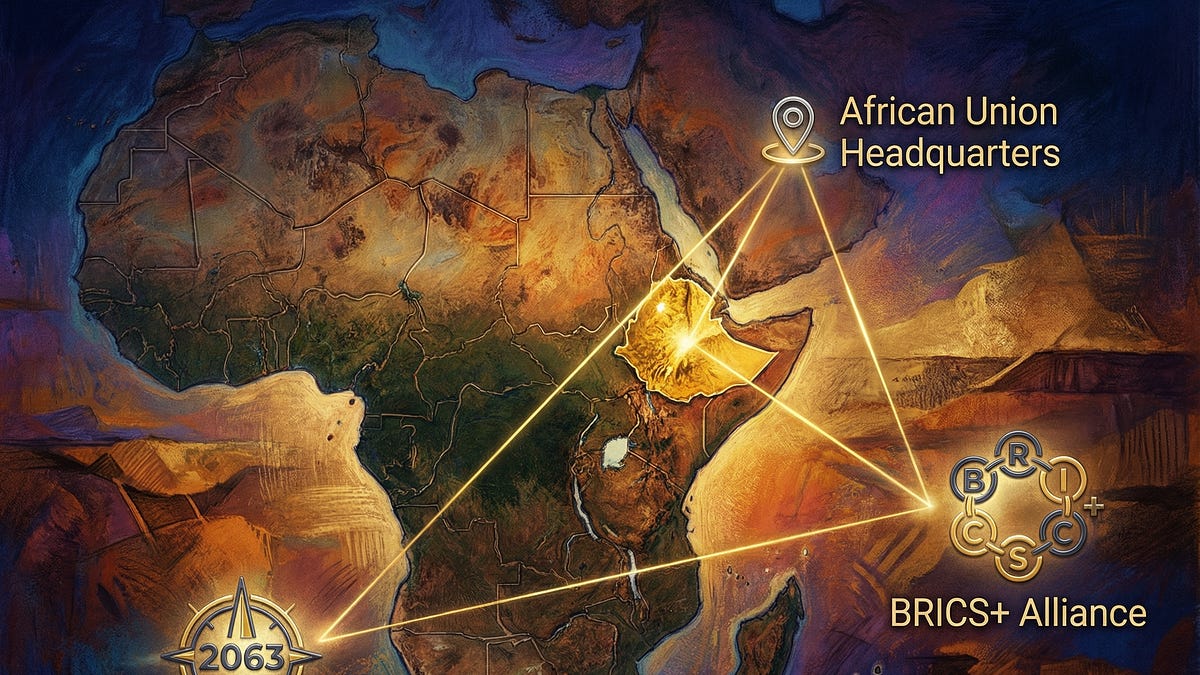
The geopolitical significance of BRICS expansion into Africa, exemplified by Ethiopia’s recent accession, marks a shift from “political liberation” to “economic integration”. This transition is framed by the AU’s Agenda 2063, a blueprint designed to transform Africa into a global powerhouse. By aligning with BRICS, African nations are moving away from the traditional Western-led “shock theory” and aid-dependence toward a model based on South-South cooperation and trade-based partnerships.
This is not merely a change in rhetoric but a fundamental redefinition of sovereignty as financial independence. The “Strategic Nexus” involving Ethiopia, the AU, and BRICS allows African nations to balance Western pressure on debt and security with alternative paths to development. However, the alliance is far from monolithic. Each BRICS member brings specialized expertise to the table: China leads in financing high-speed rail; India supports digital public infrastructure like tele-education; Russia and the UAE engage in renewable and nuclear energy; and Brazil shares technology for agricultural transformation. This diversity allows African nations to “multi-align,” though it also introduces tensions between conflicting conditionalities, such as IMF-mandated austerity versus NDB-backed expansion.
The economic driver behind this geopolitical shift is a staggering “Financing Chasm.” Africa faces an annual infrastructure financing deficit of $68–$108 billion, within a total annual need estimated at $130–$170 billion. Traditional multilateral financing often imposes pro-cyclical austerity, which can stifle growth. In contrast, the New Development Bank (NDB), often referred to as the “BRICS bank,” is quietly rewriting the rules of investment finance.
The NDB’s model is built on three transformative pillars:
-
No Policy Conditionality: Unlike Western institutions that may demand political or economic “shock therapy,” the NDB focuses on a project’s “bankability” and its alignment with local priorities.
-
Local Currency Settlement: To bypass the “dollar trap”—where African nations often pay a 300-basis point risk premium simply because of their geography—the NDB aims to extend 30% of its financing in local currencies by 2026.
-
Project Preparation: Through its Project Preparation Fund (PPF), the NDB provides technical grants to turn concepts into “investment-ready” projects, helping to attract further private capital.
This financial evolution is already visible in Ethiopia, which serves as a critical case study. Despite defaulting on a Eurobond in late 2023, Ethiopia has maintained a GDP growth rate of 9.3%, far outpacing the continental average of 4%. The country is leveraging BRICS partnerships to fund a $1.55–$2.35 billion project pipeline, including a $1.6 billion digital infrastructure deal with ZTE and Huawei.
The synergy between BRICS and Africa is most tangible in massive infrastructure projects designed to facilitate the African Continental Free Trade Area (AfCFTA)—a unified market of 1.4 billion people with a combined GDP of $3.4 trillion.
Energy diplomacy is a cornerstone of this strategy. Ethiopia has transformed into the “Power House of the Horn of Africa,” with the Grand Ethiopian Renaissance Dam (GERD) generating 75.4 billion Birr in revenue in the 2024/25 fiscal year and exporting electricity to Kenya, Djibouti, and Tanzania. This success serves as a model for the Grand Inga Dam, an Agenda 2063 flagship project designed to provide 43,200 MW of power—enough to potentially supply much of Central Africa.
Furthermore, the 39th AU Summit reframed water security as “economic infrastructure”. With water-related diseases costing Africa 115 deaths every hour, the AU and its partners are pushing a $32 billion pipeline for 80 projects focused on hydropower and climate-resilient irrigation. Ethiopia is currently seeking $200–$350 million from the NDB specifically for these water and irrigation initiatives.
Beyond physical rail and dams, the “plumbing” of this new order is being built in the digital and financial spheres. The Pan-African Payment and Settlement System (PAPSS), when integrated with BRICS-led digital payment expertise, has the potential to eliminate $5 billion in annual transaction fees by allowing intra-African trade in local currencies rather than routing through the costly SWIFT system.
In Ethiopia, a digital revolution is already underway. Over 95% of transactions are now virtual, driven by fintech platforms like Telebirr and Arifpay. This expertise is being positioned as a lead for the Agenda 2063 Cyber Security and Virtual University flagships, showing how a single nation can scale its internal successes across the continent via BRICS-supported frameworks.
While the opportunities are vast, the partnership faces “critical” risks, primarily regarding debt sustainability. Ethiopia’s external debt stands at approximately $28.9 billion, with 35–40% of bilateral exposure to China. There is a lingering risk of “entrenchment” where heavy debt to a single partner could limit future maneuverability.
Moreover, internal security remains a “chronic” challenge. Conflicts in regions like the Sahel and Sudan strain diplomatic capacity and can disrupt the industrial parks intended to drive export diversification. For BRICS engagement to be truly transformative, it must navigate these “implementation capacity gaps” and ensure that mega-projects do not aggravate local inequalities.
The Trajectory of a Multipolar Partnership
The trajectory of the BRICS-Africa partnership is moving toward a future where Africa is no longer a site for simple resource extraction, but a center of high-value renewable energy and digitally transformed economies. The 2024–2026 transition period is pivotal; it is the window where “free zones” in industrial parks, local currency trade (such as Birr-Yuan settlements), and the Single African Air-Transport Market (SAATM) must move from concept to execution.
As Ethiopia’s role as the “national anchor” suggests, the success of this partnership depends on the ability of African nations to secure domestic stability while leveraging diverse global partnerships. If these initiatives succeed, the result will be an Africa that governs itself without external interference, linked seamlessly by high-speed rail, digital networks, and a shared vision of ontological peace and financial independence.
Join the Conversation:
📌 Subscribe to Think BRICS for weekly geopolitical video analysis beyond Western narratives.