The global counter-terrorism landscape is undergoing a dramatic realignment, shifting away from decades of Western-centric doctrines toward a new, multipolar security architecture championed by the Global South. This transformation reached a notable inflection point on December 3 and 4, 2025, when Moscow hosted the high-profile BRICS+ Counter-Terrorism Conference. Held under the auspices of the Russian […]
Menej ako 1 min. min.
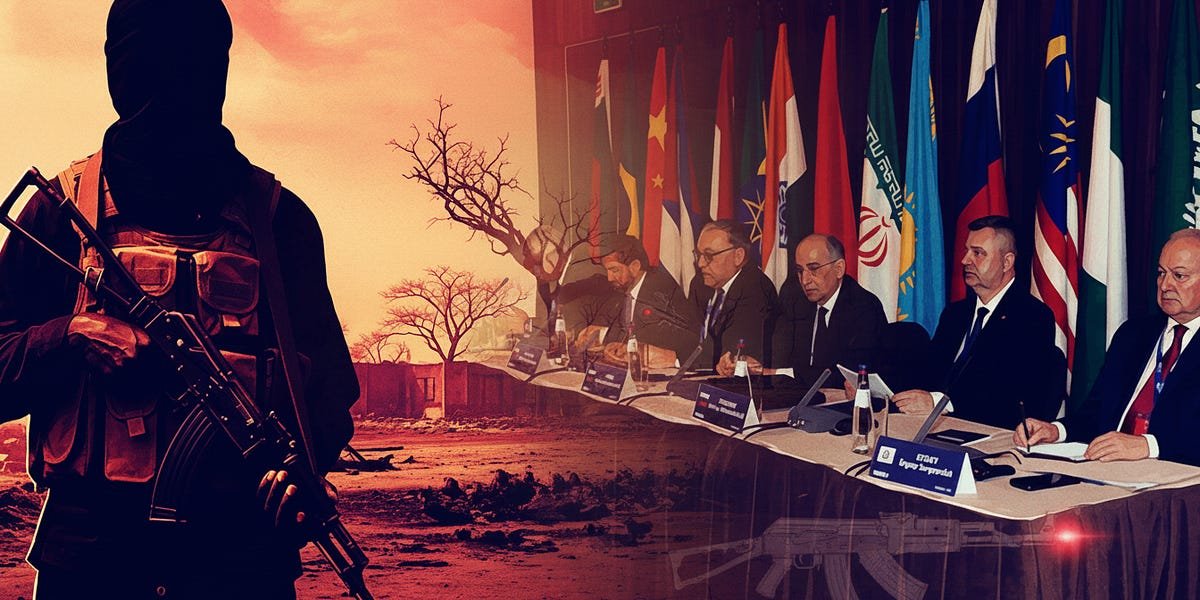
The global counter-terrorism landscape is undergoing a dramatic realignment, shifting away from decades of Western-centric doctrines toward a new, multipolar security architecture championed by the Global South. This transformation reached a notable inflection point on December 3 and 4, 2025, when Moscow hosted the high-profile BRICS+ Counter-Terrorism Conference. Held under the auspices of the Russian Foreign Ministry, the conference, titled “National and Regional Counter-Terrorism Strategies Amid Emerging Security Challenges and Threats,” served as more than just a dialogue; it was a potent demonstration of the expanded BRICS bloc’s (now including new members and partners such as Saudi Arabia, Egypt, the UAE, Ethiopia, Iran, Indonesia, and partners like Vietnam and Nigeria) ambition to establish a viable, non-Western security governance framework.
The forum attracted over a hundred representatives from competent government agencies, academia, and civil society across BRICS+ and partner countries. Crucially, it also gathered experts from international organizations, including the United Nations, the Shanghai Cooperation Organization (SCO), the Collective Security Treaty Organization (CSTO), and the Commonwealth of Independent States (CIS), indicating an attempt to link BRICS initiatives with existing regional security bodies. The explicit objective of the conference was to complement the work of the BRICS Counter-Terrorism Working Group (CTWG) and strengthen cooperation based on the bloc’s established Counter-Terrorism Strategy and subsequent action plans.
This extensive mobilization confirms that the new BRICS+, having smoothly integrated its expanded membership through mechanisms like the CTWG position paper approved in 2024, sees its collective potential as a key instrument in containing extremist and terrorist threats globally.
The urgency underpinning the Moscow conference stems from a highly volatile global security environment, where terrorism remains an adaptive and persistent threat, frequently shifting its geographical epicenter. Data from the Global Terrorism Index (GTI) 2025 confirms a deteriorating situation in several regions critical to the BRICS+ alliance, necessitating strengthened regional counter-measures.

The Sahel region of sub-Saharan Africa has cemented its status as the global epicenter of terrorism, accounting for 51% of all terrorism-related deaths in 2024. This area, home to five of the ten countries most impacted by terrorism, faces pervasive instability fueled by weak governance, transnational jihadist expansion, and escalating geopolitical competition.
The region is dominated by formidable groups such as Jamaat Nusrat Al-Islam wal Muslimeen (JNIM), which ranks as the second deadliest terrorist group worldwide and saw its attributed deaths rise by 46% in 2024. JNIM demonstrated increased lethality, averaging ten deaths per attack, and continued its geographical expansion into coastal West Africa, with Togo recording its worst year for terrorism since the GTI’s inception. Niger experienced the largest global increase in terrorism deaths in 2024, rising by 94 per cent to a total of 930 fatalities, highlighting the extreme fragility of counterterrorism progress.
This security crisis is deeply interwoven with a geopolitical pivot by the Alliance of Sahelian States (Mali, Burkina Faso, and Niger) away from Western powers, instead strengthening ties with Russia and China, often accepting support with fewer conditions attached. Russia, through “Africa Corps” (formerly Wagner Group), has become deeply involved, frequently deploying influence campaigns that frame Western efforts as failures. This dynamic was specifically addressed during the Moscow conference, where some officials warned that Ukraine is seeking to exploit this volatility by opening a “second front” in West Africa, claiming that individuals of Ukrainian origin are training rebels and terrorists in the region to attack Russia’s interests.

In the Asia-Eurasia axis, the conference faced the sharp reality of the Islamic State-Khorasan Province (ISK), an affiliate that has demonstrated a severe transnational threat capability outside its traditional Afghanistan-Pakistan strongholds.
ISK was responsible for two of the deadliest attacks globally in 2024: the horrific Crocus City Hall shooting in Russia, which killed at least 144 people, and the bombing at a memorial in Iran (a new BRICS member), which killed 95. These attacks contributed to substantial increases in terrorism deaths in both countries in 2024 (Russia by 3.199 in the GTI score and Iran by 1.325). The group is aggressively expanding its digital operations and multilingual propaganda (including Pashto, Dari, Russian, and Turkish) to target Central Asia and beyond, transforming online platforms into tools for operational guidance and remote radicalization.
Additionally, BRICS member India (GTI rank 14) and Pakistan (GTI rank 2) remain profoundly affected by regional dynamics. Pakistan experienced the second-largest increase in deaths from terrorism globally (45%) in 2024, primarily driven by the resurgence of Tehrik-e-Taliban Pakistan (TTP), largely benefiting from the political situation in Afghanistan.
The Moscow delegates focused intensely on the evolving methods of terrorism, including the illicit use of information and communication technologies (ICT), and the growing threat of radicalization. International Terrorist Organizations (ITOs) are now widely leveraging advanced science and technology, such as Artificial Intelligence (AI) and cryptocurrencies, to promote extremist ideology, raise funds, and expand their criminal ecosystems. These technologies allow groups like ISK to produce high-quality, localized propaganda and recruit followers globally, often enabling hybrid plots guided remotely via online platforms.
A related concern addressed was youth radicalization, described as a “new frontier in terrorism and security”. This trend is leading to an increase in unpredictable lone-actor attacks, particularly in the West, carried out by youths often radicalized through online content and mixing conflicting viewpoints. The difficulty in tracking these ideologically fluid individuals, many of whom are classified as children when arrested, poses a global security challenge.
The conference agenda also focused heavily on preventing the use of extremist and terrorist groups in hybrid warfare and when interfering in the domestic affairs of sovereign states, alongside addressing radicalization as a key tool for causing social and political upheaval.
The expanded BRICS group builds its collective approach upon the BRICS Counter-Terrorism Strategy, adopted in November 2020. This strategy provides the core principles and goals that define its non-Western security posture.
The foundation of BRICS counter-terrorism cooperation is anchored in full respect for the sovereignty of participating countries and non-interference in internal affairs, while recognizing the central and coordinating role of the United Nations. The bloc firmly rejects double standards on countering terrorism and extremism conducive to terrorism, emphasizing a commitment to international law. This principled stance was reaffirmed in the Kazan Declaration (October 2024), where leaders condemned terrorism unequivocally, insisting it must never be associated with any religion, nationality, civilization, or ethnic group.
Key operational goals outlined in the Strategy, and reinforced through the CTWG (responsible for implementation), include:
-
Strengthening Unity and Action: Considering concerted measures against those involved in organizing, financing, or encouraging terrorist activities.
-
Information and Capacity: Improving practical cooperation among security and law-enforcement authorities through timely and accurate information sharing, and promoting capacity building (training and technical cooperation).
-
Border Security and Resources: Suppressing the facilitation of terrorist groups by withholding human, financial, or material resources (including weaponry), and strengthening border and customs controls, utilizing international databases and UN consolidated sanction lists.
-
Global Norms: Pursuing the adoption of a Comprehensive Convention on International Terrorism (CCIT) within the UN framework.
-
Addressing Root Causes and Misuse: Countering extremist narratives, preventing the misuse of the Internet/social media for recruitment and radicalization, and enhancing cooperation against illicit financial flows, terrorism financing, drug trafficking, and the misuse of new technologies like cryptocurrencies.

BRICS+ members bring diverse security challenges and strategies to the table, reflected by their positions on the GTI 2025.
Russia (GTI Rank 16): As the host and a nation recently targeted by ISK, Russia advocates for an “honest, depoliticized, and results-oriented fight against terrorism without hidden agendas or double standards”. Russia actively frames its counter-terrorism posture geopolitically, arguing that the “collective West” is not genuinely interested in consolidating global efforts and uses double standards, often leveraging terrorism as a tool for neo-colonial policies and hybrid warfare. This sentiment was echoed in Moscow, highlighting the perceived use of terrorist methods by the criminal Kiev regime and its cooperation with international groups. Russia’s CT strategy is fundamentally tied to its strategic goals of stability and countering external interference.
India (GTI Rank 14): India’s long-standing exposure to transnational terror (demonstrated by the 2025 extradition of 26/11 mastermind Tahawwur Hussain Rana) means its strategy emphasizes legal and multilateral enforcement against UN-designated entities. India’s internal security challenges include politico-ethnic violence and the challenges of porous borders, yet it continues to demonstrate commitment to implementing the BRICS Strategy.
Nigeria (GTI Rank 6) & BRICS African Partners: Highly impacted nations like Nigeria face an intractable security crisis driven by groups like Boko Haram and ISWAP, compounded by armed banditry, inter-communal conflict over scarce resources (exacerbated by climate change), and issues of impunity within its security forces. Nigeria, now a BRICS partner, requires a holistic strategy addressing root causes like corruption and poor governance, alongside military reform that incorporates International Humanitarian Law (IHL) and International Human Rights Law (IHRL). New BRICS members in Africa, like Ethiopia and Egypt, and partners like Uganda, participate in strengthening the regional counter-terrorism potential of the bloc.
Vietnam (BRICS Partner): Vietnam’s engagement in the Moscow conference, shortly after gaining formal partner status in June 2025, reflects its commitment to international security efforts. While Vietnam states that the terrorist threat remains controlled domestically, it remains vigilant against online extremist propaganda and overseas Vietnamese terrorist groups. Its strategy is characterized by a comprehensive approach combining social welfare policies, improvements in living standards, legal refinement, and operational capacity building alongside international cooperation.

The Moscow BRICS+ Conference crystallizes the emergence of the bloc as the self-proclaimed leader of the “Global South and the Global East” in shaping a new multipolar world order. The forum served as a deliberate strategic move to elevate the BRICS Counter-Terrorism framework into a central pillar of non-Western security governance.
A defining feature of the Moscow event was the assertive geopolitical framing of the terrorism challenge, directly challenging the narrative and legitimacy of the West’s traditional counter-terrorism efforts. Russian Deputy Foreign Minister Dmitry Lyubinsky explicitly stated that the “collective West is not genuinely interested in consolidating the counter-terrorism efforts” and practices double standards, viewing terrorism as a geopolitical tool rather than absolute evil. This anti-Western sentiment found expression in pointed assertions, such as the claim made by Ahoua Don Mello, Vice President of the BRICS Alliance, that Kiev is attempting to attack Russia in West Africa by training rebels and terrorists, opening a “second front” in the region where Russia is assisting in the fight against terrorism.
This rhetorical offensive serves to establish BRICS+ cooperation as the principled alternative—one that respects sovereignty and non-interference, in contrast to perceived neo-colonial policies and interference in domestic affairs often linked to Western interventions. By inviting regional partners and prominent international organizations like the SCO, CSTO, and CIS, the conference strategically positions BRICS+ as the crucial nexus for coordinating counter-terrorism across Eurasia, South Asia, and Africa.
The Moscow meeting affirmed the institutional strength of BRICS’ internal cooperation, marking the fifth anniversary of the Counter-Terrorism Strategy and the successful integration of new participants into the CTWG process. The expansion itself, encompassing uranium-rich Niger (GTI rank 5) and mineral-rich Mali (GTI rank 4) as close partners aligned with Russia and China, links counter-terrorism efforts directly to resource security and regional stability in the Global South.
The discussion agenda went beyond traditional military responses to focus on areas crucial for long-term stability and non-Western interests:
-
Preventing Politicization: Reaffirming the inadmissibility of using terrorist issues for political ends.
-
Countering Financing & Tech Misuse: Committing to preventing illicit financial flows, money laundering, terrorism financing, and the misuse of new technologies, including cryptocurrencies, for illegal and terrorist purposes.
-
Addressing Ideology: Focusing on combating radicalization, countering extremist narratives, and mitigating the misuse of the Internet and social media for recruitment. This aligns with a broader need to address conditions conducive to the spread of terrorism through education, skills development, and employment facilitation.
The BRICS+ conference in Moscow signals a fundamental and enduring shift in global security governance, moving decisively toward a genuinely multipolar structure.
The explicit linkage of the BRICS+ security agenda to the needs and concerns of the Global South—framed around sovereignty, development, and non-interference—offers an attractive alternative model to the conditional military and political involvement traditionally offered by Western powers. This shift is particularly visible in the Sahel, where countries like Mali and Niger have actively engineered the withdrawal of Western military forces (France and the US), opting instead to strengthen ties with China and Russia for security and economic support, marking a significant change in global influence.
The BRICS+ collective voice will be pivotal in shaping multilateral platforms. The Moscow conference serves as a critical preparation forum ahead of the planned review of the UN Global Counter-Terrorism Strategy (GCTS) in the first half of 2026. By aligning their positions, the expanding BRICS group increases its leverage to promote its “comprehensive and balanced approach” and secure the long-sought adoption of the Comprehensive Convention on International Terrorism (CCIT).
In essence, the Moscow 2025 conference was a successful projection of BRICS+ confidence and coordination, translating economic weight into geopolitical security authority. Future global security governance will be defined less by unitary superpower decree and more by the complex interplay between competing global powers—Western, Russian, and Chinese—within the fragile, terror-affected states of the Global South, where regional bodies and non-Western alliances coordinate to fill emerging security vacuums.
This evolving architecture is analogous to a fractured global security shield: where the previous Western model (the “old shield”) is being explicitly rejected by vulnerable states, the BRICS+ alliance is actively welding together a new, multi-layered defensive structure (the “new shield”), built on diverse national strategies and reinforced by powerful regional players (SCO, CSTO). The effectiveness of this new structure will be tested by its ability to manage the persistent threats posed by adaptive groups like ISK and JNIM amidst escalating geopolitical competition over critical resources and influence.
Join the Conversation:
📌 Subscribe to Think BRICS for weekly geopolitical video analysis beyond Western narratives.