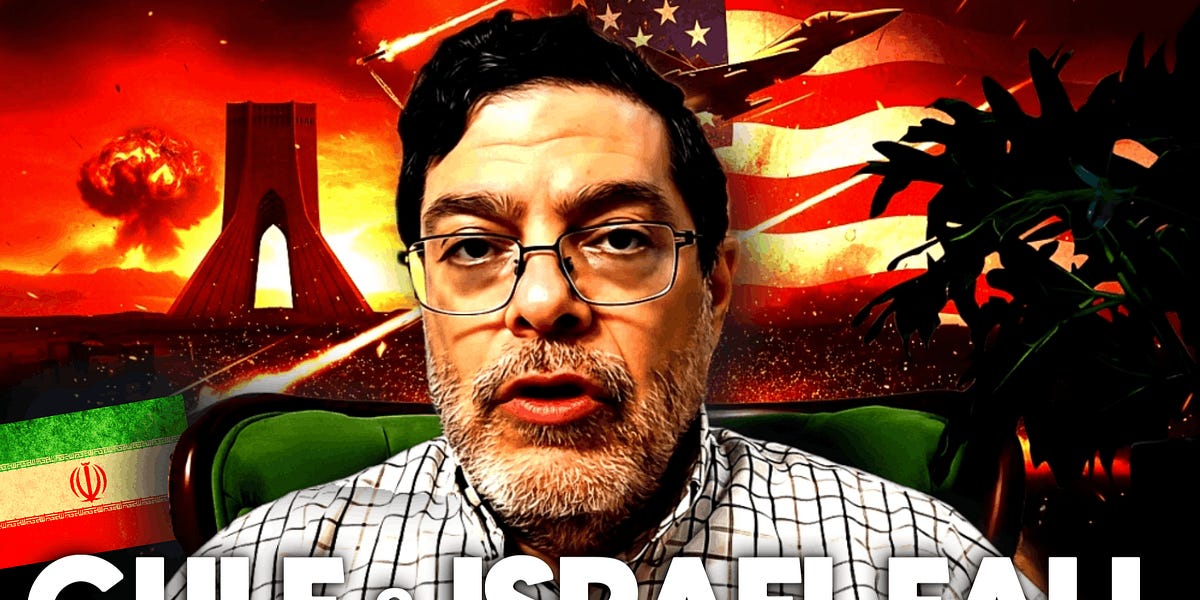
What would actually happen if the United States went to war with Iran? Not the sanitized think-tank version — the real, cascading consequences for oil markets, Persian Gulf monarchies, Israel, and the American presidency itself. In a recent Think BRICS interview, Professor Seyed Mohammad Marandi didn’t hold back. His answers may surprise you. The interview […]
Menej ako 1 min.
min.
What would actually happen if the United States went to war with Iran? Not the sanitized think-tank version — the real, cascading consequences for oil markets, Persian Gulf monarchies, Israel, and the American presidency itself. In a recent Think BRICS interview, Professor Seyed Mohammad Marandi didn’t hold back. His answers may surprise you.
The interview opens with a bombshell. Prof. Marandi, a University of Tehran scholar and seasoned geopolitical analyst, lays out what he describes as a documented, coordinated campaign to destabilize Iran — one he argues involved currency manipulation, trained riot squads, and admissions from Mossad, the CIA, and Israeli media themselves.
“The US Secretary of Treasury in Davos gloated about it,” Marandi tells host Prof. Lorenzo Pacini. “He said: we crashed the currency to bring people onto the streets, and we succeeded.”
Whether you accept this account or scrutinize it, the evidence he cites — from Israeli Channel 14 reporting to Pompeo’s own tweets — raises questions that demand closer examination. And that’s before he gets to what happened on January 8th and 9th.
Marandi argues that Western media coverage of recent events in Iran isn’t just biased — it’s strategically constructed. The goal, in his view, is to build public consensus in the West for military action.
“From the very beginning — the drop in the rial, the riots, Western media — all of this is part of a project to push the American people towards accepting a war with Iran.”
He points to what he calls a telling asymmetry: when the Iranian government published a list of 3,117 names — with ID numbers — of those killed during the unrest, Western outlets went silent. “They know they have no way to discredit this,” he says. It’s a detail that raises uncomfortable questions about the information environment surrounding Iran, regardless of one’s political priors.
Perhaps the most striking portion of the interview concerns Iran’s military posture. Marandi describes a country that has spent two decades preparing for exactly the scenario now unfolding — not with bluster, but with infrastructure.
He speaks of underground missile and drone bases — separate from those used in strikes on Israel — specifically oriented toward the Persian Gulf, the Sea of Oman, and the Gulf of Oman. The targets, he suggests, wouldn’t just be American assets.
“The countries in the Persian Gulf region all have American bases. These bases are being used to conspire against Iran. So these tiny Arab family dictatorships — they’re all complicit. And if war starts, I doubt these regimes will survive.”
It’s a stark warning aimed not just at Washington, but at Riyadh, Abu Dhabi, and beyond. What does Marandi believe the actual military calculus looks like? He goes into considerable detail in the full interview.
Talks between the US and Iran were announced, then collapsed. Marandi offers two possible explanations — and neither is flattering to Washington.
Either the negotiations were never serious — a repeat, he says, of a pattern where America negotiates publicly while conspiring privately — or American officials were genuinely surprised that Iran refused to put its missile capabilities and regional alliances on the table. If the latter, Marandi is blunt: “That shows they are utterly ignorant.”
“Iran is not going to accept any limitation to its defense capabilities. It’s not going to accept giving up its nuclear program or its right to enrichment. That’s not going to happen.”
He does leave one door open — a narrow one. What Iran says it is willing to negotiate, and under what conditions, is something he addresses directly in the interview. It’s a distinction that matters enormously if diplomacy is to have any future.
Marandi raises a point that cuts across ideological lines: a war with Iran wouldn’t just affect Iran. He argues it would eliminate oil and gas flows from the entire West Asia region, triggering an economic shock the global economy — and the Trump administration — could not absorb.
“I don’t think Trump’s presidency will survive that,” he says simply.
It’s a geopolitical argument grounded in energy economics, and it sets up a deeper question the interview explores: if the costs are this obvious, why does the war option remain on the table at all? His answer involves the relationship between Washington and Tel Aviv — and it’s more pointed than most analysts are willing to say on the record.
Prof. Marandi covers far more in this conversation: the Iran-Russia-China trilateral relationship and what it actually means in practice, the role of the Supreme Leader’s personal history in shaping Iranian public confidence, and why he believes Iran’s population — whatever their political grievances — will not negotiate away national sovereignty.
This is the kind of geopolitical analysis rarely aired on mainstream platforms. Draw your own conclusions — but hear the full argument first.
Join the Conversation:
📌 Subscribe to Think BRICS for weekly geopolitical video analysis beyond Western narratives.