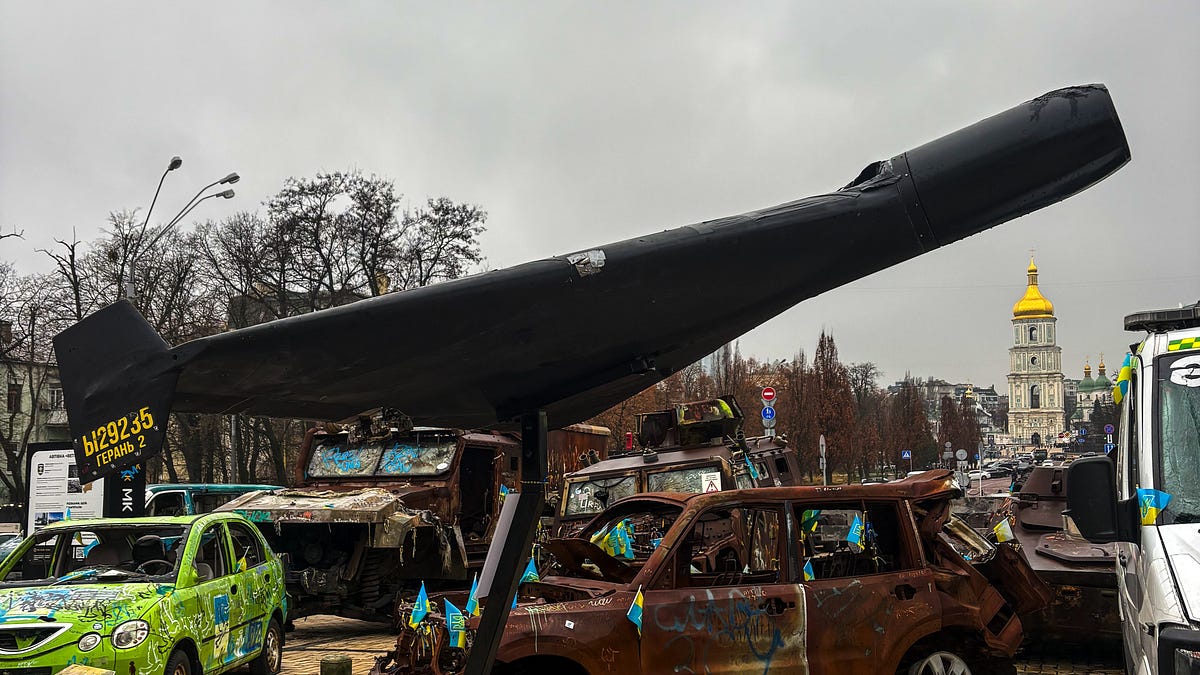
Photo: Russia’s Geran-2 (Shahed-type) drone against the backdrop of Saint Sophia Cathedral, Kyiv, Ukraine. Photo taken during my most recent visit to Ukraine From the moped-like sound of Shahed drones, deliberately used as a tool of psychological warfare, to Shaheds dropping mines, cluster munitions, and targeting trains, Russia’s innovations in UAVs are focused not only […]
Menej ako 1 min.
min.
From the moped-like sound of Shahed drones, deliberately used as a tool of psychological warfare, to Shaheds dropping mines, cluster munitions, and targeting trains, Russia’s innovations in UAVs are focused not only on battlefield utility. They are optimized for terror, disruption, and societal exhaustion.
In 2025 alone, Russian forces launched more than 54,000 long-range drones against Ukraine. The number of FPV drones used by Russia is estimated at 1,200–1,400 per day, and their use is not limited to the battlefield. The reported numbers of Ukrainian civilians killed (2,400) and injured (12,000) represent an increase of around 30% compared to 2024.
In this article, I examine six key Russian innovations in unmanned technologies aimed at targeting the civilian population, driving Ukrainians from their homes, and ultimately rendering Ukraine unlivable.
-
Remotely operated kamikaze Shahed-type drones
“The Shahed operator spotted a passenger train moving below. The operator clearly saw and understood that it was a train carrying people. The Shahed pilot decided to attack the train, but only by a stroke of luck did he miss. I will not name the train number, but the people who were peacefully sleeping on board have no idea that they were essentially born a second time,” wrote the Ukrainian drone and radio tech expert Serhiy FLASH Beskrestnov.
The innovation lies in implementing solutions based on mesh modems and installing forward-facing cameras on Shahed-type drones.
The mesh modems enable the creation of dynamic networks with chain-based relaying, in which each modem functions as a repeater for others, thereby extending connectivity and resilience.
Since August 2025, such cases have become increasingly frequent, and by early September, it became clear that this was a serial solution. Russia is now routinely equipping its long-range Geran-2 drones with modems and cameras.
The online control mode enables the Shahed to conduct reconnaissance, strike moving targets, and select impact points with greater precision.
“We have seen Shaheds strike railways and even moving locomotives. A Shahed can identify the most vulnerable point at an energy substation — meaning it can do more than just attack a set of coordinates. An operator can guide it precisely into the transformer that is most critical,” FLASH added.
Ukraine’s Main Intelligence Directorate presented a detailed analysis of the new Russian Geran-5 drone equipped with a radio modem. Similar devices had previously been identified in Geran-2 and Gerbera drones.
Russian forces have fitted the drone with Chinese XK-F358 radio modems, designed for video transmission and platform control. The XK-F358, produced by the Chinese company Xingkai Tech, is a specialized radio modem intended for unmanned platforms and the deployment of distributed communications networks.
-
Shaheds + mines
Cases of PTM-3 anti-tank mines being dropped by Shahed drones have been recorded across different regions of Ukraine. The mines are equipped with a magnetic detonator. In some instances, this is simple area mining, but often it involves mining locations near the Shahed crash site.
Reportedly, the tactic is designed to target emergency responders—anticipating that State Emergency Service or police vehicles approaching a downed Shahed may be detonated. The mine has a square shape and uses a magnetic trigger.
In summer, such mines are often found by emergency services, the military, or mobile fire groups, who then call in sappers to neutralize them. In winter, however, a mine can fall into a snowdrift and disappear from sight. If any vehicle passes nearby, the mine can detonate and damage the vehicle.
In January 2026, FLASH reported that half of the Shahed drones attacking the Kovel–Kyiv railway have been carrying magnetic mines, which they drop into the snow.
Shahed-type drones can be launched from the territories of both Russia and Belarus, making access to western parts of Ukraine easier.
-
Shaheds + cluster munitions
In November 2025, Russia attacked the city of Vyshgorod in the Kyiv region with a Shahed-type drone equipped with cluster munitions. According to Ukraine’s State Emergency Service, the Shahed struck the building’s roof but failed to explode. On-site, bomb technicians discovered the drone’s warhead along with 21 intact cluster submunitions equipped with self-destruct fuzes.
The munitions consisted of tube-shaped elements packed with fragmentation components, designed to detonate together with the main warhead—an intended mechanism to complicate demining efforts and maximize civilian casualties.
David Hambling reported on a similar incident that happened back in May 2025, and these cases are becoming more frequent.
“What is clear though is that the new weapons are not aimed at military or infrastructure targets. They have been designed specifically to kill, injure and terrify as many people as possible,” Hambling wrote for Forbes.
-
FPV drones for the precise killing of civilians
“An FPV drone has a limited battery life. If the battery is running low and there is no military target nearby, but there is a civilian one, Russians will attack the civilian target so as not to waste the drone,” commented a Ukrainian servicemember in a personal remark.
In the report “Deadly Drones: Civilians at Risk From Short-Range Drones in Frontline Areas of Ukraine,” published in May 2025, the UN Human Rights Monitoring Mission in Ukraine concluded that drones have emerged as a leading cause of civilian death and injury in Ukraine, and in some months, even surpassed more powerful weapons like missiles, artillery, and aerial bombs. The vast majority of the casualties occurred as a result of Russian attacks in territory controlled by Ukraine.
The drones used in most attacks are known as FPV drones. The enhanced visibility provided by FPV technology should support more accurate assessment and verification of the military or civilian character of a potential target. Nonetheless, operators have deployed these weapons against civilians who showed no signs of direct participation in hostilities.
Documented casualties include civilians on bicycles, in private cars, on regular public buses, in ambulances, while delivering humanitarian aid or conducting evacuations, walking outdoors, and outside on their residential property.
According to the report, some incidents may amount to intentionally directing attacks against civilians, a war crime.
Another report by the Independent International Commission of Inquiry on Ukraine, published in October 2025, established that attacks with short-range drones directed by Russian armed forces have targeted civilian persons, houses or buildings, humanitarian distribution points, and critical energy infrastructure servicing civilians.
They have even hit first responders, including ambulances and fire brigades, regardless of their special protection under international humanitarian law, thereby obstructing their interventions.
Many of the attacks have struck the same objects repeatedly, deliberately setting them on fire. Residents of the targeted localities have described life conditions as unbearable. One man stated, “We are hit every day, drones fly at any time – morning, evening, day or night, constantly.”
The Commission’s investigation shows that Russian armed forces have used drones to target civilians in a much larger area than previously reported, stretching over 300 km along the Dnipro River and over the Dnipro Gulf, across Dnipropetrovsk, Kherson, and Mykolaiv Oblasts.
The Commission has concluded that these relentless drone attacks amount to the crimes against humanity of murder and of forcible transfer of population, as well as other crimes and human rights violations.
Reportedly, in September 2025, Russians began using their Molniya drones as carriers to transport FPV to other regions of Ukraine, thereby extending their range.
They likely used FPV drones to strike a Ukrainian An-26 aircraft in the Mykolaiv region and a Mi-24 helicopter in the Poltava region in December 2025.
For these operations, Molniya drones equipped with Starlink terminals may have been used. The experts anticipate that soon Starlink terminals will also be used on Shahed-type drones, making them significantly harder to jam.
-
Fiber-optic waiting drones
Below is an excerpt from the “Algorithm of Actions for Civilians in the Event of Detection or an Attack by a Fiber-Optic FPV Drone,” published by the territorial community in the Kharkiv region:
“The “Zhdun” FPV drone is connected via a fiber-optic link, waiting in ambush for its target until a suitable object appears. These drones are primarily used to strike military equipment, but can also be employed against the civilian population. The estimated loitering (waiting) time ranges from 30 minutes to 2 hours, depending on the batteries”.
“Zhdun” is Ukrainian for “the one who waits.” Such drones are capable of remaining in ambush for extended periods and are not affected by electronic warfare systems. According to some sources, they can loiter in ambush for many hours, even up to about a day.
Like other FPV drones, they are effective at short ranges of 20–30 km, although recent Russian innovations have extended their operational range to 50 km.
In December 2025, in Kostiantynivka in Donetsk Oblast, a Russian fiber-optic FPV drone struck an evacuation vehicle. As a result of the attack, Kharkiv-based volunteer and head of the “Unbreakable” (“Nezlamna”) charitable foundation, Viacheslav Ilchenko, was killed.
-
Semi-autonomous technologies for attacks
In May 2025, Russians attacked the town of Velykyi Burluk (Kharkiv region) with a “swarm” of seven UAVs. While flying over the area, the drones apparently detected a cluster of vehicles near a Nova Poshta (Ukraine’s most popular delivery service) facility and a concentration of people at a local market. The UAVs formed a circular holding pattern and then dived onto the target. Miraculously, no one was killed or injured.
A unique color marking on the wings allows the “swarm” to maintain formation. The drones fly one above another, like birds, using the markings to keep visual contact and stay together.
Experts concluded that this was not yet a “smart” swarm. Based on the described behavior, it can be assessed as a conventional swarm exhibiting flocking, with a group center and each UAV seeking to maintain cohesion by not exceeding a defined separation distance.
While these technologies do not yet constitute fully autonomous systems or true drone swarms, there is clear evidence that Russia is experimenting and moving in that direction.
Given that the intentional targeting and killing of Ukrainian civilians is already systematic, it would be naïve to assume that future Russian drone swarms will maintain any civilian–military distinction.
Security Service of Ukraine (SBU) reported that since the start of this year’s heating season (October 15), SBU has documented over 250 Russian air attacks on Ukraine’s energy facilities and heating supply systems. Russians have deliberately targeted 11 hydroelectric power plants and 45 of Ukraine’s largest combined heat and power plants.
In addition, Russian forces carried out 49 precision air strikes against thermal power plants and 151 strikes against electrical substations across various regions of Ukraine.
Each of these attacks was combined in nature and conducted using dozens of Russian drones and missiles.
These statistics were published on January 15, and since the attacks have been continuing almost daily, the actual numbers are now higher.
All of this is happening under exceptionally cold conditions, with temperatures reaching –15 to –20°C.
The Ukrainian government has declared an energy emergency as the damaged power grid is meeting only 60 percent of the country’s electricity needs. Zelensky stated on January 16 that Ukraine needs about 18 gigawatts of power to meet domestic consumption needs in the winter, but that Ukraine’s power generation capacity can currently only produce 11 gigawatts of power.
Ukraine’s Main Military Intelligence Directorate (GUR) warned on January 17 that Russia was planning strikes on electricity transmission substations, which Ukrainian nuclear power plants depend on to operate.
“The last few days of my life have been the most surreal. I kept thinking more and more about whether I would even be able to wake up at all. The cold was so piercing that I did wake up—but from shivering, not from the alarm clock. Now, my roommates and I have been without electricity for 85 hours and without heating for 9 consecutive days,” wrote Daryna, a student at Kyiv School of Economics.
In the concluding thoughts, I want to emphasize the element of intentionality. The majority of the points described above involve the deliberate use of armed drones, as well as other weapons — including internationally banned mines and cluster munitions — by Russian forces to inflict maximum harm on civilians in Ukraine.
This is partly due to frustration over the lack of significant breakthroughs on the battlefield. It is also driven by the deeply dehumanizing view of Ukrainians within Russian society, where murder and torture of the Ukrainian population are welcomed.
Finally, this violence is directed at Ukraine’s strength itself — its civil society — which poses an existential threat to Russia’s imperial ambitions and to the survival of Russia even in its current form.
The decision of the Ukrainian population to stay in Ukraine and continue their resistance, despite everything, is one of the key reasons why Russia’s invasion did not succeed.