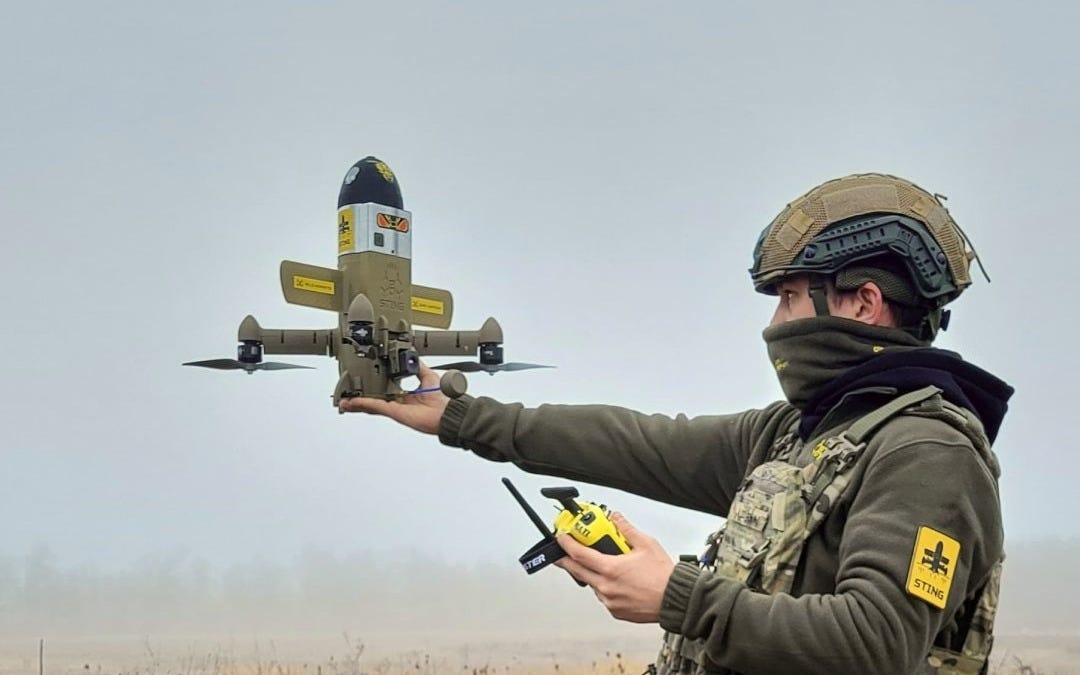
Photo: STING — a Ukrainian interceptor drone developed by Ukrainian engineers at Wild Hornets. Courtesy of Wild Hornets Ukrainian interceptor drones are likely at the peak of global demand. Ukrainian crews have travelled to the Middle East to demonstrate the effectiveness of interceptor systems, while foreign delegations are visiting Ukraine to learn the secrets of […]
Menej ako 1 min.
min.
Ukrainian interceptor drones are likely at the peak of global demand. Ukrainian crews have travelled to the Middle East to demonstrate the effectiveness of interceptor systems, while foreign delegations are visiting Ukraine to learn the secrets of its air defence. Ukrainian manufacturers are also being contacted by private companies in the Middle East seeking to protect their facilities from Shahed attacks.
Ukraine has long warned that other states would eventually need to defend themselves against Shahed drones and reportedly even offered the United States cooperation in this area, which was not fully appreciated at the time.
In this edition:
-
Ukrainian Drone Interceptors Are Becoming a Global Currency;
-
Drone Piloting Should be as Remote and Protected as Possible: 412 Nemesis Brigade;
-
P1-SUN: Ukrainian Interceptor Drone by SkyFall;
-
10+ additional developments in drone warfare in Ukraine and Russia.
Thank you for reading and supporting my work!
Ukrainian Drone Interceptors Are Becoming a Global Currency
On March 11, President Zelensky announced that Ukrainian experts in counter-drone technologies had begun working in Gulf countries. “Three of our teams have gone to the Middle East. Strong teams — with experts, military personnel, and engineers. Our military is already communicating and already working there,” Zelensky said.
The presidential spokesperson separately confirmed that the three countries where Ukrainian experts are currently operating are Qatar, the United Arab Emirates, and Saudi Arabia. Others are also helping the US defend its military presence in Jordan.
In his column for Liga.Net, Valentyn Badrak, Director of the Center for Army, Conversion and Disarmament Studies, argues that Kyiv’s logic in helping provide protection for U.S. bases (particularly in Jordan, and possibly Saudi Arabia) is well-grounded and aimed not only at countering Russian missile attacks today, but also at building a safer future.
-
Ukraine has received 11 requests from countries neighboring Iran, as well as from European states and the United States, seeking security support in countering Iranian drones.
-
This points to the formation of stable political partnerships through defence technologies — and potentially, in the future, even deeper alliance relations with the United States.
-
The author suggests that the use of Ukrainian interceptor drones could significantly reduce the consumption of expensive interceptor missiles. In the longer term, this could lead to Ukraine obtaining U.S. licenses for air defence missile production, and possibly even for strike missiles such as ATACMS or PrSM.
(Last week, President Zelensky stated that Kyiv needs only one step from Washington — a license to produce interceptor missiles capable of stopping Russian ballistic threats. According to him, Ukraine’s industrial base and engineers already have all the necessary technologies to quickly establish mass production and provide air and missile defence not only for Ukraine, but potentially for the entire European continent.)
-
A key issue for Ukraine is the ability to rapidly scale up domestic production of interceptor drones.
-
This challenge can be addressed primarily by expanding the number of manufacturers, including through licensing agreements with large and experienced companies, particularly private enterprises.
-
In early January, the Ukrainian Ministry of Defense announced that it had granted 30 licenses to private manufacturers to use military-developed technologies. These licenses covered radio-electronic intelligence systems, countermeasures against Shahed-type strike drones, and guided munitions with automatic terminal guidance.
-
MoD has also changed its drone procurement approach: demand for drones will now be generated automatically based on battlefield data — eliminating human bias, subjective influence, and corruption risks.
-
Already in December–January, Ukraine’s Defence Forces were receiving more than 1,500 interceptor drones per day.
-
There are, therefore, strong grounds to believe that Ukraine will be capable of supplying interceptor drones to both its own armed forces and partner countries.
-
Ukraine has de facto already built a layered air and missile defence system. The development and integration of interceptor drones into the air defence system has become a Ukrainian solution to the problem
Ihor Fedirko, Executive Director of the Ukrainian Council of Defence Industry, said in an interview with Radio NV that the current production of Ukrainian interceptor drones exceeds the Defence Forces‘ needs by two to three times.
As of January 2026, Ukrainian defence manufacturers were producing 80–90% of the interceptor drones required by the Defence Forces, but over the past two months production has increased significantly.
The WSJ reported that the oil corporation Saudi Aramco is negotiating with at least two Ukrainian companies (SkyFall and Wild Hornets) to purchase interceptor drones to protect oil fields from potential attacks by Iran. According to sources, Saudi Aramco is moving quickly to secure these drones — racing ahead of the Saudi government itself and regional competitors, particularly Qatar.
Wild Hornets wrote on their social media that this information does not reflect the company’s current position or activities. The company is not conducting any direct negotiations regarding exports. „The Government of Ukraine is currently engaged in discussions with international partners regarding operator training and the potential supply of interceptor drones within broader security cooperation frameworks. Should such initiatives require industrial participation, Wild Hornets is prepared to contribute accordingly,” the manufacturer added. Read my article about Wild Hornets and their interceptor drone Sting here.
Here is my earlier open-access report, “Drone warfare in Ukraine: war in the Middle East and Ukraine’s expertise.”
Drone Piloting Should be as Remote and Protected as Possible: 412 Nemesis Brigade
The 412 Nemesis Brigade operates in a multidomain format. It works at different depths and across different environments—from interceptors and maritime operations to frontline and middle-range strike missions. The brigade is also one of the leaders in intercepting Shahed drones.