The morning of February 28, 2026, did not bring the usual dawn to the Iranian plateau; instead, it brought the “Lion’s Roar”. As waves of American and Israeli munitions struck targets across the Islamic Republic, the geopolitical architecture of the Middle East, already fractured by decades of shadow war, finally collapsed into open, high-intensity conflict. […]
Menej ako 1 min.
min.
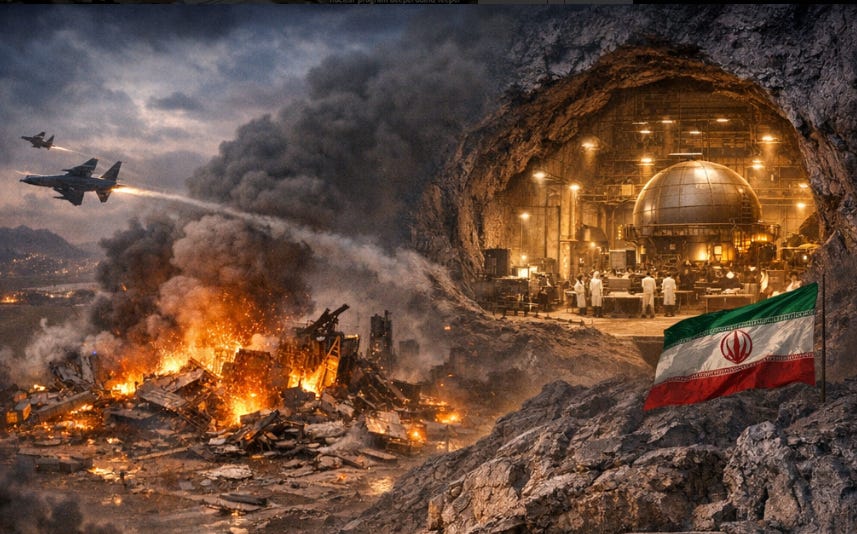
The morning of February 28, 2026, did not bring the usual dawn to the Iranian plateau; instead, it brought the “Lion’s Roar”. As waves of American and Israeli munitions struck targets across the Islamic Republic, the geopolitical architecture of the Middle East, already fractured by decades of shadow war, finally collapsed into open, high-intensity conflict. For the second time in less than a year, the most scrutinized nuclear infrastructure on Earth was under fire. But beneath the smoke rising from the enrichment halls of Natanz and the mountain fastness of Fordow lies a deeper story—not just of centrifuges and enriched uranium, but of a nation’s strategic desperation and a global non-proliferation regime that may have just met its end.
To understand the weight of this moment, one must look back to June 2025. That was when the first major blow, operation “Lion’s Strength” (also referred to as „Operation Rising Lion“), shattered the technological foundation of Iran’s nuclear ambitions. Before those strikes, the world was obsessed with the “two-week breakout” window—the theoretical time Tehran would need to produce enough weapons-grade material for a bomb. By June 2025, Iran had amassed over 9,000 kilograms of enriched uranium, including over 440 kilograms of 60% highly enriched uranium (HEU). Technologically, they were on the threshold.
Then the bombs fell. The June 2025 campaign was surgical and devastating. In Isfahan, the uranium conversion plant—the vital gateway where raw ore becomes the gas needed for enrichment—was largely reduced to rubble. At Fordow, a facility buried deep within a mountain near the holy city of Qom, the United States deployed six Massive Ordnance Penetrator (MOP) bombs. Even if the mountain didn’t collapse, the facility was rendered functionally useless. The “two-week” clock was reset to zero, and the technological basis for an immediate breakout was effectively vaporized. By early 2026, Iranian officials were forced to admit that enrichment had ground to a halt; their facilities were simply too damaged to operate.
Yet, the Iranian state does not operate on a purely technological timeline. It operates on a doctrine of “asymmetric deterrence”. In the wake of the 2025 strikes, the leadership in Tehran faced a choice: capitulate to the draconian “four points” demanded by Washington—which included the total abandonment of enrichment and the dismantling of their regional “Axis of Resistance”—or double down in the dark. They chose the latter.
While the world’s cameras were fixed on the ruins of the old sites, a new, more secretive geography of defiance was being carved into the Iranian landscape. At Kuh-e-Kolang Gaz La, known to Western intelligence as “Pickaxe Mountain,” satellite imagery began to show a frantic accumulation of excavated rock. This was “Natanz-2,” a facility designed with the lessons of June 2025 in mind: deeper, better protected, and hidden behind entrance portals designed to deflect the blast waves of bunker-busting munitions. Simultaneously, at the Parchin military complex, a massive concrete “sarcophagus” began to rise over the Taleghan-2 site—a place long suspected of hosting experiments for nuclear weapon triggers. These were not the actions of a state seeking a “peaceful” energy program; they were the actions of a state building a fortress for a future arsenal.
This physical shift was accompanied by a quiet, more lethal campaign. The June 2025 strikes were not limited to concrete and steel; they included operation “Narnia,” a targeted effort to decapitate the human capital of Iran’s nuclear program. For decades, the ghost of the “Amad” project—the early 2000s effort to design a nuclear warhead—had haunted the IAEA. Israel’s Mossad had long maintained that the project was never truly ended, only “stretched in time” and kept alive by an “old guard” of scientists. Operation Narnia took aim at these men. While Tehran claims at least a third of its scientific core survived the liquidations, the loss of key figures who held the “tribal knowledge” of weaponization has created a bottleneck that no amount of concrete can fix.
Geopolitically, the walls were closing in on Tehran in ways that had nothing to do with uranium. In August 2025, a US-mediated peace deal between Armenia and Azerbaijan over the Zangezur corridor effectively handed control of a vital border region to Western-aligned forces. For Iran, this was the “principle of threatening encirclement” made manifest. They saw American troops potentially stationed on their northern border, threatening their last land link to Europe and Russia. This sense of being cornered exacerbated the internal rift between the pragmatists under President Masud Pezeshkian, who campaigned on easing sanctions, and the “ultra-conservatives” who see any concession as “great humiliation”.
The religious dimension, often dismissed by Western analysts as mere window dressing, also began to shift. Since 2003, the bedrock of Iranian diplomacy has been Supreme Leader Ali Khamenei’s fatwa forbidding the production or use of nuclear weapons. But in the cafes of Tehran and the halls of the Majlis, a new, more dangerous rhetoric began to emerge in late 2025. Conservative voices began to argue that while the use of nuclear weapons might be a sin, their production for deterrence was a matter of national survival. They pointed to the “takiyah” doctrine—the concept of permitted dissimulation in the interest of protecting the faith. Even mainstream clerics began to suggest that “forbidden things become permissible in times of extreme necessity”. The fatwa, once a “steel shield” of religious certainty, was being reinterpreted as a flexible instrument of statecraft.
By February 2026, the diplomatic track was not just cold; it was dead. The United States and Israel, sensing that Iran was using the lull in enrichment to move its program further underground, decided to strike again. The February 28 attacks were designed to “ensure the dismantling” of what was left. But as the smoke clears from this latest round of “Lion’s Roar,” the strategic landscape looks more precarious than ever.
The strike has effectively buried the 9,000 kilograms of enriched uranium under the ruins of Natanz and Fordow. CIA Director John Ratcliffe noted that extracting that material now would be “extremely difficult,” but Western intelligence cannot be certain that a portion of the stockpile wasn’t moved to “third-party” locations or hidden deep within Pickaxe Mountain before the bombs fell. Iran’s “breakout time” is now a matter of pure speculation; the variables of hidden materials and clandestine sites have made the IAEA’s mathematical models obsolete.
Moreover, the strikes have pushed the Iranian public into a “patriotic surge”. The economic misery caused by the collapse of the rial and the looming threat of a “Venezuelan-style” naval blockade has not led to a regime-changing revolution. Instead, it has marginalized the reformers and empowered those who believe that only a nuclear deterrent can prevent the “final humiliation” of the Islamic Republic. The 2026 protests were co-opted by a state that has mastered the art of “asymmetric response,” turning domestic discontent against the “aggressors”.
Regionally, the “Axis of Resistance”—Hezbollah in Lebanon, the Houthis in Yemen, and various militias in Iraq—has not been dismantled. While their activity dipped briefly in late 2025, they remain the “long arm” of Tehran’s defense strategy. Iran’s investment in a massive and diversified missile arsenal—including the development of the Khorramshahr-5, a potential ICBM with a 12,000 km range—ensures that even without a nuclear tip, Tehran can reach any US base or Israeli city with devastating precision. They have traded the “small force” of proxies for a “wide front” of technological escalation.
As we look toward the remainder of 2026, the question is no longer whether Iran can build a bomb, but whether the international community has any tools left to stop it other than perpetual war. The June 2025 and February 2026 strikes have shattered the Non-Proliferation Treaty (NPT) as a viable framework for this crisis. Russia, once a co-guarantor of the nuclear deal, now watches from the sidelines as its partner is pushed into a corner, warning that the “dynamite” the US has placed under the cornerstone of international security is about to blow.
The “Lion’s Roar” may have destroyed some centrifuges, but it has also silenced the voices of compromise within Iran. We are now in a world where the Iranian nuclear program exists in a state of “quantum uncertainty”—simultaneously crippled and more determined than ever to reach the finish line.
The shadow war is over; the era of the “encircled fortress” has begun. And in the darkness of Pickaxe Mountain, the work continues, driven no longer by the ambition of a rising power, but by the cold, hard logic of a regime that believes it has nothing left to lose. The forward-looking note is not one of resolution, but of a grim, unfolding reality: the more you strike the Iranian nuclear program, the deeper it goes into the earth, and the more certain its ultimate completion becomes.
Source Note: This piece is grounded in research from the PIR Center Report Series: „The Nuclear Program of the Islamic Republic of Iran: An Assessment of Its Current Status and Capabilities“ (March 2, 2026).
Join the Conversation:
📌 Subscribe to Think BRICS for weekly geopolitical video analysis beyond Western narratives.