Originally published on Regnum.ru by Leonid TsukanovRepublished with permission The assassination by the Israelis of Iran’s Supreme Leader (rahbar) Ali Khamenei, who had defined the country’s strategic course since 1989, has placed the Islamic Republic before a difficult choice. The new rahbar must not only keep the flag from falling — ensuring continuity of course […]
Menej ako 1 min.
min.
Originally published on Regnum.ru by Leonid Tsukanov
Republished with permission
The assassination by the Israelis of Iran’s Supreme Leader (rahbar) Ali Khamenei, who had defined the country’s strategic course since 1989, has placed the Islamic Republic before a difficult choice.
The new rahbar must not only keep the flag from falling — ensuring continuity of course — but also lead the country to victory in the confrontation with Israel and the United States. It is no wonder that a fierce struggle has broken out around the election of a new leader.
The Israelis, for their part, appear for now to have decided to watch the Persians’ behind-the-scenes games from the audience. While not forgetting, of course, to take notes for internal use.
Rumors about the formation of a “priority list” of potential successors surfaced as early as the summer of 2025 — when, as a result of the Israeli operation “Lion’s Force,” the entire command-level leadership of the security bloc was wiped out, and a threat to the life of Iran’s Supreme Leader emerged as well.
The paranoia was deliberately stoked by the US and Israel, who promised to “cut off the serpent’s head” of the pro-Iranian “Axis of Resistance”, meaning the top leadership of the Islamic Republic.
Moreover, Washington and West Jerusalem were preparing to carry out the operation within the first months following the conclusion of the “12-Day War,” which pushed Khamenei to settle on a successor without unnecessary delay.
The list of candidates for the post of Supreme Leader was classified. However, following Khamenei’s death in February 2026 and the election of an acting rahbar, concealing their names was no longer expedient.
The appointment of Alireza Arafi to the post of acting Supreme Leader of Iran surprised few. As a member of the Assembly of Experts — the consultative body of authoritative Shia clerics — he has also distinguished himself as a talented administrator, including by leading Friday prayers in Qom, an important religious center of Iran, which is a sign of the highest favor and trust.
Arafi repeatedly participated in closed meetings of the Supreme Leader, including during the operations “True Promise” against Israel and the United States. This makes him a promising successor capable of continuing the line of the previous rahbar.
On the other hand, despite his high standing, Arafi’s authority is unquestioned only among theologians. He has yet to build sufficient ties with the security forces, which creates a risk of weakening the rahbar–IRGC nexus, and prospectively, even the formation of alternative centers of governance within the republic.
Naturally, connections are something one can work to build over time. However, cultivating them during the active phase of a conflict is not only problematic but of little value — particularly given the systematic elimination of the IRGC’s top brass by the Israelis and the Americans.
Moreover, the newly minted rahbar has no time to warm up — the population expects energetic action from him in repelling external aggression. And so his political future will depend on just how far-sighted and resolute Arafi proves to be during the February campaign.
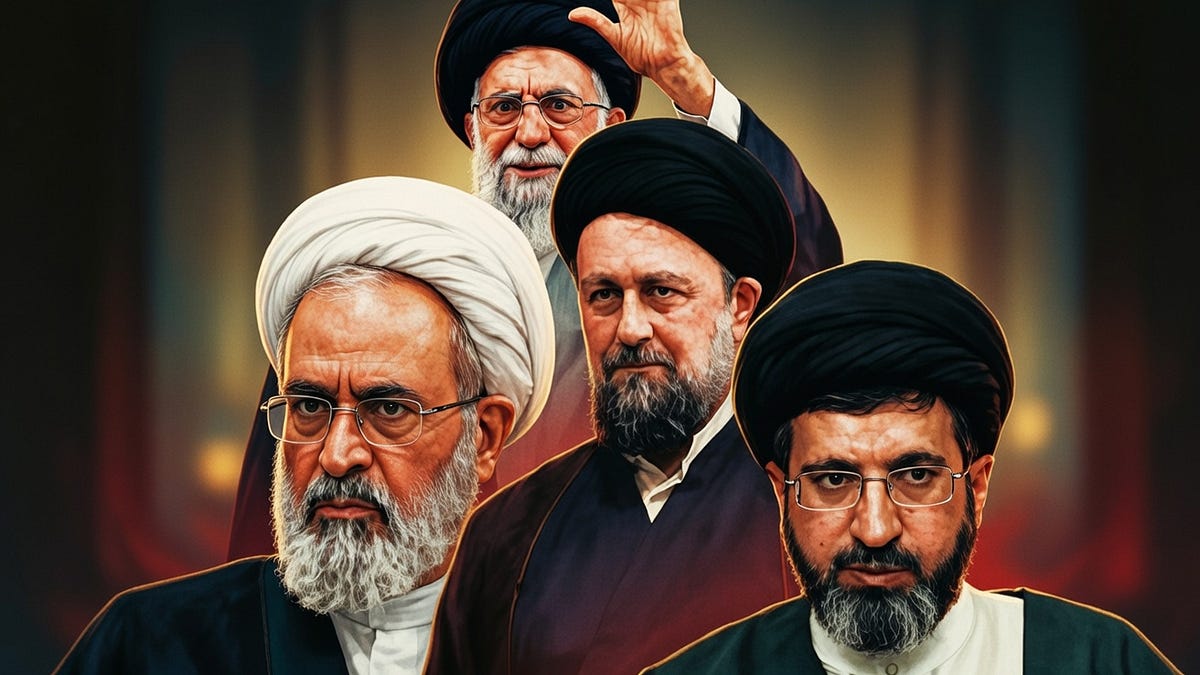
Two other candidates being backed in the Assembly of Experts are heirs of former rahbars: Mojtaba Khamenei (son of the fallen Ali Khamenei) and Hassan Khomeini (grandson of Iran’s first Supreme Leader, Ruhollah Khomeini).
Yet Mojtaba’s position — widely considered one of the most powerful shadow politicians in Iran — is shakier. Despite great reverence for Khamenei, his son does not possess the requisite clerical rank. What’s more, the very idea of transferring power “from father to son” is criticized by the clergy — as it not only carries the spirit of the old Shah’s regime but also raises the risks of an internal crisis by concentrating levers of power within a specific dynasty.
Far more likely is that Mojtaba will set his sights on the presidential seat, riding a wave of rising conservative sentiment in the republic. And he has every chance of securing the post in the near term — especially if Masoud Pezeshkian‘s government wavers under pressure from Israel and the US and tries to play at a policy of appeasement.
That said, Mojtaba is content to remain the “gray cardinal” of the Iranian court, since it gives him the ability to influence the course of official Tehran without taking on additional obligations — and without being in the crosshairs of Israeli intelligence services.
Hassan has far better odds of making it to the top. His kinship with the leader of the Islamic revolution lends him important symbolic significance — not only in the eyes of ordinary Iranians, but also among members of the “Axis of Resistance.”
Tehran can easily play the “return of Khomeini” card, thereby rallying the ranks of loyalists during a difficult period for the republic — including by forming a counterweight to the idea of a monarchist restoration in Iran: a descendant of the revolution’s leader will not allow the return of the Shah’s descendants.
Of course, the weak spot of young Khomeini is his zero experience in state administration. Managing his illustrious grandfather’s mausoleum, he has held no top state executive positions and has a hazy understanding of crisis management.
However, the Iranian elites tend to interpret this rather favorably. The young rahbar will clearly need loyal advisers and talented administrators, which creates conditions for a rebalancing of influential families.
Standing apart is another influential heir — Sadeq Larijani. As the son of Ayatollah Hashem Amoli — a close companion of Khomeini and one of the ideologues of the Islamic revolution — and the brother of National Security Council Secretary Ali Larijani, he commands authority both among theologians and among the security forces.
And if the former are guided primarily by respect for the figure of the late ayatollah, the latter fear the consequences of the wrath of Iran’s foremost “hawk” and “admiral” of Iran’s “shadow fleet.”
Furthermore, Sadeq himself carries substantial political capital. Ten years as head of the judiciary and a subsequent move to a leadership position on the Expediency Council have made him a seasoned veteran and heavyweight of Iranian politics, capable of fighting for the rahbar’s seat — especially after his brother effectively took personal control of the campaign of retribution against the West and its allies.
A peculiar dark horse in the race for Supreme Leader is former Iranian president and architect of the first “nuclear deal” — Hassan Rouhani.
His main trump card is his readiness to pursue a more flexible line — including initiating a political thaw that would, in theory, extinguish anti-government protests and remove the key lever of internal pressure on official Tehran.
However, Rouhani’s support among the elites is minimal: neither the influential security forces nor the theologians close to the previous leadership want him entrenched in the post of Supreme Leader. The risk is too great that the “reformer in a turban” will attempt to negotiate with the West without external constraints and drive Iran into a diplomatic trap.
Moreover, Rouhani’s actual role in the failed reformist palace coup attempt of January 2026 has not been fully established: President Pezeshkian’s intercession shielded him from the blow, but questions from the security services remain.
As for the other candidates from the Assembly of Experts — Mohammad Mirbagheri and Hashem Hosseini Bushehri — they tend to be viewed more as technical candidates, put forward to confuse the opposition. Despite their influence and considerable experience, these theologians have not yet staked any real claim to the rahbar’s post.
However, given their anti-Western stance, they may over time move to the front — especially if other contenders unexpectedly drop out of the race.
For Israel, the change of Supreme Leader in Iran is a success, but not a victory. The hopes that Khamenei’s fall would provoke a paralysis of power did not pan out. And the new candidates are no less authoritative or willing to continue the confrontation.
In Israel, the baseline assumption is that the list of “finalists” still includes young Khomeini and Larijani. Arafi (as acting leader) has been temporarily bracketed out, but not crossed off.
Not having a precise picture of exactly who will lead Iran after the war, the Israelis will primarily seek to target charismatic figures capable of assuming not only strategic but also tactical governance of the country — as Khamenei did in June 2025.
And it won’t necessarily be the race leaders who end up as the top priority. For instance, Mirbagheri poses a particular danger to Israeli interests — he could well serve as the locomotive of a campaign to revisit Khamenei’s “nuclear fatwa” and, leaning on dogma, unambiguously legitimize Iran’s right to develop nuclear weapons.
And that is a far greater threat for Israel than Tehran’s refusal to make concessions or pursue a “separate peace” under Arafi — or the preservation of levers of influence in the hands of the Khamenei or Larijani clans.
Join the Conversation:
📌 Subscribe to Think BRICS for weekly geopolitical video analysis beyond Western narratives.