At the end of February 2026, the geopolitical scenario in the Middle East was marked by a sudden and significant deterioration in relations between Israel, the Islamic Republic of Iran, and the United States. What many observers considered a remote possibility—namely, a direct military conflict between Israel and Iran with the subsequent involvement of the […]
Menej ako 1 min.
min.
At the end of February 2026, the geopolitical scenario in the Middle East was marked by a sudden and significant deterioration in relations between Israel, the Islamic Republic of Iran, and the United States. What many observers considered a remote possibility—namely, a direct military conflict between Israel and Iran with the subsequent involvement of the United States—materialized extremely quickly, giving rise to a far-reaching international crisis.
The events that took place between February 27 and 28, 2026, are part of a long sequence of geopolitical tensions that have characterized the Middle East since the end of the Cold War. The initial attack by Israel against Iranian targets, followed by direct intervention by the United States through the military operation called Epic Fury, has led to a new phase of regional and global instability. This development must be analyzed not only from a military point of view, but also from a rhetorical, ideological, and strategic perspective, as the conflict is unfolding simultaneously on the levels of armed force, political communication, and competition between global powers.
This essay aims to analyze three main dimensions of this crisis: first, the initial dynamics of the attacks and military reactions; second, the discursive construction of the conflict through political rhetoric, particularly in the speech given by US President Donald Trump; and finally, the possible long-term geopolitical implications, considering the role of other global powers and the strategic logic behind US intervention in the region.
On February 28, 2026, Israel launched a military attack against the Islamic Republic of Iran in an operation that simultaneously targeted political, military, and logistical objectives. Among the main targets were the two central figures of the Iranian leadership: the Supreme Leader of the Revolution, Ayatollah Ali Khamenei, and the President of the Republic, Masoud Pezeshkian. The nature of the attacks clearly suggests that the main objective was to strike at the political leadership of the Iranian system, with the aim of destabilizing the state’s decision-making structure.
Subsequently, military operations were extended to military and logistical infrastructure, while some attacks also targeted civilian areas, helping to amplify the political and media impact of the operation. Israel quickly claimed responsibility for the action, naming the operation “The Lion’s Roar” and presenting it as a continuation of the hostilities that had already manifested themselves in the previous 12-day conflict.
An intense communication campaign developed in parallel with the military offensive. At first, the United States maintained a relatively cautious position, avoiding immediate official statements. However, the main US media outlets were quickly involved in spreading the narrative that the Israeli attack was part of a coordinated action with Washington. Within a few hours, the news spread to European and Asian media, helping to transform a regional military operation into a global geopolitical crisis.
The Iranian response was relatively moderate. Tehran carried out limited attacks against some Israeli cities, including Tel Aviv, mainly targeting military objectives. Similarly, some US military bases in Kuwait, Qatar, Jordan, Bahrain, and the United Arab Emirates were the target of symbolic attacks. However, the intensity of these operations remained limited: the use of conventional weapons and the small number of strikes suggest that Iran’s objective was primarily demonstrative, aimed at signaling its capacity to respond without triggering an immediate and irreversible escalation.
This strategy could indicate the existence of informal diplomatic channels or ongoing negotiations, in which Iran would have sought to maintain a position of deterrence while avoiding total conflict.
A central element in understanding this crisis is the political rhetoric used by the United States to justify military intervention. President Donald Trump’s speech is a particularly significant document, as it outlines the interpretative framework through which the US administration presented the conflict to the national and international public.
From the outset, the speech adopts a strongly moralized language. Iran is not simply described as an adversary state, but as an intrinsically evil entity, defined by expressions such as “terrorist regime” or “the world’s leading sponsor of terrorism.” In this way, the conflict is reinterpreted not as a geopolitical dispute between state actors, but as an ethical clash between good and evil. This rhetorical transformation has the effect of shifting the legitimization of war from the political to the moral plane, making military intervention seemingly inevitable.
This narrative framework is further reinforced through the use of traumatic historical references. The presidential speech evokes episodes such as the 1979 hostage crisis at the US embassy in Tehran, the 1983 bombing of the Marine barracks in Beirut, and other events attributed to organizations linked to Iran. The succession of these references constructs a narrative of historical continuity that presents the current conflict as the inevitable result of decades of aggression.
The nuclear issue plays a central role in this discourse. The repetition of the phrase “they will never have a nuclear weapon” functions as a slogan that condenses an extremely complex issue into a simple and absolute principle. From a psychological point of view, this simplification allows a large-scale military operation to be presented as a necessary means of achieving an apparently shared and universally acceptable goal.
Another characteristic element of the discourse is the personalization of leadership. The president emphasizes his own individual role in rebuilding American military power, implicitly suggesting that the decision to intervene represents an act of political courage that other leaders would not have had the determination to carry out. This type of rhetoric helps to construct the image of an exceptional leader, capable of making decisive decisions at critical moments in history.
The speech also includes a significant religious dimension. Invoking God and describing the military mission as a “noble mission” help to sanctify military action, placing it in an almost providential perspective. This rhetorical strategy strengthens domestic consensus by transforming a political decision into a morally legitimate mission.
Finally, the passage addressed directly to the Iranian people is particularly relevant. Through the call to “take control of your government,” the presidential speech implicitly introduces the goal of regime change. In this way, the conflict takes on not only a military dimension but also a psychological and political one, simultaneously addressing different audiences: the American public, the Iranian military elite, and the civilian population.
A few days after the initial attack, the United States announced the launch of a vast military campaign called Epic Fury. According to official statements from the White House, the objective of the operation would be the permanent destruction of Iran’s nuclear potential and its missile networks.
The intervention was presented as the application of the “Peace Through Strength” doctrine, according to which international stability can be guaranteed through military superiority and the demonstration of force. In this perspective, diplomacy is considered ineffective when it is not supported by credible military coercion.
The strategic logic underlying this operation appears consistent with a broader tradition of US foreign policy, characterized by frequent use of military force to maintain the international balance of power and protect strategic allies in the Middle East, particularly Israel.
To fully understand the significance of these events, it is necessary to place them in the broader context of competition between great powers. From this perspective, the conflict with Iran can be interpreted not only as a regional crisis, but also as part of a global strategy aimed at containing the rise of new powers, particularly China.
According to some geopolitical interpretations, US foreign policy continues to be influenced by the traditional dichotomy between maritime and continental powers. In this theoretical framework, thalassocratic powers seek to limit the influence of continental powers that control the so-called Eurasian Heartland. Iran, strategically located between the Middle East, Central Asia, and the Indian Ocean, is a crucial node in this competition.
The reaction of the other major powers has been relatively muted. Russia has expressed diplomatic concern and called for a peaceful solution, but has avoided direct involvement. China, traditionally cautious in international crises, has surprisingly called for a rapid resolution of the conflict.
At the international institutional level, the United Nations Security Council appears unable to produce an effective response due to the presence of powers with veto rights that hold opposing positions.
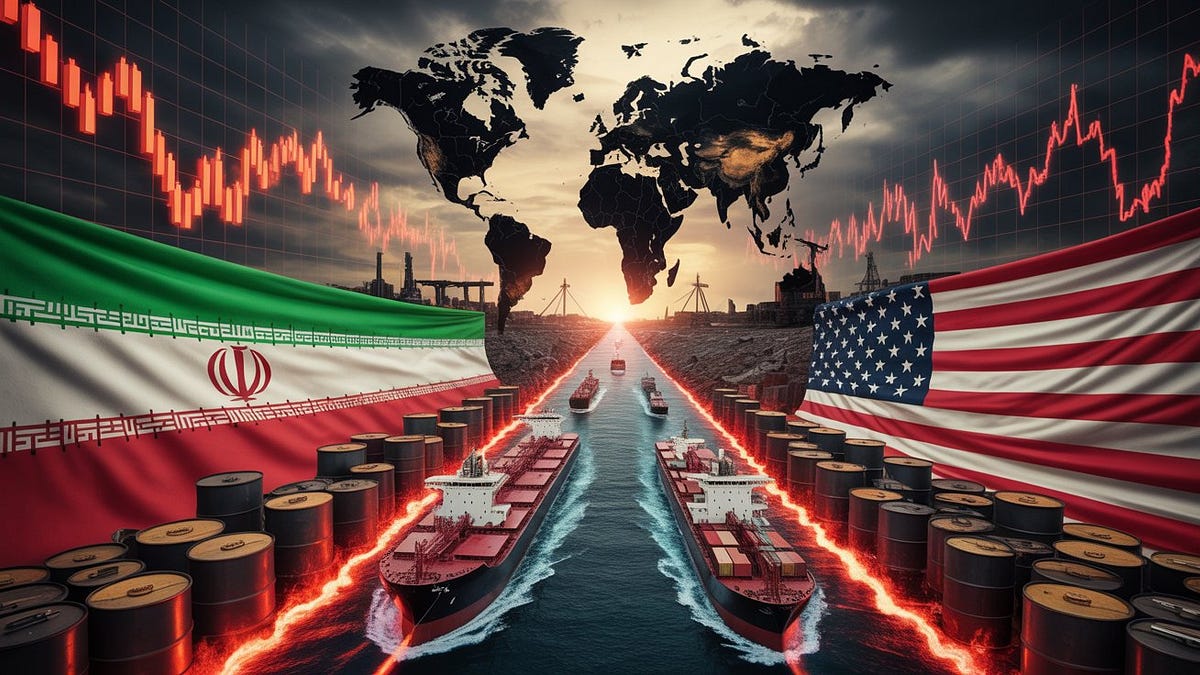
Meanwhile, Iran has taken a measure of great strategic impact by blocking the Strait of Hormuz, one of the main hubs of global energy trade. This decision could have significant economic consequences, as a significant portion of global oil and natural gas traffic passes through this maritime corridor.
The events of February 2026 represent a critical phase in the transformation of the contemporary international order. The conflict between the United States, Israel, and Iran cannot be interpreted solely as a regional crisis, but must be analyzed within the broader framework of global geopolitical dynamics.
The combination of military operations, political rhetoric, and competition between major powers suggests that the conflict could have long-term consequences for the international balance of power. At the same time, the initial restraint of Iran’s response and the relatively cautious reactions of Russia and China indicate that the main actors are trying to avoid uncontrolled escalation.
What can we learn from all this? The growing fragility of the international order and the difficulty of multilateral institutions in managing conflicts between powers with divergent strategic interests. Pure military force is still a favored instrument of power. The evolution of the situation in the Middle East could be one of the main factors in redefining the geopolitical balance in the 21st century. And what will become of the multipolar world?
Join the Conversation:
📌 Subscribe to Think BRICS for weekly geopolitical video analysis beyond Western narratives.