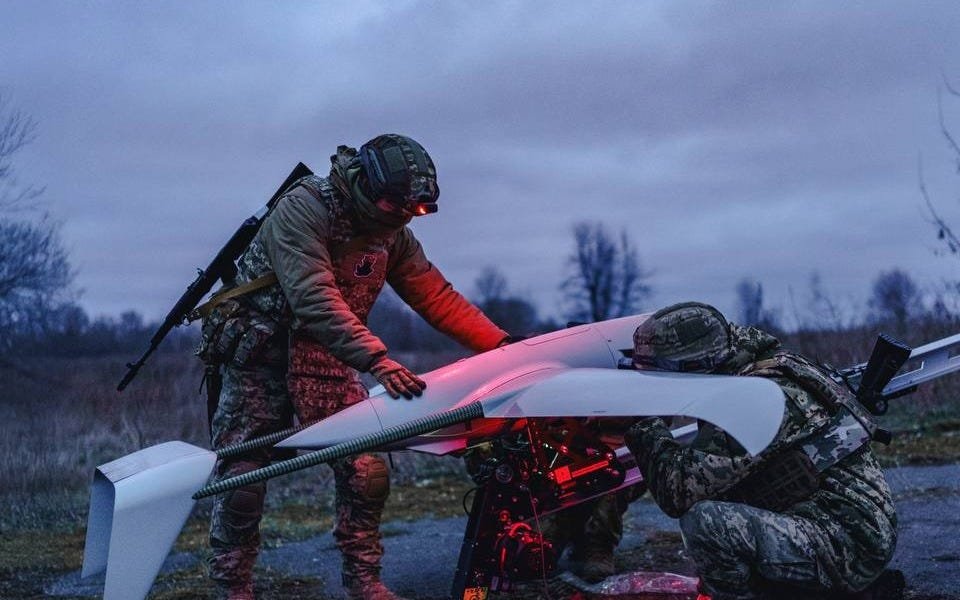
Photo: Final preparations before the hunt. 424th UAS Battalion. Courtesy of MoD Ukraine @DefenceU / X Russia’s drones are rapidly becoming a global threat. In October, Germany reported a record number of drone sightings over its military bases. More recently, Russia has begun training Venezuelan forces in the use of FPV drones. In Ukraine, where […]
Menej ako 1 min. min.
Russia’s drones are rapidly becoming a global threat. In October, Germany reported a record number of drone sightings over its military bases. More recently, Russia has begun training Venezuelan forces in the use of FPV drones. In Ukraine, where these technologies are being tested and refined, experts point to Russia’s use of mesh networks, AI-enabled systems, and other innovations that not only help Russian forces gain battlefield advantages but also intensify their terror against the Ukrainian civilian population.
In this edition:
-
How to Increase the Effectiveness of Deep Strike Drones: Comments from Ukraine’s Aerorozvidka;
-
Russians Train Their AI for Better Solutions: Summary of Interview with Serhiy FLASH;
-
How Ukraine’s Drone Exports Will Work;
-
additional developments in drone warfare in Ukraine and Russia.
I’ve recently launched the Topic Navigator, where you can find all past articles organized by theme. Check it out!
Thank you for reading and supporting my work!
How to Increase the Effectiveness of Deep Strike Drones: Comments from Ukraine’s Aerorozvidka
Current long-strike drone practices do not always deliver the required precision or effectiveness. Uncontrolled munition drops lead to wasted resources, increased risk for drone operators, and greater collateral damage.
In his column on DOU, Oleksandr Kvyatkovskyi, IT engineer at the Ukrainian NGO Aerorozvidka, explains why the development of guided munitions for strike drones is one of the most promising and essential directions for Ukrainian defence tech (Read the earlier column by Aerorozvidka here “DELTA, UAVs, and Real Combat: Lessons from Ukraine for Allies).
Oleksandr gained direct combat experience using bomber drones and has personally seen how much it depends on the pilot. Each mission is a complex coordination effort requiring synchronisation between reconnaissance units, drone operators, and infantry on the ground.
Why unguided munitions often fail
-
When a pilot drops unguided munitions, many strikes miss the target. Sometimes the munition lands just centimetres from the intended point but still fails to cause critical damage.
-
Subjectively, the accuracy of standard dropped munitions is 40–60% in ideal weather, and may fall to 15–25% under unfavourable conditions.
For example, a cumulative charge hitting 50 cm away from armour will not penetrate it. High precision is essential — and it requires exceptional operator skill. -
External factors heavily impact outcomes: wind at different altitudes, target visibility, and enemy electronic warfare. Weather is especially critical: at wind speeds above 8 m/s, accuracy drops sharply — and with gusty winds, it declines even more.
-
Modern drone missions require many people, making each operation labour-intensive and risky. A typical sortie requires at least 2–3 personnel: a drone operator, a navigator, and a sapper. Each of them faces danger, especially during equipment deployment and during the flight itself.
-
The consequences of a miss can negate all this effort. The drone may be unstable due to wind or a lack of satellite signal. It may also come under small-arms fire, forcing the operator to maintain a higher altitude, which further reduces accuracy.
-
This creates a vicious cycle that can only be broken through technological solutions.
The technical solution: guided munitions
-
Strike UAVs are enormously valuable, but their full potential can be unlocked only when they carry guided munitions, says Oleksandr.
-
This represents a paradigm shift from “drop and hope” to “drop and reliably hit the target.”
-
Guided munitions would allow drones to operate from higher altitudes, increase platform survivability, improve operator safety, and reduce training time.
-
Missions from 300–1000 m could become standard practice, removing drones from effective small-arms range.
-
Such systems would also allow a single drone to carry out multiple strikes per sortie, improving resource efficiency.
Examples of guided solutions
-
There is already a broad spectrum of guided munitions — from relatively simple, semi-automatic systems (laser-beam riding), such as APKWS (Hydra 70) by BAE Systems; Korsar / Stugna-P anti-tank systems by Luch Design Bureau, to complex systems like the GBU-53B StormBreaker by Raytheon, which provides fully autonomous multi-sensor guidance.
-
A successful Russian example for traditional aviation is the UMPK bomb kit. Known widely as “KABs,” these modules consist of wings, a guided tail assembly, and a computing unit with a GNSS receiver. They attach to standard FAB-250/500/1500 bombs.
-
This design is relatively simple but highly effective. Russia has already modified it into UMPB-30D and others, extending the range to 100 km. Russian aircraft can drop these munitions from outside the range of Ukrainian air defence. The simplicity of the construction allows Russia to produce thousands of such kits every month.
What mass adoption of guided munitions would achieve
In the initial concept, the operator is supposed to point the camera at the desired object, lock onto the target, and release, after which the munition would guide itself. This greatly simplifies the pilot’s work and reduces the skill requirements: instead of complex calculations for lead and wind correction, the operator simply needs to “click” on the target displayed on the screen.
Introducing guided, precision strike munitions at scale would bring several key advantages:
-
Higher effectiveness of each strike.
-
Lower skill threshold for pilots: simplified guidance procedures would speed up training and reduce operator stress.
-
Expanded use cases: bomber drones could operate from higher altitudes and in both day and night conditions.
-
Reduced drone consumption: a single platform could perform multiple strike tasks per flight.
Russians Train Their AI for Better Solutions: Summary of Interview with Serhiy FLASH
Probably my favourite radio-technology expert, Serhiy FLASH Beskrestnov, gave a two-hour interview in which he assessed the current state of the Russian Armed Forces—their breakthroughs and development; new Shaheds and Ukraine’s long-range capabilities. I listened and took detailed notes.
Additionally, here is my summary of the other interview with Serhiy: “Daily Dynamics of Drone Warfare”.