In a move that reverberates far beyond West Africa, Niger has officially begun exporting its uranium without French involvement—effectively ending a six-decade relationship that epitomized post-colonial extractivism. According to a December 1, 2025, report by Oil Capital, the transitional government in Niamey is now in advanced negotiations with non-French buyers, with zero discussions taking place […]
Menej ako 1 min. min.
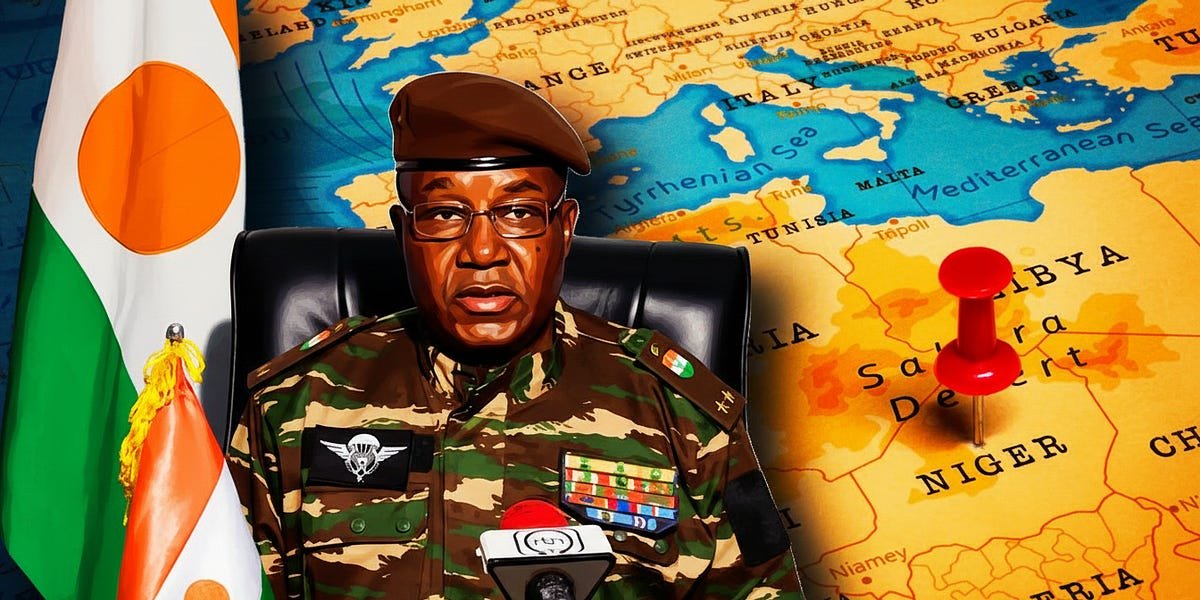
In a move that reverberates far beyond West Africa, Niger has officially begun exporting its uranium without French involvement—effectively ending a six-decade relationship that epitomized post-colonial extractivism. According to a December 1, 2025, report by Oil Capital, the transitional government in Niamey is now in advanced negotiations with non-French buyers, with zero discussions taking place with any French entities, including Orano, the former operator of Niger’s largest uranium mines.
This is not merely a commercial adjustment. It is a calculated act of economic decolonization—one that speaks to a broader realignment across the Sahel and the Global South, where control over strategic minerals is increasingly seen as indivisible from national sovereignty.
Since Niger gained nominal independence from France in 1960, uranium has remained a linchpin of bilateral relations—though always on profoundly unequal terms. France, through its state nuclear conglomerate (first Cogema, then Areva, now Orano), secured mining rights in the 1960s that granted it privileged access to high-grade deposits in northern Niger.
At its height, Niger produced over 2,000 metric tons of uranium per year, accounting for approximately 5 percent of global supply and 15–20 percent of France’s nuclear fuel needs. The two flagship mines—Somair and Cominak, near Arlit—became cornerstones of France’s civilian and military nuclear programs. Yet despite this contribution, Niger received minimal financial return. Under contracts criticized for their opacity and imbalance, the country earned royalties of just 5.5% of market value, while French companies repatriated the vast majority of profits.
Local communities paid a steep price. Decades of mining led to radioactive contamination, water table depletion, and chronic health issues—all while infrastructure investment in the region remained negligible. Public discontent simmered for years, but only after the July 2023 coup did the political will emerge to break the cycle.
The military-led National Council for the Safeguard of the Homeland (CNSP), which assumed power after ousting President Mohamed Bazoum—a figure closely aligned with Paris—moved swiftly to dismantle French influence. French troops were expelled within weeks. Diplomatic ties were downgraded. And crucially, Orano’s operations were suspended in July 2023.
The final blow came in June 2024, when the CNSP officially revoked Orano’s mining license, citing environmental violations, unpaid royalties, and a breach of national sovereignty. The decision was more than symbolic—it was structural. With Orano out, Niger began the complex process of finding new partners who would accept Niamey’s terms: greater state ownership, transparent revenue sharing, and local value addition over time.
According to Oil Capital, Niger is now in advanced talks with several non-Western countries to offload its uranium stockpiles and secure future offtake agreements. While the government has not disclosed buyer identities, analysts point to strong interest from:
-
India, which relies on imported uranium for its expanding civilian nuclear program and has long-standing diplomatic ties with African nations;
-
China, already active in Niger’s oil and infrastructure sectors through state-backed firms like CNPC and Sinohydro;
-
Turkey, which has deepened its Sahel engagement through defense cooperation and humanitarian aid;
-
And Gulf partners, particularly the UAE, which has emerged as a major investor in African critical minerals through sovereign wealth funds.
Critically, all potential partners are being evaluated not just on price, but on their willingness to support long-term industrial development, including possible co-investment in a uranium conversion facility—a first step toward moving beyond raw material exports.
Niger currently exports uranium in the form of yellowcake, a powdered concentrate that must be processed abroad. Building domestic conversion capacity would allow it to capture more value, but that requires capital, technology, and stable partnerships. It is precisely here that BRICS+ nations may offer an alternative model: one based on infrastructure-for-resources swaps, joint ventures, and non-interference.
Niger’s uranium pivot does not happen in isolation. It is part of a coordinated strategy by the Alliance of Sahel States (AES)—a mutual defense and economic pact formed in 2023 by Niger, Mali, and Burkina Faso after each expelled French forces and realigned toward Russia, Turkey, and other non-Western actors.
The AES has declared its intent to jointly manage and market strategic resources, including gold, lithium, and uranium. In October 2025, the three nations announced plans for a common mining exchange and a sovereign wealth fund to pool resource revenues. While still in early stages, the initiative signals a rejection of fragmented, bilateral deals with former colonial powers in favor of collective bargaining power and regional integration.
This bloc’s emergence challenges the traditional Western-dominated architecture of global mineral governance—long controlled by institutions like the OECD, the World Bank, and major commodity traders based in London, Geneva, or New York. Instead, the AES is building direct links with partners in Beijing, New Delhi, Ankara, and Abu Dhabi, creating what some analysts call a “Southern commodity corridor.”
For BRICS nations and the wider Global South, Niger’s uranium move is more than a regional story. It is a test case in strategic autonomy.
Uranium sits at the intersection of energy security, defense technology, and industrial policy. As the world races to secure critical minerals for clean energy and advanced manufacturing, control over supply chains becomes a geopolitical asset. Niger—holding the world’s fifth-largest uranium reserves (estimated at 210,000 metric tons)—is now asserting that ownership means more than legal title. It means setting terms, choosing partners, and defining the purpose of extraction.
This is the essence of the new Global South consensus: resources are not just for export, but for leverage, development, and sovereignty.
France’s exclusion is not driven by anti-Western sentiment alone—it is a response to decades of asymmetry. What Niamey wants now is partnership on equal footing, not patronage disguised as investment.
Challenges remain. Niger must navigate technical limitations, market volatility, and the risk of overdependence on new powers. Transparency in new deals will be crucial to avoid repeating past mistakes in different forms. Yet the direction is clear: the era when Africa’s strategic minerals flowed automatically to former colonial capitals is ending.
What rises in its place may not be a perfect system—but it will be one designed by Africans, for African interests, with allies chosen not by history, but by shared vision.
And in that sense, every ton of uranium Niger sells without France is not just a transaction—it is a declaration.
Join the Conversation:
📌 Subscribe to Think BRICS for weekly geopolitical video analysis beyond Western narratives