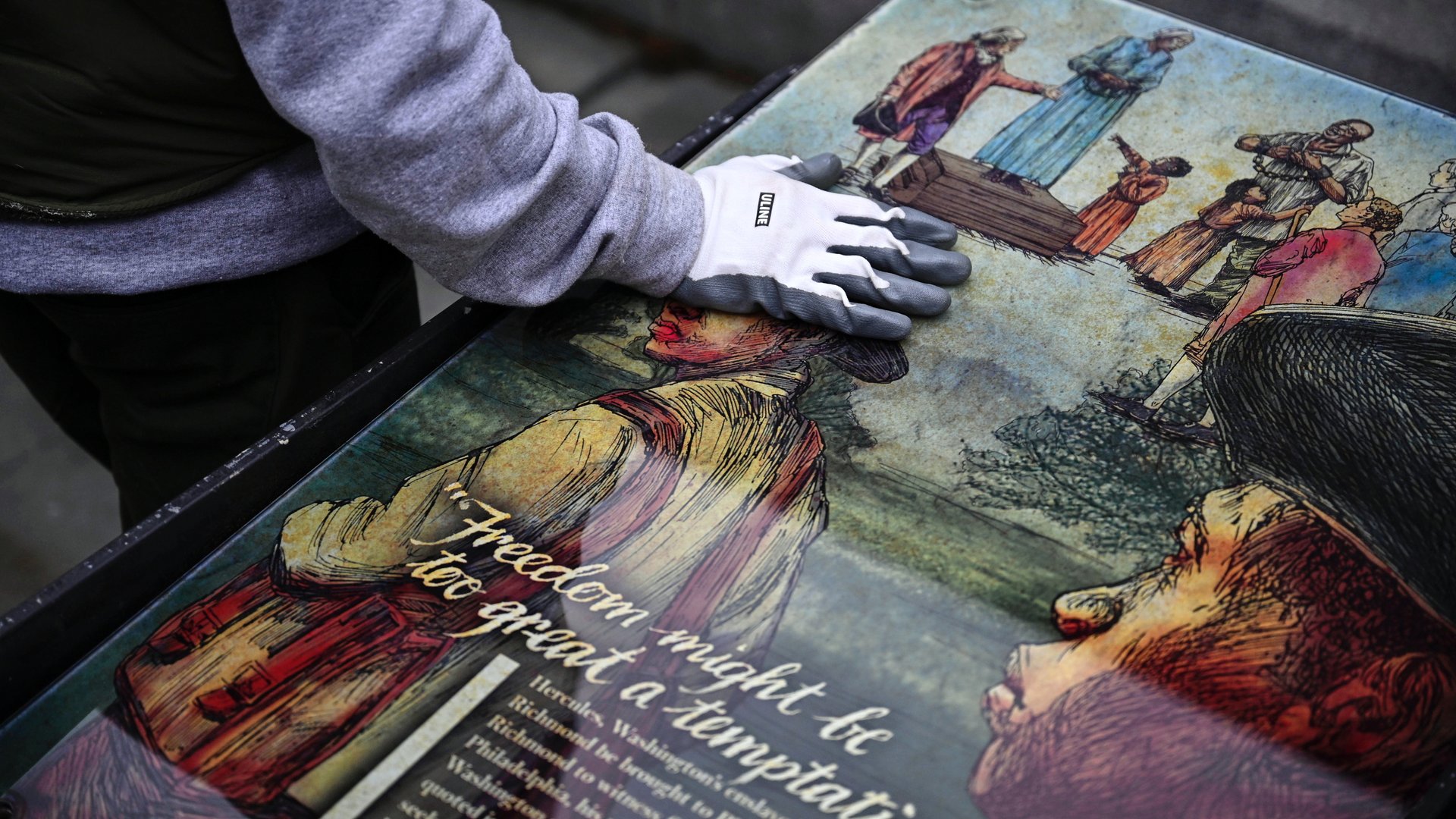
Some parts of an exhibit about the history of slavery began being restored this week in Philadelphia’s Independence National Historical Park after they were removed by the Trump administration in January. A federal judge ruled on Monday that the exhibit needed to be put back up, giving officials a Friday deadline to do so. However, […]
Menej ako 1 min.
min.
Some parts of an exhibit about the history of slavery began being restored this week in Philadelphia’s Independence National Historical Park after they were removed by the Trump administration in January.
A federal judge ruled on Monday that the exhibit needed to be put back up, giving officials a Friday deadline to do so. However, an appeals court ruled late Friday that work on it can stop while federal government officials appeal the reinstallation order.
Around half the panels on the exhibit were restored before then, The Associated Press reported. U.S. Circuit Judge Thomas Hardiman said in his Friday order that these must stay in place and remaining materials have to be preserved.
Philadelphia Mayor Cherelle Parker celebrated the restoration on X, though acknowledged this wasn’t the end of a legal battle between the city and federal officials.

Download the SAN app today to stay up-to-date with Unbiased. Straight Facts™.
Point phone camera here
“We will handle all legal challenges that arise with the same rigor and gravity as we have done thus far,” Parker said.
In a video she posted, Parker thanked the National Park Service staff working on putting the exhibit back up, telling them: “I want you to know I’m grateful.” An NPS staffer responded by saying “it’s our honor.”
The legal battle behind the exhibit
Last March, President Donald Trump signed an executive order, which called for the removal of “public monuments, memorials, statues, markers or similar properties within the Department of the Interior’s jurisdiction” which perpetuate what the administration deemed to be a “false reconstruction of American history.” This order specifically mentioned Independence National Historical Park in Philadelphia, Pennsylvania, where the exhibit was.
Then, in January 2026, the National Park Service began removing panels on the exhibit that talked about slavery, leading the city to sue Secretary of Interior Doug Burgum and Jessica Bowron, acting director of the National Park Service, as well as the agencies themselves.
City officials argued that they had equal rights with the NPS to approve of the final design of the exhibit. However, NPS did not get approval to alter the exhibit before getting rid of the panels, “rendering their actions arbitrary and capricious and not in accordance with law,” the city said in its lawsuit.
“Defendants have provided no explanation at all for their removal of the historical, educational displays at the President’s House site, let alone a reasoned one,” the city added.
Philadelphia City Council President Kenyatta Johnson said the removal of the exhibit “is an effort to whitewash American history.”
“For the last 15 years, the memorial has served as a public education space, informing visitors about the complicated legacy of the early United States and the resilience of those enslaved,” Johnson said.
Pennsylvania Gov. Josh Shapiro, in a statement at the time, said the displays taken down “aren’t just signs — they represent our shared history, and if we want to move forward as a nation, we have to be willing to tell the full story of where we came from.”
“Donald Trump will take any opportunity to rewrite and whitewash our history — but he picked the wrong city and the wrong Commonwealth,” Shapiro said in January.
During a court hearing Jan. 30, Assistant U.S. Attorney Gregory in den Berken said that “although many people feel strongly about this (exhibit) one way, other people may disagree or feel strongly another way.”
“Ultimately, the government gets to choose the message it wants to convey,” he was quoted by The Associated Press as saying.
Senior U.S. District Judge Cynthia Rufe, according to the AP, cut in den Berken off, saying he was making a dangerous statement.
“It is horrifying to listen to,” she said. “It changes on the whims of someone in charge? I’m sorry, that is not what we elected anybody for.”
Rufe is the judge who granted the Monday injunction for the exhibit to be put back.
In her order, the judge referenced George Orwell’s famous book “1984,” saying that, like Big Brother, “the government claims it alone has the power to erase, alter, remove and hide historical accounts on taxpayer and local government-funded monuments within its control.”
About the exhibit
The President’s House Site at Independence National Historical Park has an outdoor exhibit called “Freedom and Slavery in the Making of a New Nation,” which, according to its website, looks at the “paradox between slavery and freedom in the founding of the nation.”
Included there are the names of nine people enslaved by first President George Washington. Ona or “Oney” Judge, one of the people honored at the exhibit “seized her freedom” while the Washington family ate dinner, the website said, and eventually got to New Hampshire.
Panels in the exhibit, the AP reported, have been on display since 2010, through collaborative efforts of the city, National Park Service, historians and others.