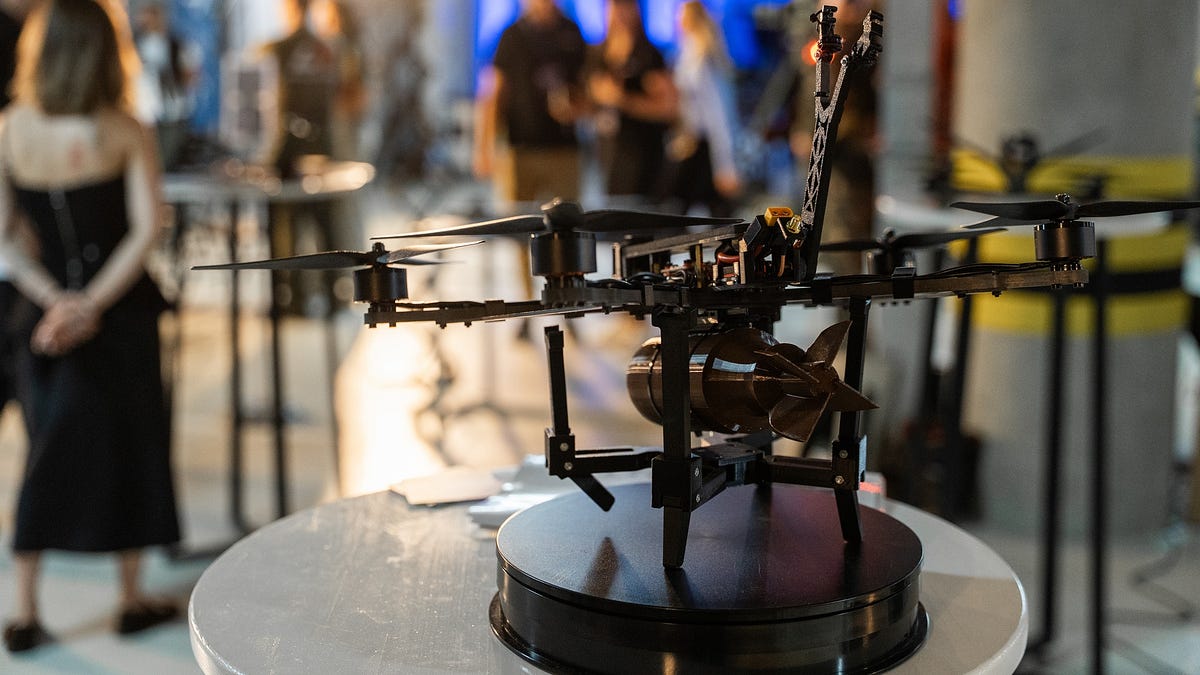
Photo: The Lupynis-10 FPV drone, equipped with the TFL-1 autonomy module. Courtesy of The Fourth Law “A fully autonomous drone will be like a grenade: every soldier with basic skills will be able to use it; it will operate under intense electronic warfare and function as a highly precise weapon,” says Yaroslav Azhnyuk, founder of […]
9 min.
“A fully autonomous drone will be like a grenade: every soldier with basic skills will be able to use it; it will operate under intense electronic warfare and function as a highly precise weapon,” says Yaroslav Azhnyuk, founder of The Fourth Law, Ukraine’s leading developer of autonomous defence technologies.
Despite significant hype, such systems are not yet widely present on the Russia–Ukraine battlefield. However, a future in which drones fly over cities like Kyiv or Moscow, autonomously selecting targets based on predefined criteria, or both sides deploy dense “wall-to-wall” waves of drones, no longer feels distant.
I’m glad to finally publish this article on The Fourth Law, a driving force behind Ukraine’s autonomous defence tech.
The Fourth Law (TFL) was founded in 2023 by Yaroslav Azhnyuk. As many of Ukraine’s defence-tech developers, Yaroslav was previously a highly successful civilian entrepreneur. His earlier venture, Petcube, was valued at $36–50 million by Forbes in 2021. Petcube is a global leader in pet cameras (with over 1M devices shipped), which enable owners to monitor, play with, and feed their pets remotely.
In November 2023, Azhnyuk transitioned into the miltech sector and founded two companies: The Fourth Law (TFL), which develops autonomous solutions, and Odd Systems, which focuses on thermal cameras for FPVs. Both companies also produce FPV drones.
The Fourth Law team brings together engineers, scientists, and military veterans, with offices across Ukraine, the EU, and the United States. The company’s name references a hypothetical “fourth law of robotics” — an idea meant to extend the three famous laws formulated by Isaac Asimov.
The Fourth Law (TFL) has a public roadmap toward a new paradigm of warfare:
-
Last-Mile Terminal Guidance
-
Autonomous Bombing Guidance
-
Autonomous Search and Destroy
-
Full Navigation in GPS-Denied Environments
-
Autonomous Takeoff and Landing
The first level is already operational and in serial production – TFL-1 terminal guidance and cruise modules. “We are integrated with dozens of manufacturers, and this layer is continuously being refined. These are last-mile guidance systems. This is a critically important technology. It allows drones to fly farther, overcome radio-horizon constraints, and reliably reach targets at 50–90 km and beyond,” Azhnyuk said in the interview to Militarnyi in 2024.
In 2025, the company launched its operational autonomous bombing module, TFL-2.
The developers also work on neural-network–based object recognition that runs effectively on very low-cost hardware without sacrificing quality.
In 2025, TFL raised funding from a group of venture capital funds and angel investors from the EU, the US, and Canada.
In July 2025, The Fourth Law announced its ready-to-use terminal guidance solution, TFL-1. Powered by machine vision, the system enables an FPV drone to automatically strike a target selected by the operator.
TFL-1 is an onboard computer running AI algorithms that takes control during the final 500 meters of flight. This approach—described by the company as “last-mile autonomy”—allows FPV drones to track all types of targets (static, moving, and camouflaged) more effectively and to operate despite EW interference, signal loss, and other battlefield constraints.
Additionally, it has a cruise mode. When a drone loses control due to jamming, it can switch into cruise mode and continue flying along its trajectory until control is restored.
In July 2025, a video was released showing the combat use of UAVs equipped with the TFL-1 system on the battlefield. For the first time in history, this footage demonstrated the systematic use of AI-enabled drones to destroy enemy targets in the terminal phase of flight.
“The video includes a short clip from Anduril showcasing its product. However, the company does not present real-world examples of its use. We therefore decided to produce a simple, straightforward video that shows real-world combat use of our own product, as it is actually employed by Ukrainian forces,” mentioned Yaroslav Azhnyuk in the podcast, emphasizing his respect towards Anduril and its founder.
The system is already in operational use across more than 30 military formations of Ukraine’s Defence Forces.
TFL-1 can be integrated into drones from more than a dozen manufacturers. The company supplies both hardware modules and software licenses to government customers and UAV producers.
The module is designed for mass production—potentially hundreds of thousands of units per month. According to the manufacturer, the upgrade increases a drone’s cost by only 10–20%, while improving mission success rates 2-4 times.
The development of TFL-1 required a deliberate engineering focus on quadcopter-based FPV platforms. As of now, the system cannot be integrated into fixed-wing platforms, such as the Bulava loitering munition. This reflects a clear prioritization: FPV drones are the most widely used systems on the frontline, making their enhancement the company’s immediate and foundational task.
With sufficient funding, the next phase will involve greater autonomy and integration across a broader range of platforms, including fixed-wing UAVs.
In September 2025, one of Ukraine’s largest FPV drone manufacturers, Vyriy Drone, and The Fourth Law announced the start of mass production of FPV drones equipped with onboard terminal-guidance systems. Azhnyuk said that most frontline drones are expected to be fitted with similar autonomy systems within the next 6-9 months.
Additionally, according to his post, 2025 marked the first successful strike against an enemy boat using the TFL-1 system, demonstrating its effective application against maritime targets.
In 2025, the company launched TFL-2, an autonomous bombing moduleю
This is a high-precision ground-attack system designed to reduce operator workload while significantly improving strike accuracy.
Autonomous targeting:
The operator designates a target and activates attack mode. From that point on, the module independently locks onto and tracks the target, calculates the optimal release point, and guides the drone accordingly—taking into account speed, wind, and altitude.
Payload release and evasive maneuver:
At the calculated point, the system automatically releases the munition along a ballistic trajectory. The drone then stabilizes, gains altitude, safely exits the strike area, and hands control back to the operator for return to base.
Components:
The module includes a camera, a Raspberry Pi 5, and a LiDAR unit (20 m or 50 m range).
The company has also developed its own FPV platform — Lupynis-10-TFL-1. It is offered either as a standalone UAV or as a complete system, which includes 100 drones, a ground control station, and auxiliary equipment.
The platform’s core advantage is the TFL-1 autonomy module.
Key features of Lupynis-10:
-
Flight range of up to 30 km and speeds of up to 80 km/h.
-
Combat payload of up to 4 kg.
-
Price on the Brave1 Marketplace: UAH 20,500 ($480), comparable to most similar FPV drones that do not feature autonomy systems.
-
The system operates without communication during the final 500–1,000 meters of flight, making the drone resistant to radio-horizon limitations and EW systems.
-
Combat use demonstrates a hit rate of around 80%, dramatically increasing the effectiveness of FPV drones.
A large engineering team worked for nearly a year to bring the system to maturity, refining it for large-scale production and mass deployment, making it suitable for batches numbering in the hundreds of thousands and, in the future, millions of units.
In 2025, Ukraine acutely felt the need to counter hundreds of Shahed drones, as the Russians began routinely launching mass attacks against cities. The logical response became the development of interceptor drones.
The effectiveness of any air-defence solution depends on several factors: 24/7 availability, all-weather capability, all-aspect engagement, and multi-channel capacity. A scenario in which a single operator controls a single interceptor drone, has only one interception attempt, and can engage a Shahed only from behind is inherently low in effectiveness, writes Defence Express.
This is where terminal-guidance systems come into play. Installing an autonomous guidance module on an interceptor drone can increase the probability of a successful intercept and significantly lower the training threshold for operators. Only after that does it make sense to seriously discuss fully autonomous interceptor drones.
Yaroslav Azhnyuk told Defence Express that computer vision tasks—detection and tracking—are not the most difficult parts of developing this technology. The real challenge lies in control: the higher the speeds involved, the harder this problem becomes. It becomes even more complex at higher altitudes, where air density drops, winds intensify, and the interceptor must contend with turbulent airflow generated by a Shahed.
Unlike engaging a ground target, the interceptor attacks an object moving in three dimensions. This is why autonomous guidance for interceptor drones is far more complex than it may appear at first glance—and why progress in this area is incremental rather than immediate.
In 2025, the company launched the TFL Anti-Shahed Detection Module designed to counter enemy aerial targets such as Shahed-type drones.
The TFL Anti-Shahed module is installed between a thermal imaging camera—most commonly the Kurbas‑640a produced by Odd Systems—and either the flight controller or the video transmitter. The module uses AI algorithms to automatically detect and track targets in the thermal feed, analyzing their heat signature, speed, and flight trajectory.
Once a target is acquired, the system places a green contour around the drone and maintains stable real-time tracking. Importantly, the module operates in parallel with manual flight control and does not interfere with the pilot’s actions: the operator independently decides when and from which direction to attempt the intercept. Developers say they are already working to expand the system’s capabilities, including adding autonomous guidance and automated attack decision-making.
The module is designed to operate at altitudes of up to 5,000 meters, with Shahed-type drones detected at ranges from 50 to 1,000 meters, depending on weather conditions. Claimed recognition accuracy is around 80%. A complete kit with the thermal camera costs approximately $800, while the standalone module is priced at around $300, making it one of the most affordable solutions in its class.
Autonomous weapons raise ethical concerns about allowing machines to make decisions to destroy a target. Critics of this technology worry that fully autonomous weapons lack human judgment and accountability, potentially violating international humanitarian law.
At present, establishing effective international frameworks to govern the responsible use of AI remains a work in progress.
In 2024, Ukraine participated in the Second Global AI Summit, held in Seoul, South Korea. The Summit participants, including Ukraine, agreed on a Ministerial Statement that focused on three goals: AI security, innovation, and inclusiveness.
At the same time, some military experts in Ukraine express caution about these frameworks, arguing that they could limit AI development in Ukraine and put the country at a disadvantage on the battlefield, especially when the enemy, unconstrained by such frameworks, continues to advance.
When responding to my question about whether Ukraine’s participation in international agreements could limit AI development, The Fourth Law strongly disagreed.
“It provides a framework for discipline and trust, not a restriction. While it raises standards for testing and oversight, it also improves cooperation with partners and supports scalable, reliable deployment. In practice, it is a competitive advantage, not a constraint,” the company said in written correspondence.
Yaroslav Azhyuk also expressed his worry about AI in one of the interviews: “Artificial intelligence will have a direct impact on two critical areas of military technology. The first is fully autonomous drones; the second is the use of AI in information warfare. This technology is comparable to nuclear energy: it can be used for creation and progress, or for destruction—depending entirely on how it is applied”.
“In 2025, the main shift was from experimentation to battle-proven, scalable autonomy. In 2026, the focus will be on scaling autonomy, operating under EW-contested conditions, and wider deployment in standard combat scenarios“, commented The Fourth Law in a correspondence with Ukraine’s Arms Monitor.
In the longer term, the company aims to move toward full-spectrum autonomy—from autonomous takeoff and GPS-denied navigation to automated target detection and engagement. According to the team, this would enable the creation of drone swarms, fully autonomous interceptor drones, and other systems.
When speaking about swarms, TFL noted that at this stage, the term “swarm” is often overstated and overused. In many cases, it refers to basic coordination or visual identification, not true collective autonomy. Real AI swarming requires resilient communications and EW resistance, which remains difficult in combat. Many public claims should therefore be treated cautiously.
Human drone pilots will remain highly relevant. “In the next 2–3 years, AI will not replace operators but will significantly reduce their workload. Over a 5–10 year horizon, autonomy may independently perform certain standardized missions,” according to the TFL representative. The highest return comes from human-machine teaming: investing in scalable autonomy while training operators to use it effectively.
In the future, the company plans to extend its autonomy solutions beyond quadcopters to include fixed-wing drones, missiles, and ground and maritime platforms.
In the civilian sector, TFL sees clear potential applications for autonomous technology in logistics, construction, and agriculture.
Check the list of my earlier articles on Autonomy and AI.