⏱️ Čas čítania: 5 min (830 slov) According to the latest news, the Philippines has announced visa-free entry for Chinese citizens. This makes the Philippines the latest country to grant visa-free access to Chinese citizens, following Russia and Turkey. The Philippines granting visa-free entry to Chinese citizens is particularly surprising given the recent South China […]
Menej ako 1 min.
min.
⏱️ Čas čítania: 5 min (830 slov)
According to the latest news, the Philippines has announced visa-free entry for Chinese citizens. This makes the Philippines the latest country to grant visa-free access to Chinese citizens, following Russia and Turkey.
The Philippines granting visa-free entry to Chinese citizens is particularly surprising given the recent South China Sea conflict between China and the Philippines. Logically, with territorial disputes over islands and reefs in the South China Sea, the Philippines shouldn’t be offering such extensive visa-free access to Chinese nationals.
Furthermore, in recent times, the number of countries offering visa-free entry to Chinese citizens has been increasing, and the reasons behind this trend are worth discussing in detail.
In other words, these countries believe that China will become a high-income developed country in the future, which is the fundamental reason for granting visa-free access to Chinese citizens. And the reason China will become a high-income developed country is purely due to the influence of the United States and the dominance of the US dollar.
As we all know, after World War II, the United States established a monetary system centered on the US dollar, called the Bretton Woods system. The core idea of this system was that all currencies worldwide were pegged to the US dollar, and the US dollar was pegged to gold.
With the United States deeply involved in the Vietnam War in 1971, the dollar was forced to decouple from gold, and the Bretton Woods system effectively collapsed at that time. However, the dollar’s dominance did not collapse with the decoupling from gold; instead, it gradually replaced the old Bretton Woods system to become the new global monetary system.
Under this system, in order to maintain the dominance of the US dollar, the United States has to export dollar credit to the rest of the world, which leads to a continuous increase in US national debt (the dollar is a currency linked to US Treasury bonds).
The continuously rising US national debt and persistently high inflation are key factors that could lead to Trump winning the 2024 presidential election. Since taking office, Trump has consistently focused on reducing the trade deficit, which essentially means reducing the extent to which the US exports dollar-denominated credit to the rest of the world.
This raises a problem: a reduction in the supply of U.S. dollar credit would undermine the foundations of dollar hegemony, which is unacceptable to the United States.
So, how can the United States resolve this seemingly contradictory problem of wanting to reduce its trade deficit and limit the outflow of dollar credit while simultaneously maintaining the dollar’s dominance? This inevitably requires that, while reducing the direct outflow of dollar credit, the U.S. needs another country to assume the role of indirectly facilitating the outflow of dollar credit.
For a country to shoulder this responsibility, it must be a major global exporter of goods, not simply an energy exporter (like Saudi Arabia or Russia), because simple energy exports are insufficient to maintain the dominance of the US dollar. Their trade volume is insufficient, and Russia, in particular, is subject to US sanctions. Therefore, neither Russia nor Saudi Arabia, as energy exporters, can assume the crucial role of underpinning the dollar’s credibility.
Looking at the entire world, the only country capable of replacing the United States in exporting dollar-denominated credit is China.
Because China is the world’s factory, importing energy from around the world while simultaneously exporting inexpensive goods globally, as long as China uses the US dollar for settlements, it can effectively fulfill the role that the United States previously played in exporting dollar-denominated credit to the world.
Therefore, this would cause US dollars from all over the world to flood into China, which would force the appreciation of the Chinese yuan and ultimately propel China into the ranks of developed countries. This is the truest and most fundamental logic behind China’s trillion-dollar trade surplus.
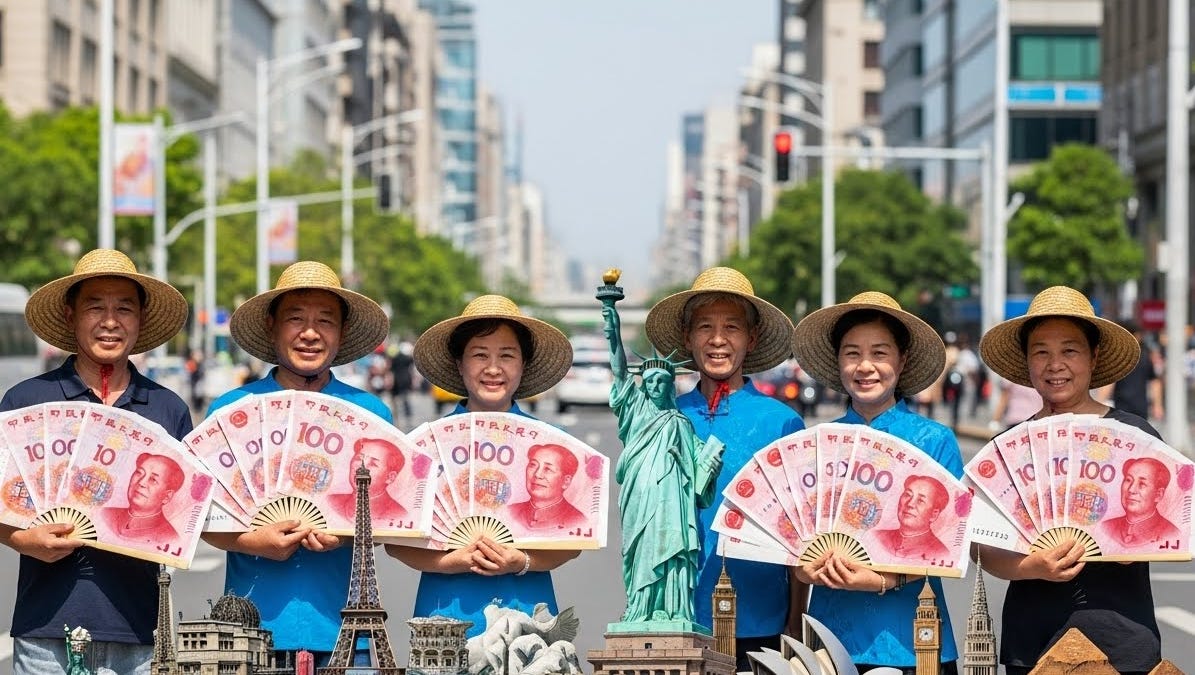
Russia, Turkey, and even the Philippines have all recognized the fact that China is on the verge of becoming a developed country, and that’s why they have granted visa-free access to Chinese citizens. They hope that once China becomes a developed country, Chinese citizens will travel there and boost their local tourism industries through increased spending.
Although the United States and China are engaged in serious competition for leadership in the future world order, both sides currently share a common interest in maintaining the dominance of the U.S. dollar. China needs to complete its industrial upgrading within the dollar-dominated system and, in the process, achieve its goal of becoming a developed country. The United States, on the other hand, needs China’s inexpensive goods and the use of the dollar in international trade to stabilize the dollar’s hegemony.
Therefore, with the help of the United States, China’s path to becoming a developed country is very smooth and unobstructed.
Join the Conversation:
📌 Subscribe to Think BRICS for weekly geopolitical video analysis beyond Western narratives.