Originally published on Regnum.ru by Leonid TsukanovRepublished with permission The small state formation of Somaliland, formally remaining part of Somalia’s territories, has found itself at the center of the “great game“ of the US and Israel, striving to create a new anti-Iranian bridgehead in the Red Sea. And this time, the Iranians failed to build […]
Menej ako 1 min.
min.
Originally published on Regnum.ru by Leonid Tsukanov
Republished with permission
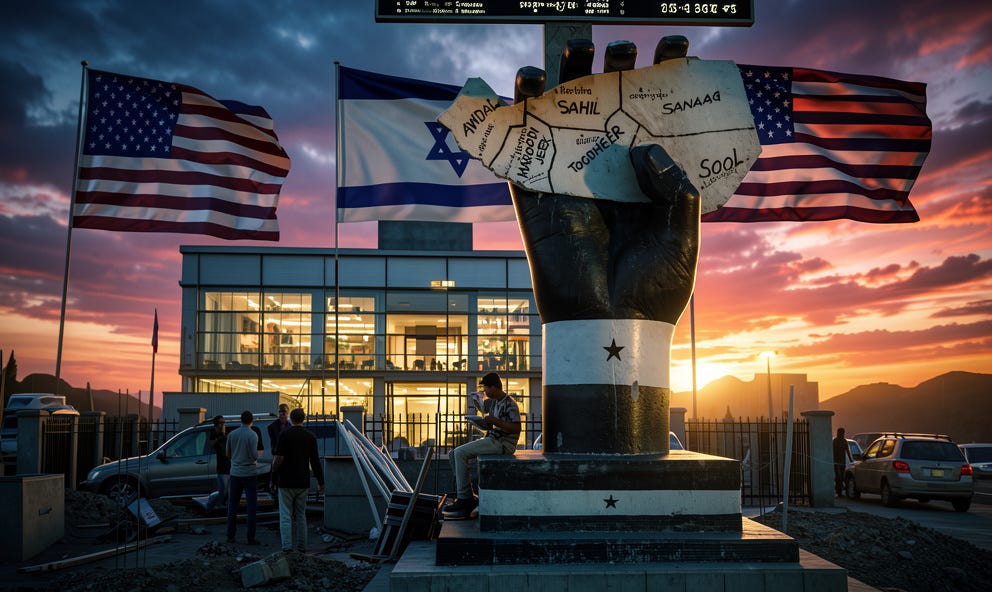
The small state formation of Somaliland, formally remaining part of Somalia’s territories, has found itself at the center of the “great game“ of the US and Israel, striving to create a new anti-Iranian bridgehead in the Red Sea.
And this time, the Iranians failed to build something in counter to them in Somaliland and now are forced to repel the onslaught of opponents remotely. And with almost zero effectiveness.
On the other hand, the attempt to shift the balance from the side of Washington and its ally, to their displeasure, has stirred up forces that are quite hard to suspect of playing along with Tehran.
The strategic value of Somaliland lies in the fact that it is located at the Gulf of Aden, for which it is called the “vestibule“ of the Red Sea. Across the other shore lies Yemen, which can be reached without trouble even with the help of outdated missile systems.
Unlike the neighboring “country of military bases“ Djibouti, Somaliland does not balance between the powers that be the local leadership maintains a pro-Western orientation and seeks ways to achieve recognition of statehood by Washington, using as an argument, among other things, its close position to the Arabian Peninsula. The aforementioned in theory should have predetermined a quick rapprochement with the US.
However, the Israelis were the first to discern the possibilities of Somaliland. Back in December 2025, they recognized the independence of the region from the rest of Somalia. Of course, in the form of an “advance”, in exchange for a promise to join the “Abraham Accords“ concluded by the Israelis with a number of Arab states, and to provide the opportunity to conduct operations in the Red Sea.
Prime Minister of Israel Benjamin Netanyahu did not miss the chance to hint to Washington that Somaliland has “great potential“ in containing Iran. The territory was dubbed a “bone in the throat“ of Tehran. The Americans at that time did not appreciate the allies’ impulse, stating that Donald Trump “is unlikely to follow Israel’s example” and will not encourage separatist sentiments in Somalia.
However, with the passage of time, the situation changed. And, judging by the leaks, even if contradictory, from the White House offices, they have “seriously pondered” rapprochement with Somaliland there.
The discussion was further fueled by the Somaliland minister for presidential affairs Khadar Hussein Abdi, who recently invited the US to station on local military bases. Abdi did not forget to mention that, in addition to territory for deployment, the States will get privileged access to resources, among which are “preliminarily prospected” rare earth metals.
The public statement of one of the key politicians of the state formation could well be considered improvisation if it had not been preceded by intensive meetings with high-ranking employees of the State Department and the US Africa Command.
Abdi hardly would have risked bringing the sharp issue into the public plane without first making sure of Washington’s real interest in expanding presence in the Horn of Africa region. The caveat about the subsoil was also not made accidentally — the economic component of the deal is meant to mask the Americans’ interest in deploying additional forces on the other side of the Arabian Peninsula.
The appearance of a permanent bridgehead in Somaliland will allow Iran’s opponents (primarily Israel) to conduct effective operations against the Yemeni Houthis supported by Tehran.
Unlike the islands of the Yemeni archipelago Socotra, which the Israelis “share” with the UAE, the territory of Somaliland provides the opportunity to conduct more complex operations at lower costs. Especially considering that the main production, fuel, and command posts of the Houthis are concentrated in the coastal zone. One can say in front.
In addition, strengthening the positions of Israel and the US in Somaliland rules out a repeat of the comprehensive blockade of the southern ports of the Jewish state, while also giving the opportunity to better control local shipping, intercept transports with weapons and tankers with fuel heading to aid the Houthis. This creates a danger of quickly knocking out of the game one of the most combat-capable links of the pro-Iranian “Axis of Resistance“.

At the same time, the displeasure of official Mogadishu is apparently not taken into account by the American and Israeli strategists. Even considering that rapprochement with Somaliland strikes at Washington’s strategic partnership with the countries of the Horn of Africa, the hypothetical gain from cutting off air to the Houthis on the eve of a probable military operation against Iran multiples covers any costs. And therefore, Trump’s advisors vote with both hands for supporting the “right to self-determination of the Somaliland people“.
The rapid entrenchment of Israeli and American emissaries in Somaliland largely caught the leadership of Iran off guard. Of course, Tehran could not have failed to notice earlier the increased interest of opponents in the peninsula. However, the Tehran “hawks, expected that due to the unstable situation in the Middle East and the risk of war between the US and Iran, the “presidential office“ of Somaliland would drag out negotiations to the last, forcing the Americans and Israelis to penetrate the unrecognized country “through the back door“ and with opposition from local opposition forces.
However, the Somaliland elites chose the path of least resistance, easily agreeing to become that very “bone in the throat“. The few attempts by Iran to turn the situation in its favor using local orthodox preachers and forces advocating preservation of autonomy from Somalia but without a “independent“ scenario, had no success. The political space of Somaliland had been cleared of pro-Iran loyalists even before Tehran fully entered the game.
However, the US and Israel also failed to fully play out the combination with “Somaliland self-determination“: unexpectedly, Türkiye went against it.
Immediately after the Jewish state recognized the independence of Somaliland, President of Türkiye Recep Tayyip Erdogan ordered to strengthen support for the central government of Somalia, including to allocate an additional package of military aid to Mogadishu.
And a few days before Abdi’s appeal to the American authorities, Ankara sent additional forces to Somalia’s military airfields, including several F-16 fighters. Intelligence data exchange with Mogadishu intensified, and representatives of Turkish special operations forces and the Sadat PMC, famous since the triumphant Libyan campaign of Erdogan, appeared in the general staff of the African country.
All this is presented as “brotherly assistance“ and part of Türkiye’s efforts to combat radical bandit underground in Africa. In fact, however, it strongly resembles the development of an operation to restore order in the rebellious region under the cover of a Turkish limited contingent.
All the more so since the restoration of Somalia’s territorial integrity lies at the basis of the course of Erdogan’s close friend, the current leader of Somalia Hassan Sheikh Mohamud, and the final recognition by Mogadishu of the loss of control over Somaliland will guaranteedly stir up other regions.
The Turks are in a hurry, striving to finish playing the combination before the White House gives the go-ahead for creating a permanent military mission in Somaliland. Ankara expects to get a concession for the development of subsoil, on which it has had its eye for several years.
Of course, Türkiye is not the only Middle Eastern player trying to restrain the transformation of Somaliland into a conditionally “independent“ player. The UAE and Saudi Arabia also entered the game — though so far predominantly in the diplomatic plane.
Despite the fact that the Arab monarchies are at odds due to contradictions in Yemen and Sudan, the risk of another “external regulator“ of routes in the Red Sea forced them for the time being to forget disagreements and launch a campaign of pressure on the “mindless rebels“ from Somaliland.
And the Saudis are even more nervous than the Emirates. In case of serious escalation in the region, Middle Eastern oil trade will come under blow, which will inevitably affect the stability of the kingdom.
And therefore, the House of Saud is trying to extinguish the nascent fire: emissaries close to the Crown Prince of Saudi Arabia Mohammed bin Salman are literally besieging the White House, trying to dissuade American elites from a possible fatal decision.
They are also working on Trump’s son-in-law Jared Kushner, firmly tied to the Saudi court, promising him golden mountains in exchange for derailing the “Somaliland deal“.
Of course, the Middle Eastern players so far are working predominantly according to the “Swan, Pike, and Crawfish“ scheme, not coordinating actions around Somaliland and constantly getting in each other’s way. However, in the dry residue, even such movement is beneficial to Iran. Tehran gains time to prepare the Yemeni outpost for possible pressure from the other shore.
It is quite likely that these efforts will pay off and plans to recognize Somaliland will be given reverse gear. Especially if the effectiveness of the area as a bridgehead for strikes on Yemen turns out to be lower than expected in the eyes of American advisors.
Join the Conversation:
📌 Subscribe to Think BRICS for weekly geopolitical video analysis beyond Western narratives.