This week, Shahed drones once again made headlines, this time in the context of the war in the Middle East. Affected countries and their Western partners immediately sought Ukraine’s expertise in countering Shaheds. Ukraine remains in a unique position to provide valuable insights into Shahed variants, the development of layered air defence systems, and the […]
Menej ako 1 min.
min.
This week, Shahed drones once again made headlines, this time in the context of the war in the Middle East. Affected countries and their Western partners immediately sought Ukraine’s expertise in countering Shaheds.
Ukraine remains in a unique position to provide valuable insights into Shahed variants, the development of layered air defence systems, and the application of low-cost countermeasures.
That said, such preparations should have begun earlier, and implementing these solutions may now take months.
This is a special edition of my Drone Warfare in Ukraine newsletter, focused exclusively on several aspects of Shahed countermeasures, interceptor drones, and featuring multiple exclusive commentaries. It is free to read and share.
In this edition:
-
War in the Middle East and Ukraine’s Expertise;
-
Thermal Imaging Cameras in Ukraine’s Interceptor Drones: Odd Systems;
-
Importance of Operator Training for Interceptor Drones: Kruk Drones UAV Training Center;
-
Russian Drone Adaptions: Future Trends
-
additional developments in drone warfare in Ukraine and Russia.
Thank you for reading and supporting my work!
War in the Middle East and Ukraine’s Expertise
Since the United States and Israel launched a military operation against Iran, Iran has turned to using its Shahed drones to strike targets in multiple countries across the region. According to the BBC, in six days Iran launched more than 2,000 low-cost drones at targets across the Middle East to overwhelm defences and spark chaos in the region.
The Gulf states have been using Patriot interceptor missiles to defend against attacks by Iranian drones. However, their stocks of interceptor missiles are already being depleted, and Middle Eastern countries are now seeking cheaper alternatives to Patriot missiles.
This is largely because a single Shahed drone costs around $30,000, whereas interceptor missiles such as the PAC-3 used in the Patriot system cost millions.
Since then, there has been a surge of interest in Ukrainian interceptor drones capable of intercepting Shaheds at a very low cost, according to the FT report.
An industry representative noted that any sale of Ukrainian systems — even those manufactured outside the country — must be approved by Kyiv.
President Zelensky stated that partner states are seeking Ukraine’s assistance in stabilizing the situation amid ongoing hostilities in the Middle East. Ukraine is now discussing with them the possibility of sending Ukrainian experts to the region. He added that the Ukrainian military has the necessary capabilities, and that Ukrainian experts will “work on the ground”.
On March 5, Zelensky wrote that Ukraine had received a request from the United States for specific support in defending against Shahed drones in the Middle East. Reuters reported that in addition to interceptor drones and electronic warfare systems, the United States and Qatar have also expressed interest in Ukrainian acoustic detection systems designed to identify long-range strike drones.
Zelensky also said that Ukraine is considering providing interceptor drones in exchange for PAC-2 and PAC-3 interceptor missiles for Patriots.
However, there is a mixed response from Ukrainian military personnel and experts regarding the type of assistance Ukraine may be able to provide to Middle Eastern countries.
A major in Ukraine’s State Border Guard Service, aerial reconnaissance specialist, and founder of the Matrix-UAV drone bureau, Yuriy Kasianov, noted that long-range strike drones in the Middle East are used mainly as a cheap supplement to ballistic missiles. According to him, drone attacks by Iran are primarily terror-style operations aimed at spreading fear, causing panic, and exhausting air defence systems.
He criticized attempts to highlight Ukrainian successes abroad while Russia continues to strike Ukrainian military, civilian, and energy infrastructure near the front line and border regions.
At the same time, even if Ukraine can supply some interceptors, merely deploying Ukrainian systems in other regions would not be enough.
A Ukrainian serviceman who has been directly involved in intercepting Shahed-type drones told Ukraine’s Arms Monitor that Ukraine faces a large-scale, daily drone threat, and its air defence responses have evolved around this reality. Russia conducts attacks according to a structured and methodical concept, which allows Ukrainian forces to anticipate the approximate directions, frequency, and patterns of strikes. For example, when Shahed drones follow known routes—such as through the Chernihiv region—defenders can estimate the azimuth and deploy mobile fire groups in advance.
The situation in the Middle East is different. Drone attacks there tend to be less predictable and less structured, often involving single drones or small numbers of drones flying toward different countries in seemingly random directions. As a result, only part of Ukraine’s experience can be directly applied.
According to the serviceman, there is one major limitation to the use of interceptor drones. Their practical interception radius is usually around 10-50 kilometers (depending on type), meaning that saturating entire national borders with interceptor coverage would be extremely difficult.
However, Ukraine can still provide valuable expertise in several areas. The first is technical knowledge about Shahed drones. Ukrainian specialists have accumulated extensive data on different Shahed variants and their components. For instance, about nine months ago, Russia began widely deploying Kometa navigation modules, which are highly resistant to electronic warfare interference.
It remains unclear which generation of Shahed systems Iran currently operates, but understanding these technical differences is crucial because countermeasures vary significantly between models.
Some drones can be disrupted by cutting mobile communications, others by electronic warfare systems, while certain variants require physical destruction. Some platforms also serve as reconnaissance drones or communications relays, complicating the defensive picture. Ukraine’s main contribution in this area could be sharing technical databases, identification methods, and operational experience.
A second area where Ukraine could help is in operational coordination and doctrine. Ukrainian forces have developed practical methods for organizing mobile fire groups, communication procedures between them, and low-cost countermeasures against Shahed drones.
One tactic that could be particularly relevant for Middle Eastern countries is the layered defence of urban areas. Creating a defensive ring of 8–10 kilometers, forming a buffer zone where drones can be intercepted before reaching urban infrastructure, is a realistic solution.
Even within Ukraine, the situation differs significantly between fronts—for example, between the Kharkiv and Kherson directions—and Russia’s tactics for employing different types of Shahed drones vary. The operational environment in the Middle East is, therefore, fundamentally different as well.
“One area where Ukraine can provide meaningful assistance is in rapid adaptation to evolving threats. Ukrainian forces have repeatedly demonstrated the ability to quickly adjust tactics and countermeasures in response to new developments. This experience could help partners develop flexible and adaptive response frameworks tailored to the specific threats they face,” a Ukrainian serviceman told Ukraine’s Arms Monitor on condition of anonymity.
At the same time, implementing a large-scale interceptor drone system in the Middle East would require time, infrastructure, and trained operators—something that ideally should have begun earlier.
In the near term, many countries are likely to rely more heavily on short- and medium-range air defence systems, such as Stinger, which are available and already integrated into air defence architectures.
Thermal Imaging Cameras for Ukraine’s Interceptor Drones: Odd Systems
According to the Victory Drones community, the interceptor drone STING, developed by the Wild Hornets, has remained the most effective interceptor drone for five consecutive months. According to official data, STING currently leads in the number of successful interceptions of Shahed-type drones. Read my article about STING here.
In August 2025, it was reported that Sting drones were equipped with Kurbas thermal imaging cameras developed by the Ukrainian company Odd Systems.
The founder of Odd Systems, Yaroslav Azhnyuk, mentioned that the Kurbas module outperforms Chinese-made Caddx cameras, offering better image quality, greater reliability under heavy vibration, and improved moisture resistance — all at the same or even lower cost.
Last week, the company unveiled an updated version of its Kurbas thermal imaging line – the new Kurbas-640 Beta thermal camera.
The updated model includes pre-configured modes for different operational scenarios, including “Air Hunting,” “Ground Hunting,” “Navigation,” and a mode designed for extreme weather conditions.
In addition, the camera offers deep customization options for drone manufacturers and military engineers, allowing them to create their own image profiles by adjusting parameters such as contrast, brightness, noise reduction, detail enhancement, gamma settings, digital zoom, and sensor recalibration algorithms.
“The strength of Kurbas-640 Beta lies in its maximum adaptability to mission requirements. From now on, not only we as the camera manufacturer, but also any drone manufacturer or unit operating drones can configure the camera to meet their specific needs. Moreover, this can be done not only before a mission but also during the mission, including changing image parameters and modes programmatically,” wrote Yaroslav on his post on LinkedIn.
A week earlier, Odd Systems announced plans to build a factory to produce sensors for thermal imaging cameras. The goal is to reduce Ukraine’s dependence on foreign components, particularly those imported from China.
According to Azhnyuk, Europe currently produces fewer than 500,000 such sensors per year, while Ukraine consumes roughly the same amount in about five months. He noted that European sensors are around five times more expensive than Chinese ones and are often not of higher quality, and that they are extremely difficult to purchase due to high demand within Europe itself. The plant is expected to triple the production of sensors for thermal imaging cameras on the European continent.
In my conversations with Odd Systems, the company highlighted several important points regarding the localization of component production.
-
Supply chains for miltech components are not only about price. They are also about availability and risk. For some critical components, localization is a security issue.
-
Over the last two years, Ukraine has launched many new manufacturing facilities. At first, this was mostly low-tech production, for example components for FPV drones. Now we see a new phase.
-
New factories are being launched that focus on more advanced components. This helps Ukraine become independent not only in security terms, but also economically. In many categories, Ukrainian producers can already compete with China on price.
-
This includes motors, cameras, communication systems, and other key components.
-
Microelectronics will also develop in Ukraine. This is not about leading-edge chips. It is about industrial microelectronics designed for real-world use, with a focus on reliability, stability, and repeatable production.
In 2025, Odd Systems started a partnership with the Danish prime Terma. The teams are working closely on a low-cost, AI-powered drone interceptor.
Odd Systems brings its expertise working with FPV drones, thermal cameras, and cooperation with the Ukrainian Defense Forces to deliver a scalable and reliable platform for countering various drone threats that arise in modern warfare.
The company’s focus is on joining R&D efforts to develop effective battlefield solutions, enhancing capabilities, and scaling internationally.
Odd Systems has a sister company, The Fourth Law, which focuses on autonomous technologies.
On March 6th, Yaroslav Azhniuk presented Zerov — an autonomous Shahed interceptor. Autonomous detection enables the system to identify targets at distances 2–3 times greater than comparable solutions.
Technical specifications of Zerov-8:
-
Designed in a tailsitter configuration (an interceptor model with vertical takeoff and landing), combining the speed of a missile with the maneuverability of a drone.
-
Maximum speed: 326 km/h (intercepts targets moving up to 270 km/h).
-
Combat radius: up to 20 km.
-
Warhead: up to 0.5 kg.
-
Deployment time: vertical takeoff (launch within 30 seconds).
-
Optics: daytime or thermal camera, depending on mission requirements.
“The most important part of an autonomous interceptor is detection. We trained the system to see targets where the human eye or standard sensors fall short. That gives us precious time and distance to maneuver — the difference between a Shahed being intercepted or striking the ground,” wrote Yaroslav.
I published a detailed profile article on The Fourth Law, which you can read here.
Importance of Operator Training for Interceptor Drones: Kruk Drones UAV Training Center
To better understand the role of operators in the effectiveness of interceptor drones, I spoke with Viktor Taran, co-founder and CEO of the Kruk UAV Operator Training Center.
The center was established in April, 2022, in response to the urgent need of the Ukrainian Defence Forces for qualified UAV operators. Today, Kruk operates as a non-governmental training center certified by the Ministry of Defence, specializing in training operators for various types of UAVs as well as related technical and operational specialties.
Here are the key highlights from our conversation:
-
For more than two years, Ukraine has warned its partners that the nature of the air war has fundamentally changed.
-
Drones have become the main threat because they are: inexpensive; widely available; highly precise; capable of targeting specific objects (for instance, using Starlink communication).
-
Traditional air defence systems, built around expensive interceptor missiles, are not designed for this type of threat.
-
Countering drones requires a fundamentally different air defence architecture.
-
These warnings were largely underestimated by Western partners in the early stages of the war.
-
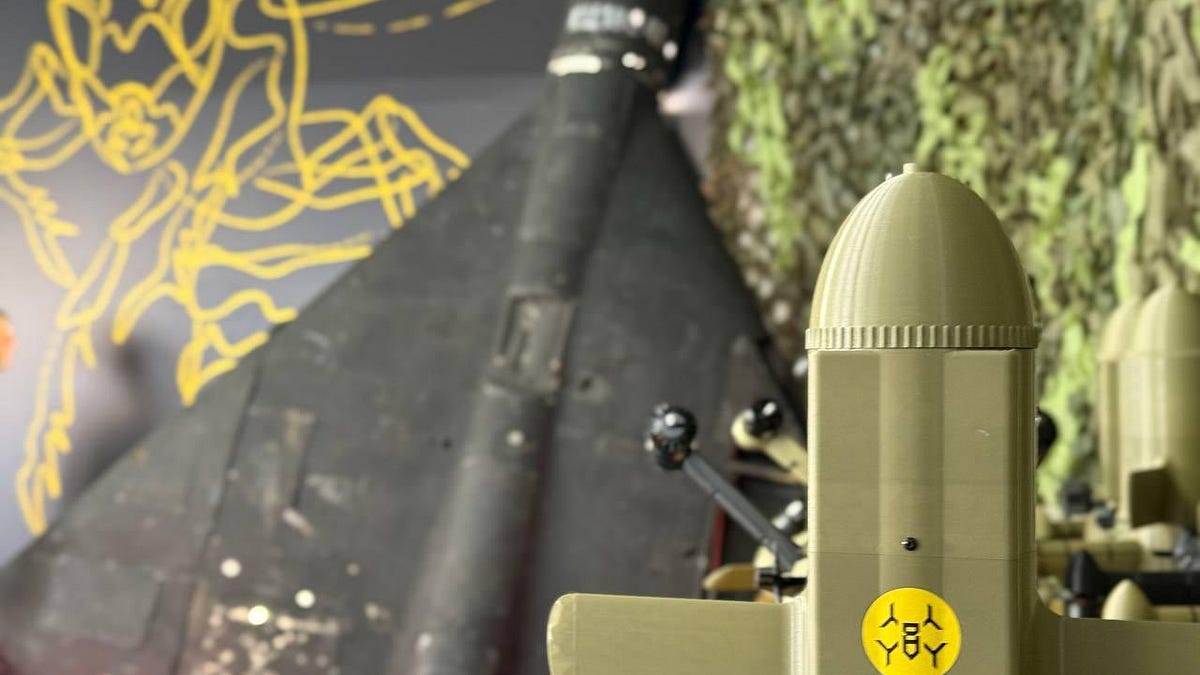
At the Ukrainian House during the Munich Security Conference in February 2026, visitors were shown a downed Russian Shahed drone and an AI-generated video simulating drone attacks on European cities, including Munich, Vienna, Davos, and Brussels.
The video depicts drones launched from Russian territory striking major landmarks, including the European Parliament in Brussels, and features quotes from Western officials alongside threats from Russian propagandist Vladimir Solovyov.
-
Even then, many Europeans treated the threat as exaggerated.
-
Today, Western countries are trying to rapidly implement Ukraine’s experience in counter-drone warfare, but building such systems takes months and often years.
-
A good example is the announced “drone wall” along the EU border, which has yet to materialize.
Interceptor Drones
-
Interceptor drones will remain an important element of air defence, but they are not a universal solution.
-
Their effectiveness depends heavily on the type of drone being intercepted.
-
Against Shahed-type drones flying at 200–250 km/h, interceptor platforms are effective.
-
Against jet-powered Shahed variants, flying at higher speeds (350-500 km/h), interceptor drones are less effective.
-
Future developments may include interceptors with autonomous or AI-assisted targeting.
Training Interceptor Operators
-
The biggest challenge today is not interceptor drones, but the shortage of trained operators.
-
Training a single operator at the Kruk Center can cost 40,000–70,000 UAH (910-1600 USD) for Ukraine’s Defence Forces. Organizing similar training programs for foreigners would likely cost more.
-
Current training groups at Kruk typically include 4–6 people, while the actual need is in the tens of thousands.
-
-
Training interceptor drone operators is complex and time-consuming. A beginner with no drone experience requires 1.5–2 months of training. Experienced drone pilots can transition to interceptors in 3–4 weeks.
-
Kruk Center conducts training in two main categories of interceptor drones:
-
At the moment, fixed-wing interceptors show higher interception success rates. FPV interceptors are a newer direction at the Kruk Center.
-
Training includes:
-
The center operates a large drone training range near Kyiv (around 80 hectares) equipped with electronic warfare systems; training support from friendly units; and operational testing environments.
-
The center also deploys alongside combat units and participates in operational missions.
-
In addition to training operators, Kruk also offers testing services for promising domestic and foreign defence innovations, allowing developers to receive feedback from end users.
Russian Drone Adaptions: Future Trends
Ukrainian activist and Victory Drones founder Maria Berlinska shared her vision of Russian drone developments over the next 1–2 years:
-
Using Shahed/Gerbera-type drones as a universal platform.
These UAVs may increasingly serve multiple functions: acting as communication relays and mesh-network nodes, laying mines, serving as “mother drones,” and enabling real-time attacks on civilian infrastructure.
Attacks using fiber-optic drones are also likely to increase, potentially carried by other drones, which would extend the effective strike range even further.
Ultimately, the side with the longer strike reach and faster decision-making cycles—including through remote control, autonomy, and networked operations—will have a clear advantage. -
Expanded use of LTE networks to intensify aerial attacks.
It is likely that Russia is already planning operations even larger in scale than Ukraine’s “Spiderweb” operation, where operators located thousands of kilometers away could simultaneously control hundreds of drones to attack critical infrastructure.
Fully autonomous drone operations are also becoming increasingly plausible. Overall, the use of autonomous systems will continue to grow, alongside countermeasures such as electronic warfare, mechanical interception, laser systems, and electromagnetic defences. -
Integration of unmanned systems into a unified operational network.
Russia is likely to link its aerial, ground, and maritime unmanned systems into a single coordinated ecosystem through software and mesh networks.
In simpler terms, this would resemble an “army of unmanned systems” where drones provide communications for one another and are controlled from thousands of kilometers away through unified software platforms. Operators could then assign tasks—such as targeting specific locations—in real time via centralized digital interfaces.
Additional Updates
-
There are two main types of interceptor drones: fixed-wing drones and multicopters, wrote Vladyslav Khrystoforov for Oboronka.
Fixed-wing interceptors resemble small reconnaissance aircraft. They are equipped with a warhead and additional target detection and tracking systems and are typically launched from a catapult.
These interceptor aircraft have a relatively low speed of around 160–180 km/h, but they can remain airborne longer and reach higher altitudes. If the mission fails, the drone can be safely recovered, refurbished, and launched again. To enable this, the detonation system is designed so that the drone explodes only on the operator’s command rather than on contact.
Multicopters, on the other hand, are operated similarly to standard FPV drones. They take off vertically from hard surfaces and can reach high speeds of 350–400 km/h. These drones can be controlled either with a traditional FPV controller and goggles or with a more advanced control panel with a screen.
Their main disadvantage is short flight endurance. While a fixed-wing interceptor may have time for a second interception attempt or return to base after a miss, a multicopter may run out of battery during additional maneuvers. Moreover, landing an explosive-equipped multicopter for reuse can be dangerous.
-
Due to weather conditions, interceptor drones targeting Shaheds have been less effective, and work is underway to improve them, President Zelensky said. “We are currently upgrading interceptor technologies. We are working on universal interceptors that can operate in any weather conditions. This winter showed us that interception rates can drop due to weather. We are now developing new technologies to ensure they function effectively in all weather,” he noted.
-
Serhiy “Flash” Beskrestnov, technology advisor to the Defence Minister, wrote that Ukraine is steadily improving the effectiveness of its interceptor drones and will sooner or later reach an interception rate of up to 90 percent. He added that he believes this could happen relatively quickly.
At the same time, he outlined how the enemy may respond:
-
Introducing evasion systems
-
Creating flight corridors for drones
-
Flying at extremely low altitudes in manual mode
Serhiy argues that Ukraine will be able to address these challenges, but that the enemy’s main bet will likely be speed.
This could include increasing the speed of jet-powered Shahed drones from 280–320 km/h to 350–400 km/h, and potentially introducing the Geran-5 variant, capable of speeds of 500–600 km/h. In such a scenario, many of Ukraine’s current interceptor drones could suddenly become ineffective.
FLASH, therefore, called on manufacturers to begin developing interception systems capable of countering strike UAVs at these higher speeds now, while there is still time.
-
Related articles:
Read more about long-range drones in this section: Deep Strike Capabilities.