Image: courtesy of Robert “Madyar” Brovdi / Facebook Let’s take a look at what is happening in the Sea of Azov and the Black Sea. The number of Russian vessels that have been hit by Ukrainian forces is approaching 200. While destroying the vessels is not the primary objective, disrupting Russia’s export logistics is—and the […]
4
min.
Let’s take a look at what is happening in the Sea of Azov and the Black Sea. The number of Russian vessels that have been hit by Ukrainian forces is approaching 200. While destroying the vessels is not the primary objective, disrupting Russia’s export logistics is—and the economic costs of these attacks, along with the resulting logistical losses, are immense.
In this edition:
-
Ukraine’s Black Sea and Sea of Azov Campaign. Operation MoLoChKa;
-
Russia Launched Over 40 Missiles at Kyiv;
-
Fedorov’s Dismissal: Key Points;
-
and 10+ additional developments in Ukraine and Russia.
Also, check out my latest Ukraine Drone Brief, available for unpaid and paid readers!
Thank you for reading and supporting my work!
Ukraine’s Black Sea and Sea of Azov Campaign. Operation MoLoChKa
The commander of Ukraine’s Unmanned Systems Forces, Robert “Madyar” Brovdi, regularly posts updates on the force’s operations, “MoLoChKa” and “Crimean Switch Off,” which target vessels in the Black and Azov seas, as well as energy infrastructure in occupied Crimea.
Between July 1 and 19, the two operations targeted 176 vessels linked to Russia’s shadow fleet and 96 energy facilities. The strikes have been carried out using aerial and naval drones.
Brovdi said that Operation “MoLoChKa” would continue indefinitely. He also explained the name of the operation: the acronym (MLChK) stands for “Moscow Will Fall Through Crimea.”
Most of the vessels struck by Ukraine’s forces did not sink but sustained varying degrees of damage. “The goal is to paralyse Russia’s feeder fleet, an important component of its shadow fleet,” Brovdi said. The feeder fleet involves small and medium-sized, 140-metre flat-bottomed tankers with a deadweight capacity of 7,000 tonnes.
The operation is part of a broader effort by Ukraine’s Defence Forces to systematically disrupt Russian logistics, restrict the supply of fuel and ammunition, and strike at Russia’s oil exports through the Sea of Azov.
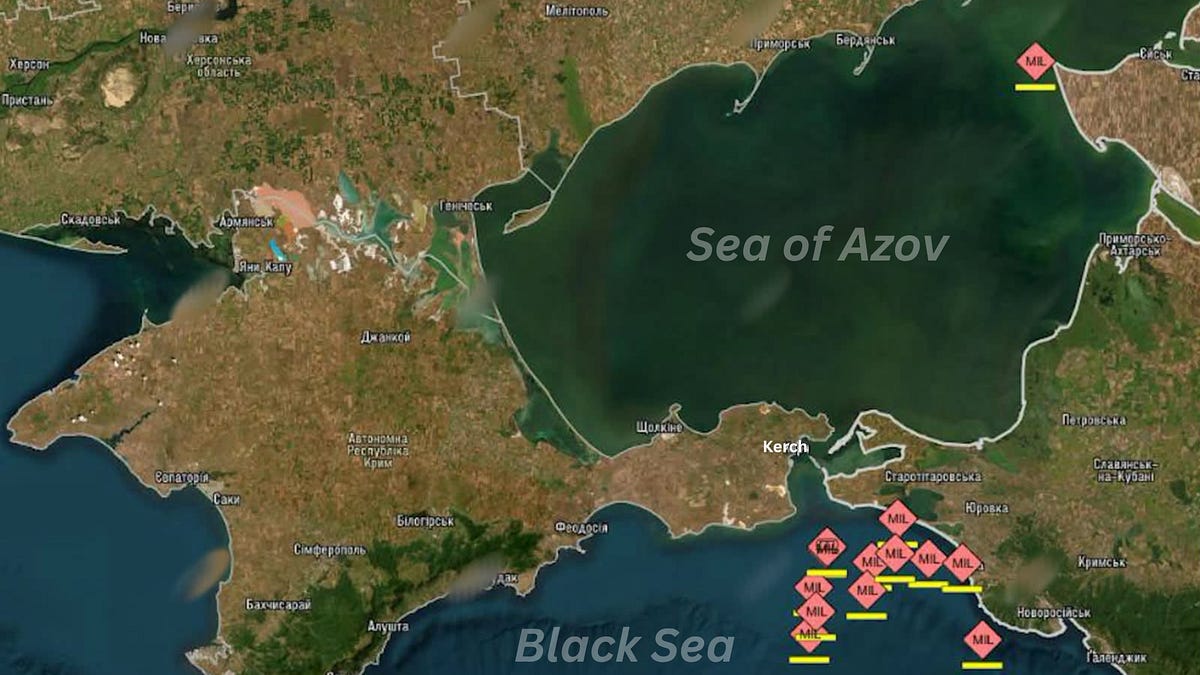
On the southern axis, Russian logistics depend primarily on two main routes. The first runs through the Kerch Strait and includes the Crimean Bridge, ferry crossings, and maritime links between Russian ports and occupied Crimea. According to Brovdi, the Kerch ferry crossing has already lost 75% of its capacity.
The second is the land corridor along the Sea of Azov, passing through Taganrog, Mariupol, Berdiansk, and Melitopol. This route also remains under constant Ukrainian fire control. That is why the Kremlin decided to make greater use of the Sea of Azov as an alternative logistics route.
The Sea of Azov is also used for so-called offshore oil transshipment. Under this arrangement, small tankers transported oil from Russian ports to anchorage areas near the Kerch Strait, where it was transferred to larger ocean-going vessels bound for India, China, and other countries.
The consequences of this operation extend far beyond military logistics, as the Sea of Azov is also a key export route for Russian grain. CNN reported that about a quarter of Russia’s wheat exports is shipped through the Sea of Azov.
On July 13, Russia temporarily suspended applications for passage through the Kerch Strait and the Azov–Don Canal. Russia is reportedly preparing to reroute its grain exports that previously passed through the Sea of Azov.
Russian military bloggers acknowledged that the Ukrainian attacks have become continuous and now affect commercial navigation. They noted that none of the ships had sunk and that no major oil spills had been observed; however, sinking vessels may not be Ukraine’s primary objective. The strikes appear designed to hit bridges and other critical sections of the ships, intimidate crews, discourage further voyages, and ultimately paralyse maritime traffic. In their assessment, the campaign is achieving this effect with considerable success.
Also, a vessel need not sink to be removed from service. If the bridge and its internal equipment burn out, repairs may be too expensive, take a long time, or become nearly impossible under sanctions.
The insurers are increasingly unwilling to cover vessels operating in such high-risk conditions. The cost of marine insurance in the Black Sea increased 204-fold in the second quarter of 2026, while the loss ratio for reinsurance covering drone-attack risks reached 2,800%.
The bloggers also highlighted Russia’s reactive approach to protecting civilian and industrial infrastructure. According to them, vessel owners received no instructions on how to respond. This mirrors the situation with strikes on oil refineries, whose owners failed to coordinate their own defences, assumed that Ukrainian attacks would not reach their facilities, and did not put adequate protective measures in place. The military, meanwhile, remained focused on the front line, leaving the protection of refineries and commercial shipping to private operators.
Possible protective measures for vessels include installing chain-link barriers at least 15 metres away from vulnerable parts of vessels. The bloggers claimed that specialists capable of organising such defences are available, but usually demand full payment in advance—and many Russian companies remain unwilling to pay for these services.
According to the ATESH resistance movement, Russia is deploying personnel from its elite Rubikon Drone Centre to protect vessels linked to its shadow fleet in the Black Sea and the Sea of Azov. Up to three service members could be assigned to each tanker. They are expected to use twin-mounted machine guns, man-portable air-defence systems, and interceptor drones to repel Ukrainian attacks.
Read my earlier reports:
Russia Launched Over 40 Missiles at Kyiv
On the night of July 19, Russian forces launched approximately 40 ballistic and anti-ship missiles at Kyiv within about 40 minutes. This was the largest number of ballistic missiles launched against the Ukrainian capital in a single attack since the beginning of the full-scale war.