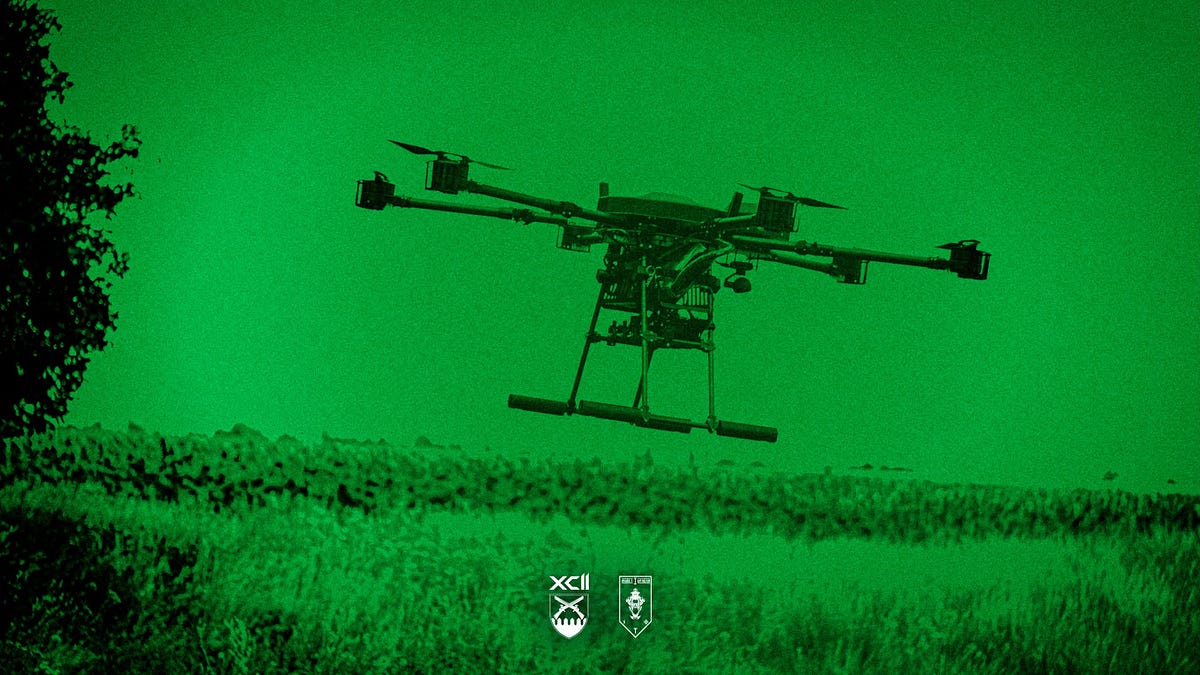
Photo: the heavy Vampire drone and its operators from the 1st Assault Battalion of the 92nd Separate Assault Brigade / Facebook Over the past couple of months, there have been many Ukrainian successes in defence innovation and its application on the battlefield. They exist first and foremost because of the talented teams working in Ukraine’s […]
Menej ako 1 min.
min.
Over the past couple of months, there have been many Ukrainian successes in defence innovation and its application on the battlefield. They exist first and foremost because of the talented teams working in Ukraine’s defence technology sector and the skilled, dedicated military personnel. The government’s role may be secondary, but it is instrumental in enabling industry and the defence forces to obtain what they need to work effectively.
Many of the successes we have witnessed were enabled by Defence Minister Fedorov and his team: their commitment to data-driven processes, human-centric warfare, and the removal of state barriers to effective cooperation among all actors in Ukraine’s defence ecosystem.
I will not devote much attention in my newsletter to everything Fedorov’s team achieved or to the reasons for its removal from the Ministry of Defence. Instead, I will continue focusing on the same subjects as before: technologies, tactics, adaptations, and iterations.
One thing is clear: his dismissal is a loss for Ukraine’s defence and a win for Russia. But the war goes on, and I would like to keep supporting Ukraine in every way I can.
Yesterday, we managed to close the fundraiser for a drone for my friend’s battalion in record time, and the Mavic will soon be heading to the frontline! Thank you to everyone who donated!
After such a long intro, let’s move on to the recent developments in drone warfare.
Baba Yaga drones are making headlines again. They have now become instrumental in what Russians describe as the “new assault tactics” of Ukraine.
Since Russians like to demonize something, I have combined reporting on the Baba Yaga—Russia’s name for the large Vampire multirotors—with reports on the so-called Martian drones, another Russian nickname, this time for the Hornet drones.
In this edition:
-
Vampire, or “Baba Yaga,” Drones: New Tactics for Frontline Logistics;
-
The Hornet Carousel: Why Quantity Matters;
-
Russians Refine the Concept of Modern Anti-Drone Air Defence.
Thank you for reading and supporting my work!
In addition to these three long reads, I also publish the weekly two-page Ukraine Drone Brief, featuring a concise list of the latest drone-related developments.
Vampire, or “Baba Yaga,” Drones: New Tactics for Frontline Logistics
Russian military channel Ramzay describes an emerging transformation in Ukrainian infantry assault tactics and frontline logistics:
-
Ukrainian infantry is increasingly infiltrating positions in small, lightly equipped groups. Individual vehicles and convoys are still used and can sometimes succeed, but dense vegetation allows Ukrainian troops to move more covertly and approach positions on foot.
-
Assault troops cross the kill zone without carrying heavy equipment. Instead of transporting all their supplies themselves, Ukrainian units increasingly rely on aerial delivery once they reach a designated area.
-
Heavy drones are used to equip fresh assault groups directly near the frontline. According to Russian military channels, “Baba Yaga” heavy multirotor drones deliver body armour, ammunition, FPV drones, Starlink terminals, heavy weapons and other supplies.
-
Once equipped, the assault group can rapidly advance toward its objective. Russian observers argue that this approach is effective because soldiers do not have to carry heavy equipment for dozens of kilometres before launching an attack.
-
Ukrainian logistics has not disappeared; it has moved into the air. What began as isolated drone-delivery missions has reportedly evolved into a more systematic aerial resupply network.
-
This creates new challenges for Russian assault units. Positions that previously may have been held by exhausted Ukrainian soldiers with rifles and limited ammunition can now unexpectedly contain well-equipped troops with anti-tank weapons or heavy machine guns.
-
Russian channels question whether their own forces can replicate this tactic. They argue that doing so would require a sufficient number of genuinely operational heavy-lift drones or unmanned ground vehicles.
-
They also express scepticism about official claims regarding the scale of Russian robotic logistics. Although Russian media frequently report the deployment of thousands of unmanned supply platforms, the author implies that the number of systems actually operating on the frontline is considerably smaller.
In April, AIN reported that a Ukrainian military unit used satellite-internet control technology on Vampire heavy-lift drones. This allows operators to control the drones remotely from more than 1,100 kilometres away from the frontline.
This technology is particularly valuable in areas where unmanned ground vehicles cannot operate because of difficult terrain and where conventional drone-control links may be disrupted by Russian EW.
The main requirement for this technology is a stable internet connection. A special control module is integrated into the drone, allowing command signals to be transmitted through a satellite communications channel. Once connected, the operator gains full control and can conduct frontline missions while remaining hundreds of kilometres away from the fighting.
The system uses remote-control boards produced by a Ukrainian manufacturer.
The unit says signal latency is minimal and is not noticeable at the Vampire’s operating speeds. Starlink imposes a speed limit of approximately 70–90 km/h on the platform carrying the terminal, but this is not a major issue because the Vampire cargo drone normally flies at no more than 50–60 km/h.
Operators only need to monitor the drone’s speed in strong tailwinds, when it may approach the Starlink terminal’s operating limit.
Several satellite-controlled drones can be launched from the same position. Unlike conventional radio-controlled systems, they do not interfere with one another’s signals.
The unit claims that an operator can learn to control the satellite-linked Vampire drone in approximately five days.
Russian forces are increasingly trying to track and intercept Ukrainian Vampire drones. This has become particularly noticeable around Kostiantynivka, where Russian forces have reportedly shot down such drones more frequently in recent months, disrupting supplies to Ukrainian troops operating inside the city.
Russian forces reportedly identified one of the launch sites used for heavy cargo-drone missions. They then expended four Gerbera decoy drones in an attack on that location, underscoring the operational importance they attach to disrupting Ukrainian aerial logistics.
Russian radar systems are also helping detect Ukrainian drones and facilitate their interception. In November 2025, Ukrainian electronic-warfare specialist Serhii “Flash” Beskrestnov told Defence Express that Russia’s SKVP radar accounted for approximately 90% of its overall counter-drone surveillance system. SKVP stands for System for Airspace Monitoring.
At the time, he warned that unless Ukraine fundamentally changed the situation, Russian forces could eventually destroy virtually all Ukrainian reconnaissance drones.
The SKVP radar can reportedly detect unmanned aerial vehicles at ranges of up to 20 kilometres. Once a drone is detected, Russian interceptor-drone operators are directed toward it.
Interceptor-drone crews are usually positioned approximately 2–5 kilometres from the radar, allowing them to respond quickly to detected Ukrainian UAVs. This radar–interceptor combination has become a major threat not only to Ukrainian reconnaissance UAVs but also to heavy-lift drones used for frontline resupply.
Here is my earlier report: “Baba Yaga” Drones in Ukraine: Key Trends.
The Hornet Carousel: Why Quantity Matters
Hornet strike drones have become one of the key factors behind the “logistics lockdown” in Russian-occupied territories of Ukraine. Roads across southern and eastern Ukraine are now littered with hundreds of burned-out fuel tankers and trucks. Check out my earlier long read: Drone warfare in Ukraine: Hornet strike drones.
The first reports of the American-made Hornet drone focused on its use by the Azov Corps in occupied Donetsk and Mariupol. Since then, new accounts of Hornet operations have continued to emerge, and several elite Ukrainian units are now known to have employed the system.