For South African business leaders, BRICS needs to become more than a political forum. Their priorities are increasingly practical: easier access to member markets, better cross-border payment solutions, more trade finance and more efficient transport links. This matters beyond South Africa. Africa is becoming an increasingly important arena for trade and investment, bringing BRICS countries, […]
Menej ako 1 min.
min.
For South African business leaders, BRICS needs to become more than a political forum. Their priorities are increasingly practical: easier access to member markets, better cross-border payment solutions, more trade finance and more efficient transport links.
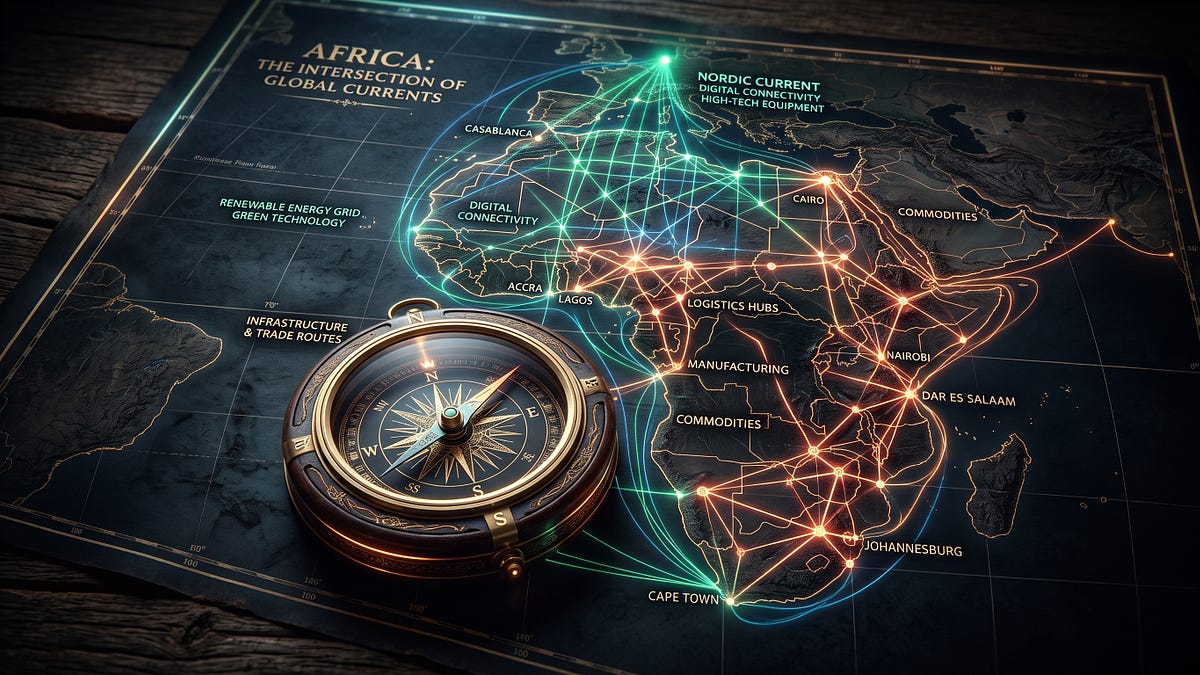
This matters beyond South Africa. Africa is becoming an increasingly important arena for trade and investment, bringing BRICS countries, the European Union and Nordic companies into closer competition.
Following a high-level meeting in Johannesburg, the South African BRICS Business Council has begun consultations with companies and other stakeholders. The aim is to identify practical obstacles to trade with BRICS+ countries and bring a more business-oriented agenda to the BRICS summit in India in September.
As Mtho Xulu, chairman of the council’s trade and investment working group, has argued, political cooperation ultimately needs to translate into actual business.
That means improving export finance, making cross-border payments easier, strengthening logistics and helping companies find customers in new markets.
For South Africa, the issue is particularly important. Trade with the other BRICS countries reached around $62 billion in 2025. But the balance remains uneven: imports were approximately $38 billion, compared with exports of $23.2 billion.
South African exports are also heavily dependent on commodities. Minerals, metals and agricultural products account for roughly 85 percent of export value, leaving the economy exposed to changes in commodity prices and global demand.
The challenge is therefore to move further up the value chain, with greater exports of processed products, industrial goods, specialised equipment, technology and professional services.
South Africa’s approach reflects a wider shift across Africa. The continent needs investment in energy, infrastructure, digital services and industrial capacity, while its mineral resources are becoming increasingly important to the global energy transition.
BRICS gives African countries additional economic partners. China, India, Russia and Brazil are all expanding their engagement with the continent, giving African governments more options when negotiating trade, investment, financing and technology.
The key question is whether these relationships will help build local industry and processing capacity, rather than simply increase exports of raw materials.
This is where the changing African landscape becomes directly relevant to the Nordic countries.
Sweden, Denmark, Finland and Norway are relatively small, export-dependent economies with strong positions in green technology, energy, mining equipment, telecommunications, transport, shipping and digital services[cite: 2]. Many of these sectors correspond closely with Africa’s infrastructure and development needs.
The opportunity is obvious, but so is the competition.
South Africa wants to strengthen its own industrial base and increase exports of processed goods. Chinese and Indian companies already have substantial capabilities in infrastructure, manufacturing and technology. As BRICS trade becomes more practical and interconnected, Nordic companies may face stronger competition in markets where they have traditionally relied on technological expertise.
That means Nordic companies will need to compete not only on technology, but also on financing, local partnerships and knowledge transfer.
The European dimension is equally important.
Sweden, Denmark and Finland conduct much of their trade policy through the European Union, while Norway has its own relationship with the EU internal market through the European Economic Area. What happens in EU-Africa relations will therefore have direct consequences for Nordic businesses.
A credible European approach should not be based primarily on aid or warnings about geopolitical competition[cite: 2]. It should offer trade, investment and long-term partnerships in which African countries see clear economic benefits[cite: 2].
European debate often views the expanding role of BRICS in Africa mainly through the lens of geopolitical competition. That risks overlooking why many African governments are seeking a wider range of economic relationships.
They want access to capital, technology and markets, but also greater control over how their economies develop. The emergence of several competing external partners gives them more room to negotiate on their own terms.
For Europe, this should not automatically be seen as a threat. It is a sign that the relationship with Africa is becoming more balanced and more competitive.
For the Nordic countries, that change presents a choice. They can view the growing BRICS presence primarily as a challenge, or they can look for areas where Nordic expertise and African development priorities overlap.
South Africa’s future BRICS presidency in 2028 could provide another opportunity to shape the group’s economic agenda.
The question for the Nordic countries is therefore becoming increasingly important:
How should we engage with an Africa in which BRICS carries greater economic weight?
The answer may be neither to treat BRICS simply as a competitor nor to see it automatically as a partner.
It may be to recognise that it is becoming both.
The author’s views are their own and do not necessarily reflect the blog’s.
📌 Subscribe to Think BRICS for weekly geopolitical video analysis beyond Western narratives. Follow also our new channels BRICS Business and Think BRICS Chronicles.