We are pleased to republish an article by Igor Zelezetskii and Ann Rutledge, whose distinguished experience in financial services and credit analytics offers valuable insight into the evolving frameworks of economic resilience and sustainable finance. We extend our sincere appreciation to the authors for contributing their expertise to our platform. In 2023, the United States […]
Menej ako 1 min.
min.
We are pleased to republish an article by Igor Zelezetskii and Ann Rutledge, whose distinguished experience in financial services and credit analytics offers valuable insight into the evolving frameworks of economic resilience and sustainable finance. We extend our sincere appreciation to the authors for contributing their expertise to our platform.
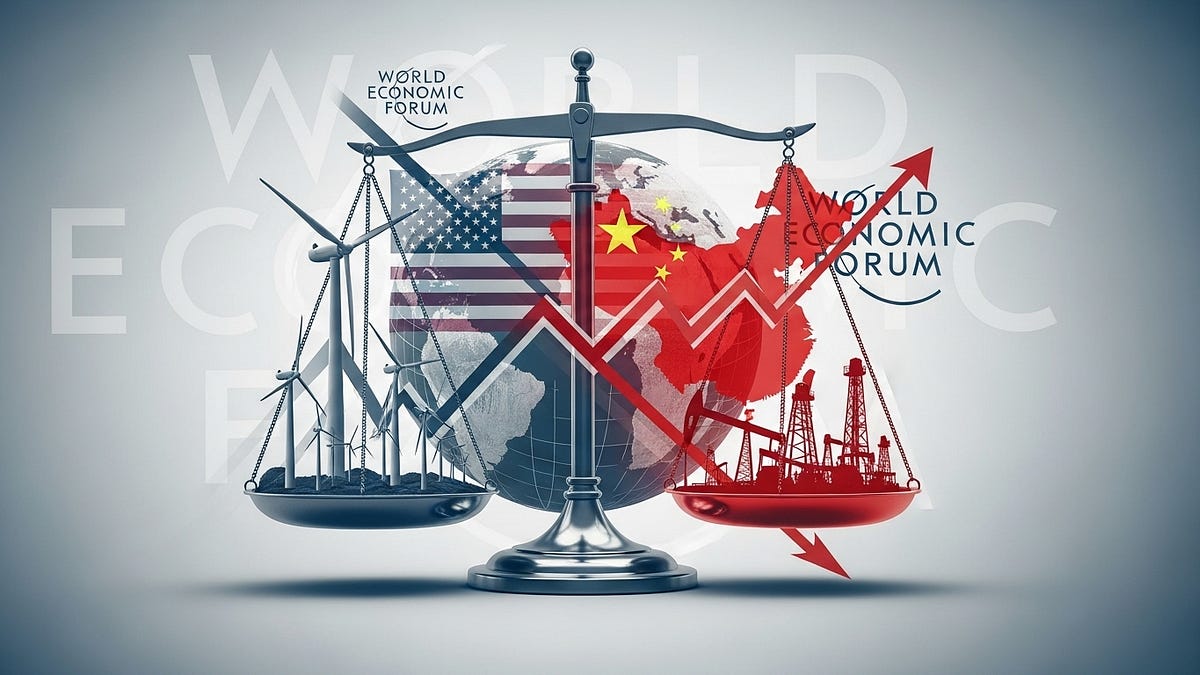
In 2023, the United States ranked 12th in the World Economic Forum’s Energy Transition Index; China ranked 17th.¹ By 2024, these positions had reversed: China held at 17th while the United States dropped to 19th.² For the first time, the world’s two largest economies had traded places in the most widely cited global benchmark for energy transition progress. The 2025 rankings confirmed and widened this reversal: China climbed to 12th (its highest ever) while the United States moved to 17th.³
For readers unfamiliar with the ETI, the framework measures “effective” energy transition across two broad blocks: system performance (whether an energy system delivers security, equity, and sustainability) and transition readiness (whether enabling conditions exist to sustain progress). The index has evolved considerably since its 2018 launch, but its basic architecture, system performance plus transition readiness, has remained stable. The question is what happens at the indicator level: whether annual revisions represent genuine methodological improvement or something closer to redefinition.
The trajectory presents a striking paradox. The United States fell to its lowest position (19th) in 2024 under the Biden administration, which pursued relatively climate-friendly policies and maintained the Inflation Reduction Act’s clean energy incentives.⁴ Yet the U.S. recovered to 17th in 2025 under the Trump administration, which systematically dismantled climate policy: withdrawing from the Paris Agreement, gutting renewable energy tax credits, suspending offshore wind development, and exiting the UN Framework Convention on Climate Change entirely.⁵ A greener policy environment produced a worse ranking; a fossil-friendly policy reversal produced a better one.
Meanwhile, China moved in a consistent direction, pouring unprecedented capital into clean energy until renewables reached 50% of its electricity mix.⁶ Carbon Brief identified 2025 as the first year in which clean power generation drove a decline in Chinese emissions.⁷
That China rose while investing heavily in decarbonisation seems straightforward. That the United States improved its ranking while retreating from climate commitments requires explanation. The answer lies partly in what each country did, and partly in how the measuring instrument itself was recalibrated. During this same period, the ETI underwent significant methodological revisions. These changes altered how the index processes institutional risk, governance quality, and investment patterns.
The World Economic Forum’s Energy Transition Index has attracted sustained criticism from both Western and Eastern scholars.⁸ Western critiques typically focus on aggregation choices and the risks of treating a composite index as a transition leaderboard.⁹ Scholarship from China and other non-Western contexts has questioned the ETI’s fit with heterogeneous development models, often adapting rather than rejecting the framework.¹⁰ This article joins that tradition but with a different emphasis: rather than revisiting issues of usage or cross-country comparability,¹¹ it examines the ETI methodology as an evolving construct, one increasingly designed to remain relevant in a world shaped by two structurally different energy systems.
From this perspective, the ETI’s design choices can be read not simply as technical compromises, but as attempts to accommodate divergent models of energy transition while preserving the index’s global legitimacy.¹² The analysis traces methodological evolution from 2021 to 2025 and advances an interpretive hypothesis: that the pattern of revisions reflects a continuous balancing act, recognising China’s genuine achievements while cushioning the United States from the full consequences of its policy reversals.
The ETI is not a decarbonisation leaderboard. This is often misunderstood. Since around 2023, the index rests on a philosophical premise: that an energy transition is only “effective” if it simultaneously delivers security, equity, and sustainability.¹³ These three imperatives carry equal weight in the system performance score. Sustainability, the dimension most closely associated with climate progress, accounts for just one-third.¹⁴ A country that decarbonises aggressively but experiences grid instability or price spikes will score lower than one that transitions slowly while maintaining reliable, affordable supply.
This architecture rewards incumbency. Countries with large domestic fossil reserves, diversified fuel mixes, and energy self-sufficiency accumulate points for security regardless of emissions trajectory. The United States ranks first globally in energy security precisely because of its hydrocarbon abundance.¹⁵ That structural advantage persists even as climate policy deteriorates.
Beyond system performance, the ETI measures “transition readiness”: the enabling conditions that determine whether a country can sustain progress. This dimension covers regulation, infrastructure, investment climate, human capital, and innovation. Most of the methodological volatility has occurred within transition readiness, and the distributional consequences of indicator choices are most apparent in this dimension.
The ETI’s audiences matter for understanding why these methodological choices are consequential. Media organisations use headline rankings to construct narratives about national energy performance: “Country X overtakes Country Y” stories that shape public perception. Policymakers treat the index as a benchmarking tool, using relative position to justify (or criticise) domestic energy strategy. Investors consult ETI scores as one signal among many for country risk and clean energy capital allocation. Advocacy groups and think tanks cite rankings to legitimise arguments about transition progress or failure. If the ETI functions as a reputational scoreboard for national energy policy, then methodological churn has outsized narrative power, changing what “progress” means before the headline is even written.
The ETI is not a fixed ruler applied consistently over time. Between 2021 and 2025, it has been substantially reconfigured. Indicators have been added and removed. Weights have been adjusted. Dimensions have been reorganised. Metrics have been renamed. WEF presents these changes as technical improvements: better data sources, broader coverage, enhanced statistical robustness. This may be true. But the result is an index that measures something different each year, making longitudinal comparison unreliable.
The conceptual problem here runs deeper than data quality. In a traded index like the S&P 500, swapping constituents is normal: members enter and exit based on market capitalisation, and the basket rebalances accordingly. But ETI is not a traded index. It purports to measure something about reality: how effectively countries are transitioning to clean energy systems. When inputs change annually, the “measurement” becomes unstable. This happens not because reality shifts, but because the instrument itself is being recalibrated. What appears as methodological refinement may be indistinguishable from moving the goalposts.
Consider the scale of change. In 2021, the ETI’s tenth anniversary edition covered 115 countries with 39 indicators organised across six enabling dimensions.¹⁶ The methodology explicitly emphasised decarbonisation urgency, with weights adjusted *”to reward countries moving away from fossil fuels.”*¹⁷ China ranked around 68th; the United States sat in the advanced tier but outside the top ten.¹⁸ By 2022, following the energy crisis, WEF emphasised resilience and security.¹⁹ In 2023, governance was no longer separately highlighted but *”treated as part of composite indicators.”*²⁰ That year, China entered the top 20 for the first time while the United States ranked 12th.²¹ The 2024 edition expanded the indicator set to approximately 46 metrics.²² The 2025 edition removed five indicators, introduced new composites, and renamed several metrics: “Carbon prices” became “Net-effective carbon rates,” “Quality of education” became “Labour market competitiveness,” and “Public R&D spend” became *”R&D as share of GDP.”*²³
The net effect has been to shift the index away from governance and institutional durability toward investment scale, innovation capacity, and market-facing signals. This shift favours some countries over others.
The removal of Rule of Law as a standalone indicator is the most analytically significant change in the 2025 methodology. Previously sourced from the World Bank’s Worldwide Governance Indicators, this metric had served as a direct proxy for institutional durability, measuring the extent to which agents have confidence in the rules of society, including contract enforcement, property rights, and the courts.²⁴ Its removal from the 2025 framework²⁵ eliminated a metric that had been present since the index’s early editions.
The conventional interpretation is that eliminating this metric benefits China by removing an indicator on which Western governance indices have historically penalised it. But this reading is too simple.
The premise that Rule of Law is structurally U.S.-friendly depends on the assumption that American institutional quality remains high. External governance indices tell a different story. The World Justice Project’s Rule of Law Index has recorded declining U.S. scores across multiple dimensions in recent years.²⁶ V-Dem’s Liberal Democracy Index shows measurable deterioration in institutional quality.²⁷ Freedom House has downgraded American scores on civil liberties and political rights.²⁸ These are not marginal movements. They document a trend of democratic backsliding.
The policy developments of 2025 reinforce this concern. Executive challenges to court authority.²⁹ Efforts to use the judiciary to pressure the Federal Reserve.³⁰ Attacks on regulatory agency independence.³¹ Politicisation of law enforcement.³² Threats toward allies, including public statements regarding Denmark and Greenland.³³ These represent measurable erosion in precisely the institutional qualities that Rule of Law indicators capture.
ETI 2025 itself acknowledges the problem in general terms, noting that *”in some regions, a diminished rule of law further undermined policy effectiveness.”*³⁴ The language does not name the United States, but it supports recognition that rule of law is not static and that some advanced economies may be backsliding.
If so, had Rule of Law remained a standalone indicator in 2025, it might have penalised the United States more severely than in any previous edition. The historical assumption that America outperforms China on rule of law may no longer hold, or the gap has narrowed substantially. The removal of the indicator therefore does not merely eliminate a potential drag on U.S. scores. It may have eliminated precisely the metric that would have made American institutional deterioration most visible.
WEF’s stated rationale for the removal (improving data consistency and statistical robustness³⁵) is methodologically defensible. Governance indicators are perception-based, lag real-world events, and exhibit cultural bias. Reducing reliance on such variables has legitimate justification. But the timing creates an unavoidable optic: a governance indicator disappears just as governance in the world’s largest economy comes under unprecedented strain.
While the Rule of Law removal arguably cushioned the United States, the introduction of “Economic freedom and investment in clean energy” worked in the opposite direction, systematically favouring China.
The indicator combines two components: an “economic freedom” element capturing market openness and business environment, and a “clean energy investment” element capturing capital flows into low-carbon technologies.³⁶ Its assignment to both the “Regulation and political commitment” and “Finance and investment” sub-dimensions amplifies its influence on the overall score.³⁷ WEF’s stated purpose was to *”improve coverage of macroeconomic enablers in the energy transition.”*³⁸
China performs exceptionally on these dimensions. It attracts roughly 40% of global clean energy investment.³⁹ Its industrial policy provides sustained, clear signals to investors in prioritised sectors. Five-year plans may constrain political freedom, but they are not uncertain. They deliver the policy predictability that capital-intensive, long-dated energy projects require. The indicator rewards exactly what China does: policy-backed investment at unprecedented scale.
The United States faces headwinds on both components under current policy conditions. Tariff escalation (reaching 145% on Chinese imports with retaliatory measures throughout 2025)⁴⁰ undermines the economic freedom element. The elimination of IRA tax credits⁴¹, suspension of offshore wind leases⁴², and politicisation of ESG investment⁴³ undermine the clean energy capital component. While the ETI does not single out specific policies, these developments plausibly weaken U.S. scores on precisely the dimensions the new indicator measures.
Beneath the indicator-level changes lies a fundamental contrast in governance approaches that the ETI must somehow accommodate.
China represents state-directed deployment with policy coherence: industrial planning provides investment certainty, capital flows into prioritised sectors at unprecedented scale, and workforce development aligns with transition needs. China’s 56-place improvement since 2021⁴⁴ reflects genuine achievements: world-leading clean energy investment, manufacturing capacity, and deployment scale. Its emissions trajectory may have reached an inflection point.⁴⁵ These are real accomplishments, and any index should capture them. China retains structural weaknesses; it remains the world’s largest greenhouse gas emitter, responsible for approximately 30% of global emissions.⁴⁶ but the ETI’s methodological evolution has created alignment with China’s development model.
The United States under the Trump administration represents the opposite: institutional volatility with high legacy capacity. Fossil reserves provide security; capital markets provide depth; innovation ecosystems remain world-leading. But regulatory predictability has collapsed, climate commitments have reversed, and the legal framework for long-term investment has become unstable. ETI 2025 itself links “rising tariffs” and “volatile capital markets” to *”delayed infrastructure and higher financing costs.”*⁴⁷ The tariff war (175% on Chinese solar panels, 195% on polysilicon, 100% on electric vehicles)⁴⁸ constrains U.S. deployment even when framed as industrial policy. China’s retaliatory export controls on rare earths threaten supply chains globally.⁴⁹
In aggregate, the methodology rewards what the United States has (scale, fossil reserves, innovation capacity) while muting what it is losing (institutional stability, regulatory predictability). The renamings reinforce this pattern: “R&D as share of GDP” captures private-sector research where the U.S. remains strong, and “Labour market competitiveness” favours the large, flexible American workforce. The distributional consequences are real, even if WEF describes all changes as generic methodological improvements.
The ETI’s reliance on ordinal rankings rather than cardinal measurement compounds the interpretive difficulty. In an ordinal system, a country’s position reflects not only its own performance but the performance of all others. The United States could rise from 19th to 17th without improving at all, if two peer countries deteriorated faster. A country making genuine progress can fall if competitors improve more rapidly. The headline number communicates nothing about whether a country is on track for net-zero; it signals only relative positioning in a shifting field. A cardinal approach would measure distance from fixed benchmarks: emissions intensity targets, renewable penetration thresholds, institutional quality floors. Progress would then mean movement toward the goal, not relative positioning. WEF acknowledges the limitation in its methodology appendix, advising that *”country rankings should be considered in the context of a country’s unique circumstances and not a clear-cut diagnosis of energy transition accomplishment.”*⁵⁰ But this caveat sits buried while headline rankings dominate public discourse.
An uncomfortable question hovers over this analysis. Is the ETI’s perpetual recalibration a sincere search for optimal measurement, or does it reflect pressures to produce rankings acceptable to major stakeholders?
Nothing in this analysis claims that WEF designed methodology changes to benefit particular countries. But there are structural pressures to consider. The Forum depends on engagement from the world’s major economies. An index that consistently produced results deeply embarrassing to the United States or China would generate institutional friction.
The pattern of changes between 2021 and 2025 has a curious quality. Modifications that benefit China (the investment-weighted composite, R&D intensity emphasis, governance dilution) are accompanied by modifications that cushion the United States (Rule of Law removal, Economic Freedom smoothing, security weighting, labour market framing). The net result allows China to overtake while limiting the visibility of U.S. deterioration.
This pattern is consistent with a methodology functioning as a perpetual balancing act. China’s rise is recognised; U.S. face is saved. The gap reverses but remains narrower than underlying fundamentals might suggest. Each annual revision recalibrates without producing results that would alienate either power.
Methodological improvement is legitimate. Data sources change. Analytical frameworks must adapt. The 2022 energy crisis genuinely required security reconsideration. There are defensible reasons for each individual change. But the cumulative effect is an index that moves in directions convenient for stakeholder management. Users seeking objective measurement should take note.
If the ETI is to evolve beyond its current limitations, several directions merit consideration.
The most fundamental would be contextual realism: an analytical layer assessing transition feasibility relative to each country’s structural conditions, legacy dependencies, and institutional constraints. The ETI currently asks what outcomes and enablers exist today. A contextual layer would ask what is realistically deliverable given where a country starts. This would require delivery realism indicators (permitting timelines, grid connection queues, curtailment rates, supply-chain concentration) that determine whether announced projects can actually be built. It would require recognition that countries with high fossil dependence face different challenges than those starting from cleaner baselines. It would require institutional durability measures capturing whether commitments are legally enforceable and likely to persist across electoral cycles.
Such an approach should also recognise and reward effort relative to structural difficulty. Countries facing greater obstacles, whether due to historical patterns of energy dependence, limited capital access, or challenging geography, expend more effort to achieve the same outcomes as countries starting from favourable positions. A poor country that builds modest renewable capacity against significant headwinds may demonstrate greater transition commitment than a wealthy country that expands clean energy from an already-advantaged position. Similarly, a historically coal-dependent economy that achieves measurable diversification may warrant recognition beyond what a raw distance-from-benchmark score would suggest.
A shift to cardinal benchmarking would address the ordinal measurement problem. Progress would mean movement toward fixed targets (emissions intensity thresholds, renewable penetration goals, institutional quality floors) rather than relative positioning among shifting peers.
Beyond indicator selection, the deeper issue is measurement governance. A credible index would operate under explicit stability rules limiting annual indicator churn, perhaps requiring that core metrics remain unchanged for a minimum period, with back-casting showing how past scores would have differed under any new methodology. It would include a validation framework demonstrating that its indicators actually predict transition success, not merely correlate with each other. It would specify how external feedback is integrated and how contested methodological choices are adjudicated. The number of variables matters too: forty or more indicators creates opacity and allows distributional effects to accumulate in ways that are difficult to trace. A leaner framework would be harder to manipulate through selective reweighting and easier for users to interpret. Without such governance infrastructure, annual redesign risks reflecting stakeholder management rather than analytical refinement.
The Energy Transition Index remains a valuable contribution to global energy discourse. Its systematic framework, comprehensive coverage, and annual updates provide benchmarks that inform policy and investment decisions. But it must be read with awareness of what it measures and what it obscures.
The U.S.–China ranking dynamics reveal an index whose annual revisions produce results convenient to both powers: China’s genuine transition achievements are recognised, while American institutional deterioration is partially masked. Whether this reflects deliberate accommodation or coincidental methodology is less important than recognising the pattern exists.
For those seeking more reliable measurement, the reforms outlined earlier offer a path forward: contextual realism that weighs progress against starting conditions; effort-adjusted scoring that recognises structural difficulty; cardinal benchmarks that measure distance from fixed targets rather than relative positioning; and governance infrastructure that limits indicator churn and validates predictive power. These changes would not eliminate subjectivity (no composite index can) but they would make the ETI’s judgments more transparent and its year-to-year comparisons more meaningful.
Some critics may go further, arguing that composite indices like ETI cannot deliver credible measurement under any design: that the combination of perception-based inputs, stakeholder pressures, and annual recalibration produces something closer to pseudo-measurement than genuine analytical signal. This article takes a more reformist view: that ETI can be improved with governance reforms and methodological discipline. But readers should be aware that the sceptical position has merit, and that reliance on any single index to capture something as complex as “energy transition progress” carries inherent risk.
For investors, policymakers, and analysts, the appropriate response is not to dismiss the ETI but to interpret it with appropriate caution. Rankings should be contextualised by methodology. Headline numbers should be decomposed into constituent dimensions. And the fundamental question (Is this country actually transitioning to a clean energy system?) should be answered by reference to physical deployment data and policy analysis, not index rankings alone.
WEF advises readers to *”interpret ETI scores in the context of each country’s structural realities.”*⁵¹ That guidance deserves more prominence than it receives. In a world where methodological calibration may be as important as underlying performance in determining who ranks where, understanding how the index works matters as much as knowing where countries stand.
Footnotes are availabe at the end of the original publication.
Join the Conversation:
📌 Subscribe to Think BRICS for weekly geopolitical video analysis beyond Western narratives.