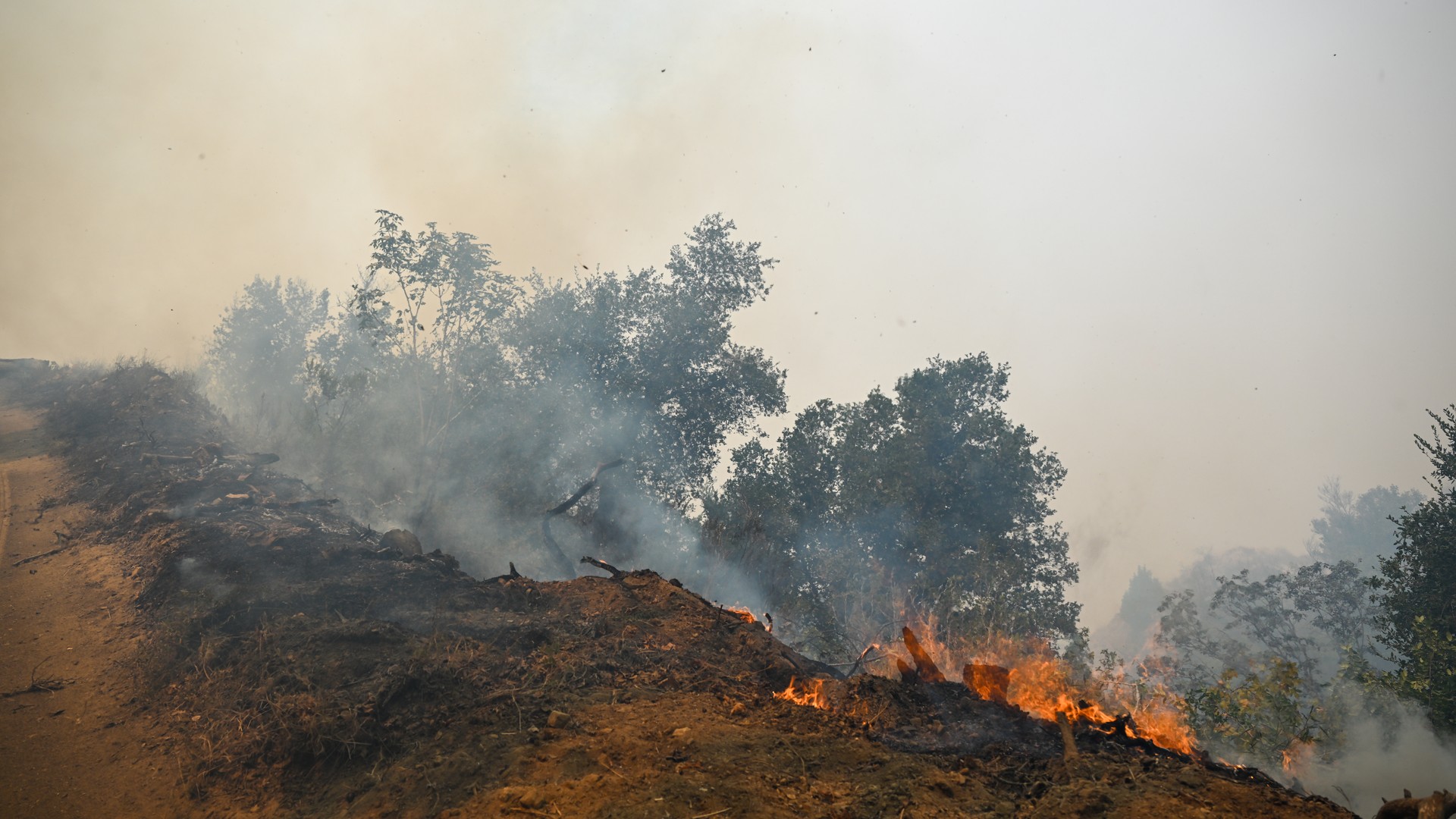
An already historic wildfire season is setting another tragic record. Federal data shows there have been 12 entrapments at this point in the year, six of which have been deadly. Entrapments occur when fire crews encounter a life-threatening situation while battling blazes because their escape route is compromised. Reuters, which analyzed the data from the […]
Menej ako 1 min.
min.
An already historic wildfire season is setting another tragic record.
Federal data shows there have been 12 entrapments at this point in the year, six of which have been deadly. Entrapments occur when fire crews encounter a life-threatening situation while battling blazes because their escape route is compromised.
Reuters, which analyzed the data from the Wildland Fire Lessons Learned Center, said this number is the highest year-to-date number of entrapments the U.S. has experienced in two decades.
Any number of entrapments, “even one, is a tragedy,” Joe Ten Eyck, the director of Wildland-Urban Interface Fire Programs for the International Association of Firefighters, told Straight Arrow.

Download the Straight Arrow app today to get the stories that matter free from manipulation, bias or agenda.™
Point phone camera here
“There’s been multiple entrapments, and some have resulted in fatalities, and some have resulted in burn center visits out there as well,” Ten Eyck said. “Where I get concerned, and what a passion of mine is, is the training side of it, and then after that, the leadership side of it.”
Part of the problem is the high number of wildfires in 2026 — and how they’ve been strengthened by weather conditions such as heat and droughts brought on by climate change.
Firefighters are currently responding to 48,000 fires that have burned at least 6.5 million acres of the U.S. as of Friday, according to the National Interagency Fire Center, which makes for, respectively, 126% and 155% of the 10-year averages.
Several active and retired firefighters who spoke to Reuters, as well as The New York Times, also expressed concerns about job cuts at the U.S. Forest Service under the Trump administration. This, combined with the push for a “full suppression” response from the federal government, has some fire personnel worried their colleagues are engaging in more dangerous behaviors to fight these fires.
“We just don’t have enough people in the system, not for this kind of fire season,” Mike Dudley, who retired in 2018 as a Forest Service regional director, told The New York Times. “We’re paying the price for it right now.”
Joe Stutler, a veteran fire incident commander who retired as the Deschutes County forester in Oregon, said in an interview with The Times that “nobody has all they need.”
“This is an extraordinary year,” Stutler said.
The Forest Service lost 6,000 jobs since President Donald Trump started his second term in 2025 through buyouts, early retirements and layoffs that include those recommended by the now-defunct Department of Government Efficiency.
As of July, 6, the Forest Service said on its website it had 11,816 wildland firefighters on board nationwide. Although this is more than its goal of 11,300 for 2026, it said it still “isn’t enough capacity to meet the needs of the continuing wildfire crisis.”
“This is the number of firefighters we are able to support with existing infrastructure, funding and other resources,” the Forest Service said.
The Forest Service said it boosts its firefighting capacity with “other agency staff and administratively determined (AD) emergency workers qualified to support fire management activities.”
Currently, the United States’ Wildfire Preparedness Level is at five out of five — the highest it can be. A Preparedness Level 5 means national resources are being committed at maximum capacity. Being at Level 5 nationally for a long period can strain these resources.
States in the West have been hit particularly hard. Four firefighters died battling the Knowles Fire in western Colorado after an entrapment on June 27.
U.S. Forest Service fire specialist Wesley Page, who works in Colorado, told Reuters that the concentration on full suppression might have made crews fighting Knowles act more aggressively than usual.
“In the middle of fire season, DOGE and the Trump administration’s policies and actions have weakened our ability to safely fight wildfires,” National Federation of Federal Employees President Randy Erwin said in a statement on Aug. 6.
Staffing was already a problem before the current administration as well.
Recruitment and retention of firefighters, Ten Eyck noted, has been an issue in the firefighting community for years.
“Staffing is an issue that is trying to be addressed,” Ten Eyck said. “I know at federal, state and local levels, we have insufficient staffing and insufficient training.”
Being short-handed in the field carries real consequences — including firefighters getting stuck with longer assignments. In Ten Eyck’s experience, he’s been on fires for 36, 48 and even 50 hours at a time.
“It affects how efficient you are because you’re not getting a break from the action, you’re not getting adequate rest,” he said. “But we’re in sustained combat. We’re doing rescue, evacuation of public structure defense, perimeter control using ground and air forces, and we can’t disengage because of what’s at stake there — people and their families.”
Agriculture Secretary Brooke Rollins and Interior Secretary Doug Burgum visited the National Interagency Fire Center in Boise, Idaho, on Tuesday, along with other federal, state and local leaders for a briefing about fires in the West.
She said in a statement on X that the federal government is “surging firefighters, aircraft, equipment, and other resources where they are needed most,” as well as “mobilizing resources across federal, state, local, and Tribal partners.”
“We will continue to surge every resource possible to protect our communities and support the brave men and women on our front lines,” Rollins said.
Other state and local government leaders have made similar commitments, Ten Eyck said, though he acknowledged change won’t come overnight.
“The key to that will be sufficient funding for those programs as well as sufficient training, so we can get the right amount of trained uniformed professionals on fire apparatus to be able to respond to these incidents,” he said.
What’s also needed is for firefighters to get “a livable wage with good benefits and the ability to retire with dignity,” Ten Eyck said, in order to ensure they stick around.