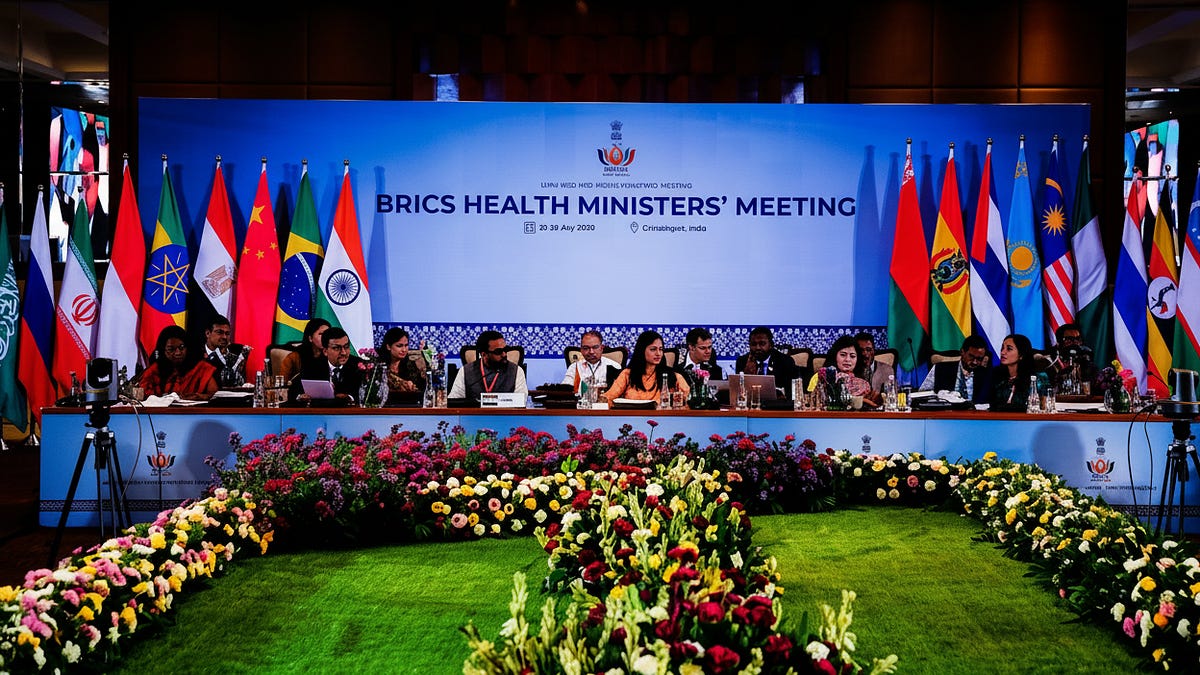
Chandigarh, India. July 2026 – For most of its history, BRICS health cooperation meant communiqués: warm language about solidarity, thin on follow-through. That changed this month in Chandigarh, where health ministers from the bloc’s eleven members closed their 16th meeting having done something rarer than a declaration — they built machinery. The group, which now […]
Menej ako 1 min.
min.
Chandigarh, India. July 2026 – For most of its history, BRICS health cooperation meant communiqués: warm language about solidarity, thin on follow-through. That changed this month in Chandigarh, where health ministers from the bloc’s eleven members closed their 16th meeting having done something rarer than a declaration — they built machinery.
The group, which now includes Brazil, Russia, India, China, South Africa, Saudi Arabia, Egypt, the UAE, Ethiopia, Indonesia and Iran, represents close to half the world’s population and roughly 40% of global GDP. Under the banner “Building for Resilience, Innovation, Cooperation and Sustainability,” the ministers moved to formalize a set of institutions designed to let Global South nations manage their own medical and social priorities, rather than inherit them from Washington, Brussels or Geneva.
The centerpiece is the BRICS Network of National Public Health Institutes, or BNN — a structure that designates a “center of excellence” within each member state to handle specific functions, from workforce training to genomic surveillance. The newly adopted Operational Framework for the BNN sets these institutes up as the bloc’s primary source of public health guidance, tuned to the epidemiological realities of member countries rather than priorities set elsewhere.
Alongside it, the bloc endorsed an Integrated Early Warning System for outbreak detection, backed by a dedicated coordinating secretariat. Ministers were careful to reaffirm the World Health Organization’s “vital coordinating role,” but the practical effect of standing up a parallel surveillance body — one built around member states’ own data ownership rules — is a step toward independence from Western-anchored monitoring systems, whatever the diplomatic language says.
The most consequential shift may be conceptual. Ministers formally adopted the Operational Framework for Fighting Diseases Driven by Social Determinants of Health, a policy largely shaped by Brazil during its 2025 chairship. It argues that tuberculosis, HIV and malaria are driven less by gaps in medicine than by poverty, food insecurity, poor housing and inadequate water and sanitation — and that treating those conditions is itself a health intervention.
That argument is now backed by a body, the SDH Action Council, tasked with pushing a “whole-of-government, whole-of-society“ approach across member states. It’s a deliberate break from a security-first framing of global health that has dominated Western policy since COVID-19, and it doubles as an implicit critique: if BRICS countries can move health outcomes through social policy rather than pharmaceutical firepower, it undercuts the premise that Western-style biomedical response is the only credible model.
The pandemic exposed how dependent Global South nations were on vaccine and diagnostic supply chains concentrated in a handful of Western economies. The bloc’s answer is what it calls the Health Economic Industrial Complex — an effort to pool India’s and China’s manufacturing scale with Brazilian and Russian R&D capacity into a self-sustaining medical production base.
Two vehicles anchor this: the BRICS Vaccine R&D Centre and a proposed e-R&D Hub, both aimed at localizing production and enabling voluntary technology transfer between members. Ministers also agreed to work toward common Good Clinical Practice standards and mutual recognition of drug approvals — groundwork for a regulatory environment that doesn’t run through Western patent regimes or depend on Western supply.
The bloc also created an Expert Working Group on Traditional, Complementary and Integrative Medicine (TCIM), formally folding practices like Ayurveda, Unani, Afro-Brazilian healing traditions, and Chinese, Iranian and Egyptian herbal medicine into national health systems as part of universal health coverage. The framework aims to harmonize safety and quality standards while protecting the intellectual property of the communities that originated this knowledge — a hedge against the kind of extraction critics have long associated with Western pharmaceutical interest in traditional remedies. It’s also a lower-cost alternative to branded pharmaceuticals for populations priced out of them.
None of this works without financing, and BRICS is routing that through its own institutions rather than traditional donors. The New Development Bank (NDB) is being asked to open a dedicated funding window for social-determinants infrastructure — primary health centers, water and sanitation systems, housing — in high-burden regions. Ministers are also weighing a BRICS Health Emergency Solidarity Fund, explicitly framed as an alternative to the Global Fund and Gavi, whose funding has historically come with conditions set by donor governments.
The economic logic isn’t hypothetical: research on BRICS economies has consistently linked health spending and GDP growth to measurable declines in infant mortality, giving the bloc’s finance ministers a data-backed case for the investment.
The bloc’s “Rare BRICS“ initiative tackles a problem donor-driven global health has largely ignored — orphan diseases too small a market to attract investment from Western pharmaceutical firms. Using Russia’s “Circle of Kindness” program as a template, the initiative aims to harmonize diagnostic standards and pool procurement across member states, making treatment for rare conditions viable in economies that couldn’t otherwise afford it alone.
The architecture is real, but far from settled. The Solidarity Fund’s mandate and funding formula remain unresolved, and members are still negotiating who contributes what. Data-sharing across eleven countries with different privacy laws and technical standards will take years to reconcile, not months. And the BNN secretariat, which rotates between member states, raises an obvious question about institutional memory once the founding team moves on.
There’s also an unresolved tension at the heart of the project: BRICS keeps insisting it isn’t trying to replace the WHO, even as it builds an early warning system, a manufacturing base and a financing arm that duplicate the WHO’s functions in all but name. Whether that produces genuine complementarity or a more fragmented global health system is likely to become clearer only after these institutions have run through a real crisis.
BRICS’ 2024 expansion gave it a geographic footprint spanning nearly every major region, and with it, more leverage in forums like the G20 and World Health Assembly. Through the “BRICS Plus“ outreach mechanism, the bloc intends to export these frameworks to other developing nations — starting with a digital “Compendium of Replicable Best Practices“ due for release later this year, drawing on India’s digital health infrastructure, China’s disease-control reforms and Brazil’s genomics programs.
China takes over the chairship in 2027, and attention will likely shift to whether these frameworks move the needle on the Sustainable Development Goals rather than just existing on paper. For now, what changed in Chandigarh isn’t the ambition — BRICS has talked about health sovereignty for years — but the fact that it now has institutions, budgets and a secretariat behind it.
📌 Subscribe to Think BRICS for weekly geopolitical video analysis beyond Western narratives. Follow also our new channels BRICS Business and Think BRICS Chronicles.