⏱️ Čas čítania: 25 min (4,925 slov) Proposed by Kyauk Ngar. Originally published on Medium. Republished with permission. Views expressed are the author’s own. “鸡蛋从外面打开是食物 从里面打开是新生” “An egg broken from outside is food; broken from inside is a new life.” A popular Chinese internet saying Consider the current crisis in the Strait of Hormuz. Political […]
20
min.
⏱️ Čas čítania: 25 min (4,925 slov)
Proposed by Kyauk Ngar. Originally published on Medium.
Republished with permission. Views expressed are the author’s own.
“鸡蛋从外面打开是食物 从里面打开是新生”
“An egg broken from outside is food; broken from inside is a new life.”
A popular Chinese internet saying
Consider the current crisis in the Strait of Hormuz. Political conflict has resulted in closing the passage, halting roughly 30 percent of global oil transport and sending shockwaves through the world economy. This is what happens when the world relies too heavily on a single choke point. The Malacca Strait is no different — it holds the same enormous economic and political significance, and the same vulnerability with consequences far more severe than what we are seeing in the Middle East. This is not a distant hypothetical. It is a warning.
When the international media covers Myanmar, the narrative is always the same. A simple morality play: courageous pro-democracy fighters battling an evil military junta. Human rights abuses. Sanctions. Condemnations from Western capitals. The usual script, recycled from decades of similar coverage of national conflicts in the global south.
This narrative is not merely incomplete. It is dangerous. It is dangerous because it obscures what Myanmar actually is: one of the most strategically significant pieces of geography on the planet. It frames the country’s turmoil through a lens that serves imperial interests while ignoring the aspirations of its people. This narrative is brought to the people through various elitist media networks. They distort the people’s vision of the real world. Economic development, technological and medical breakthrough, infrastructure development, and scientific and educational advancement are no longer the talking point of the people. They talk a lot about abstract concepts such as freedom, human rights, and democracy, and liberal political theatrics. This prevents them from seeing an extraordinary opportunity — an opportunity to transform not just Myanmar, but the entire economic landscape of Asia and beyond. An opportunity for great national pride and fortune.
This essay offers a different framing. It argues that Myanmar holds the key to connecting half the world’s population, that its stability is essential for the ecological future of the Malacca Strait, and that the current conflict cannot be understood — or resolved — without grasping these deeper geopolitical and economic dimensions. The essay is written in the conviction that the people of Myanmar, and the Global South more broadly, develop an ideological framework adequate to the movement: one that speaks the language of the people, understands the multi-polar world, and seizes the immense potential that geography and history have placed within reach.
A vision for the future.
The Malacca Strait is one of the most crowded, stressed, and ecologically threatened waterways on Earth. Over 100,000 ships now transit it annually, carrying more than $3 trillion in trade. The traffic is relentless. This takes a heavy toll on the local ecosystems. Coral reefs persist in “fair” to “poor” condition, yet scientists have discovered that some reefs in the strait show remarkable tolerance to bleaching — they could become global refugia if given the chance to recover. Dolphins, whales, and sharks still inhabit these waters, but they do so under constant assault from noise pollution, ship strikes, and habitat degradation.
The people living along the strait’s shores have inherited an impossible contradiction. They sit on one of the most ecologically and geographically diverse environments on Earth, rich with potential for ecotourism, sustainable fisheries, scientific research, and coastal livelihoods. Yet their waters have been transformed into a global highway. The economic benefits of this traffic largely pass them by, while the ecological costs accumulate on their shores.
What if this could be different? What if the traffic could be reduced, not by magic, but by design? What if an alternative route existed — one that relieved pressure on the strait, opened new economic possibilities for an entire nation, and integrated the Asian continent as never before? This is where Myanmar enters the picture.
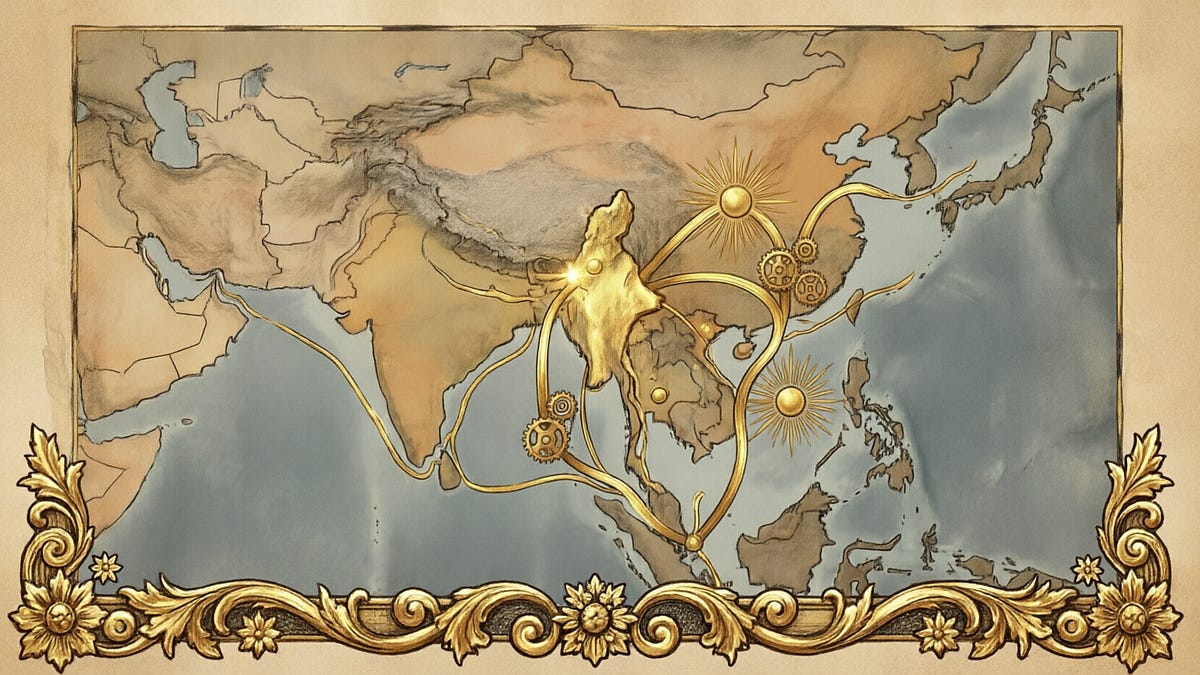
Look at a map of Asia. Really look at it. Notice how Myanmar sits at the precise intersection of the continent’s most dynamic regions. To the north lies China, with 1.4 billion people and the world’s largest economy. To the west sits India, with 1.4 billion people and the world’s fastest-growing major economy. To the south and east stretches ASEAN, a bloc of nearly 700 million people with rapidly industrializing economies. And to the west lies the Land of Rivers, Bangladesh, with 170 million people strong and a substantial economy, and beyond that, through the Indian Ocean, the Middle East and Africa — the former now diversifying their economy and the latter developing under unprecedented Chinese infrastructure and economic investment.
This is not just proximity. This is centrality. Myanmar is the land bridge that could physically connect the most populous and economically significant regions of the Earth. The scale of this potential is almost incomprehensible. A developed Myanmar corridor would directly connect China, India, ASEAN, and Bangladesh — approximately 3.65 to 4 billion people, or 40 to 50 percent of the world’s population. No other country on Earth sits at such a crossroads. No other single infrastructure project could integrate so many human beings into a shared economic space.
The China-Myanmar Economic Corridor, centered on the Kyaukphyu deep-sea port and its connecting railways, is the mechanism for this integration. The port, planned for ten berths with capacity for millions of containers, would provide China with direct Indian Ocean access — bypassing the congested Malacca Strait entirely. Goods from Africa, the Middle East, and Europe would unload at Myanmar’s ports and travel by rail directly into China’s most populated areas, reaching Kunming faster than they could transit the strait and fight through China’s coastal ports.
But the vision extends beyond China. The same infrastructure could channel goods not just from the Indian subcontinent but also from the Middle East and Central Asia into Southeast Asian markets. It could open Myanmar’s own economy to investment, job creation, and industrialization on an unprecedented scale. It could transform Myanmar from one of Asia’s poorest countries into its most dynamic crossroads — a land its people could proudly call “Htarni”: a Burmese term used to associate with the land and the people.
Here is where the two halves of this analysis connect. A functioning Myanmar corridor would not just benefit Myanmar. It would transform the entire region by relieving pressure on the Malacca Strait. Consider the arithmetic. If the Myanmar corridor captured even 20 to 30 percent of the traffic currently passing through the strait — particularly the large crude carriers and container ships heading for Chinese and ASEAN ports — the reduction in vessel traffic would be enormous. The strait would finally have room to breathe.
This would unlock a future where the strait transitions from being a global corridor to a global destination. Quieter waters would allow marine life populations to stabilize and grow. The Pulau Jarak-Segari area, already identified as a critical habitat, could become a world-class whale-watching destination. The resilient reefs of the strait, already showing tolerance to bleaching, could become global refugia — protected spaces where coral ecosystems survive and thrive, supporting biodiversity and attracting eco-tourists from around the world. Healthier fish stocks would revitalize small-scale fishing communities, allowing more access to sustainably caught seafood. Islands along the coasts could develop low-impact eco-lodges, mangrove kayaking tours, and cultural experiences that celebrate the region’s natural heritage. It would also allow more opportunities for marine research activities, furthering educational development of the region.
The economic benefits would flow not to international shipping companies, but to local communities. The ecological damage would be reversed, not accelerated. The people living along its shores would finally inherit the value their geography has always promised.
This vision, first and foremost, requires a Myanmar that is stable, sovereign, and capable of managing infrastructure on a monumental scale. The current Myanmar offers none of these things. And this is where the analysis must turn to the internal dynamics that have paralyzed the country since the 2021 coup. The situation in Myanmar is not a simple conflict between good and evil as the popular resistance likes to claim. It is a tragedy of two failures.
The State Administration Council, Myanmar’s military government, is not a coherent ideological alternative to anything. It is an inferior form of liberal government with economic and political monopoly on the country. Its leaders use the state for personal enrichment along with the cronies who benefit from unfair foreign investments. They promote cultural nationalism and traditionalism as populist tools to manufacture legitimacy, not as genuine programs for national revival.
When they engage with the Kyaukphyu port project, they do so within limits. The project will proceed only as far as their interests require. It will be constrained by military bureaucracy, by traditionalist mindsets that have not transcended Myanmar’s historical royalism, and by the ruling elite’s fear of any development that might empower forces outside their control. Mind you that Burmese monarchy was never officially abolished by its own people through a revolution but only relinquished by British rule in 1885. Under the current leadership, the economic corridor will be built — but it will be a stunted version. Inefficient. Crony-dominated. Incapable of unleashing the full potential that geography offers. The military government can imagine enough development to enrich itself. It cannot imagine enough development to transform the nation nor have the grand vision to transform the entire region as proven by their historical desire to maintain power through various tactics.
So, one thing is truly clear: the junta really must go.
The resistance forces opposing the military government present a different tragedy. While their intentions are genuine and their courage real, their ideological framework is a disaster.
The resistance speaks a language borrowed from Western liberal media. “Human rights.” “Democracy.” “Freedom.” “Authoritarian.” “Federalism.” These words mean something in the seminar rooms of American universities and the offices of European NGOs, but they mean very little to the working-class and rural populations who need to eat, to survive, to feed their children. The resistance’s only method of organizing is moralism. “Join us if you believe in good.” “We are fighting against the bad.” “We are morally righteous.” “The just shall prevail.” This is not politics. It is a children’s story. And the people, who understand that survival requires more than moral purity, are increasingly becoming indifferent — or worse, mocking the resistance in return. The resistance not only loses popularity in the lower class but also in the neighboring countries whom they blamed for “cooperating with the military junta.”
Since the coup, their approach has consisted largely of pleading with neighboring countries to “side” with them, to publicly condemn the junta and to cut ties with the military government. When these neighbors, predictably and understandably, prioritize their own national interests over the resistance’s demands, the response from the resistance is not a pragmatic reassessment but bitter accusation. The resistance doesn’t ask why any country would abandon stable, if imperfect, relationships for an untested opposition movement with no coherent vision. There is almost no sustained effort to build relationships, to foreground economic development, to understand regional concerns, to speak in languages that transcend beyond activist circles. They have failed to make the case that they, the resistance, can offer more in terms of economic partnership and regional stability than the junta can. And so, the neighbors continue to view Myanmar through the narrowest possible lens: a country plagued by decades of civil unrest, to be managed through endless calls for peace talks and an end to violence, not a potential partner in regional transformation.
At the same time, the resistance hopes for some form of interventionism from the West. When the coup happened, they rushed to Washington, London, and Brussels to ask for sanctions, for condemnations, for ideological and financial help. They framed their struggle in a way that Western audiences would understand and support. They became, in effect, the local franchise of a global brand — the “pro-democracy movement,” complete with the expected buzzwords for western audiences.
This orientation has been catastrophic. It has distanced the resistance from the Global South, whose nations see it as another “Western-backed pro-democracy” movement. It downplays the simple fact that the military government is indeed a brutal, self-serving ruling class. By dressing their struggle in Western clothes, the resistance has handed the junta an unexpected shield: the ability to frame its violent grip on the nation as a defense of national sovereignty against “foreign-backed interference”, obscuring its own rot behind the rhetoric of anti-colonial resistance. It has alienated the resistance from the workers and the peasants. It has blinded the movement to geopolitical reality, preventing them from understanding that their prosperous future lies with China, India, and ASEAN, not with distant powers that exploit their true struggle as a tool for “containing” rivals. This has created no positive vision, only offering opposition to the bad, not construction of the good.
This ideological weakness is not an accident. It is exploited. It is weaponized. The Western imperial powers have every interest in keeping Myanmar destabilized. A chaotic Myanmar is a problem for not just China but for the whole ASEAN community — a perpetual source of instability on its southwestern flank and a complication for Belt and Road (BRI) investments in the region. The “pro-democracy” framing serves this interest perfectly. It allows Western powers to pose as champions of freedom while actually pursuing strategic advantage. It turns a complex national struggle into a simple morality play that justifies sanctions, isolation, and pressure. The resistance, in its ideological dependence, becomes a tool of this game. They do not see it. They genuinely believe the West supports them because the West believes in democracy and human rights. At the same time, they are made blind to the on-going atrocities of the western powers, all thanks to the populist “pro-democracy” media agencies that largely reside abroad.
Meanwhile, the world is changing. The multi-polar order is emerging. The Global South is asserting its sovereignty, slowly but surely. The old unipolar world where the West could dictate terms and frame every conflict in its language is slowly withering away. New powers are rising. New cooperations are forming. New possibilities are opening up. The resistance downplays this development. Their media diet, their intellectual formation, their entire worldview has been heavily influenced by popular Western sources that tell them the old-world order still exists. They are fighting yesterday’s war with yesterday’s ideas, while tomorrow’s world takes shape around them.
Meanwhile, the military junta is not as oblivious to the changing world as the resistance is. They are actively working to secure a place on the global stage by speaking the language of the multipolar order. They understand, at least crudely, that playing into this rhetoric is necessary to maintain power. The major powers — China and Russia especially — are under no illusion about the junta’s incapability. Yet they engage with it nonetheless, not out of preference, but because the junta, whatever its flaws, at least recognizes the changing world. It does not come begging for sanctions or demanding they choose sides against their own interests. This is not favoritism. Just like the rest of ASEAN countries, their foreign policy toward Myanmar has been consistent regardless of who holds power in Naypyidaw. They deal with whoever rules, not because they endorse them, but because that is how relations between states work. The resistance, in its moralistic blindness, mistakes pragmatic engagement for endorsement, and in doing so, forfeits any chance of building and enriching the relationships they need, especially with ASEAN and major powers who hold enormous economic potential for the country.
If neither the military government nor the current resistance can realize Myanmar’s potential, then something else must emerge. A third force. A political movement adequate to the moment, a movement that represents the deep interest of the people. This third force is not necessarily an emergence of another faction, but rather an ideological transformation of the current resistance force through collective actions of those who believe in the multi-polar world order. The current resistance is a perfect body because the will is there. The intention is there. The raw energy is there.
What would this force look like? It would be encouraged to speak the language of the people. Not Western buzzwords, but the actual concerns of working-class and rural Myanmar: food security, jobs, education, healthcare, and economic opportunities. It would be guided to translate the abstract potential of the economic corridor into concrete promises: “This port means work for our children. This railway means our goods reach markets. This development means we eat; we live; we thrive.”
It would embrace the multi-polar world. It would understand that Myanmar’s future lies with its neighbors — with China, India, Thailand, ASEAN. It would practice strategic diplomacy and understand that in a multi-polar world, influence comes from strategic relationships, not moral posturing. It would build ties with Global South nations that share Myanmar’s aspirations for genuine sovereignty and development. It would position Myanmar as a bridge between civilizations, not a client of any single power.
The raw materials are there: the courage of the resistance, the patriotism of the people, the geographic destiny of the nation. What is missing is ideological clarity — a framework that can organize these materials into a coherent movement. While there are a handful of ideologically driven forces, they are constrained by the political landscape shaped and dominated by the popular resistance, whose moralistic noise drowns out every alternative voice. Some kind of attention to this matter needs to be brought so that the people can learn there are alternatives.
This is where international support becomes crucial. It is not the kind of international support the resistance currently seeks. The resistance does not need more Western-funded NGOs teaching them about human rights. They do not need more liberal journalists writing sympathetic profiles that sensationalize their struggle. They do not need more sanctions and condemnations that isolate Myanmar further.
What they need is independent media that can break the Western ideological monopoly on their imagination. Media that bridges the language gap by translating complex geopolitical and economic ideas into an everyday language, into the idioms and cultural references that resonate with ordinary Myanmar people. Media that decouples from the Western gaze by providing analysis rooted in Global South perspectives, explaining the motivations of China, India, and ASEAN. Media that empowers, not preaches, by giving people the intellectual tools to analyze their own situation, to see the geopolitical forces shaping their lives, to imagine alternatives. Such media would not tell the resistance what to think. It would show them what is possible. It would present the vision of the economic corridor and the impact it can have on the region.
Current mainstream media does not equip the people with necessary insight. It exploits their emotions that erupt from the distressful condition of the country. Within resistance circles, the conversation has been hollowed out. People do not talk about the things that actually elevate human existence — technological innovation, medical advancement, infrastructure development, educational development, the practical work of building a modern nation. They talk about how hopeless the world has become. They talk about the sanctity of their own cause. They talk about how this or that country must fail in order for the junta to fall. These conversations go nowhere and build nothing. The mainstream media amplifies this emptiness because the emotional outrage generates clicks and easy narratives. The resistance, fed on this diet, now lacks the ability to imagine what comes after a revolution. Ask them what Myanmar will look like in ten, twenty years, and they have no answer. The resistance has become an end in itself, not a means to something greater. A movement that cannot articulate the future it seeks to build will never inspire the sacrifices needed to reach it. The people have something to fight against, but they are yet to find something to fight for.
Let us now assemble the entire picture. The problem is clear: the Malacca Strait is a strategic choke point, congested beyond capacity and ecologically stressed, its potential as a global destination unrealized. Myanmar is trapped between an incompetent military government and an ideologically weak resistance. Western imperial interests benefit from this chaos, using the “pro-democracy” narrative to destabilize a key Chinese and Indian neighbor. At the end, a handful of media elitists and the intellectual-class alienated from the people are the beneficiaries.
But the opportunity is equally clear. Myanmar sits at the crossroads of half the world’s population. A developed corridor — ports plus rail connections — could divert significant traffic from the Malacca Strait, relieving ecological pressure and enabling the strait region to become a global ecotourism destination. It would integrate the economies of China, India, ASEAN, and beyond. It would transform Myanmar from Asia’s poorest country to its most dynamic crossroads.
The geopolitical dimensions are profound. A stable, developed Myanmar could reduce India’s trade deficit with China by enabling overland trade, transforming a source of tension into a platform for cooperation. It could provide African and Middle Eastern goods with direct access to Asian markets, bypassing the congested strait. It could become the keystone of the New Silk Road, the point where maritime and continental routes converge.
For China and India to couple, a third party is needed. Neither can do it alone — the weight of twentieth-century national rivalry, with all its accumulated suspicion and competing claims, makes direct union an impractical path. But within a buffer zone, through strengthened trade, sustained interaction, and genuine diplomatic efforts, that historical baggage can be gradually overcome. This can and must be done, for the potential of China-India cooperation is far too great for the world to ignore. Burmese culture is already a melting pot of Chinese and Indian culture and history. This is reflected in our food, clothing, social structures, and cultural philosophy. There is no other country than Myanmar to be a more suitable officiant between China and India.
Some may criticize the vision of Myanmar as a global economic crossroads by arguing that it naively ignores the country’s complex ethnic landscape. The existence of numerous Ethnic Armed Organizations (EAOs), they say, renders any unified national outlook impossible. This critique sounds sophisticated, but it is actually a failure of imagination — one that mistakes the branches for the roots. What they are not realizing is that material condition unites what identity divides.
The fundamental error in this critique is its assumption that ethnic identity is static and primary, while material conditions are secondary. In reality, EAOs do not exist in isolation from the economy. They recruit from local populations. They eat from what the local farmers grow. Those populations, regardless of ethnicity, are suffering under the same deteriorating economic conditions that afflict all of Myanmar’s working people. The farmer in Kayah State and the farmer in Bamar-majority Magway Region both struggle to feed their children. The young person in Kachin State and the young person in Kayin State both face inadequate education with no prospects. The people across the country struggle with inadequate healthcare and social services. The economic corridor vision can offer these things, and it does not discriminate by ethnicity. A railway from Kyaukphyu to Muse will pass through or near territories inhabited by Rakhine, Chin, Bamar, Shan, and numerous other groups. The jobs it creates and economic opportunities it will bring will be available to all. The national transformation it promises is not for one group at the expense of others.
Moreover, the critic who insists on centering EAOs is actually defending a status quo that has failed everyone. Decades of managing ethnic conflict through endless negotiation, ceasefires that never become peace, endless statements and mediations that are only faced with mockery, and political settlements that never arrive have only prolonged the chronic political instability for a nation blessed with extraordinary geographic potential. The current approach has failed the Bamar majority. It has failed the ethnic minorities. It has failed the neighbors. It has failed everyone but the imperial interest. A vision that offers gain for all is not naive — it is the only kind of vision that can possibly succeed in a country as diverse as Myanmar. The alternative, a politics that caters to one group while ignoring others, is what has been tried for seventy years. It is almost as if the pages of history have never been turned.
Of course, the Ethnic Armed Organizations have intentions that extend far beyond economic development. Their struggles are rooted in legitimate grievances: language and cultural preservation, cultural promotion, and the right to express their own national identities. To prioritize economic development above all else could indeed appear reductionist as if the complex tapestry of ethnic identity could be reduced to mere material calculation. But this is not what the argument claims. Ethnic minorities do not live isolated from the economy. Their languages are spoken in markets. Their cultural practices are sustained by communities that need livelihoods. Their aspirations for autonomy require resources to build schools, fund cultural institutions, and support the social infrastructure that makes collective life possible. Economic development is not a replacement for these deeper desires — it is the thread that ties them together. Without it, language preservation becomes an exercise in poverty. Cultural autonomy becomes a luxury few can afford. Self-determination sounds hollow when there is nothing to determine but the terms of one’s own deprivation. The economic corridor vision does not ask ethnic groups to abandon their identities. It asks them to recognize that those identities cannot flourish in conditions of material scarcity, and that shared prosperity creates the only firm foundation for genuine cultural survival.
The people of Myanmar are capable of holding multiple identities simultaneously. They can be proud of their ethnic heritage while also wanting an economic opportunity. They can support an EAO’s political goals while also hoping their children have a prosperous future. The economic corridor vision speaks to the parts of that complexity that have been neglected for too long: the material, the economic, the future-oriented. It does not ask anyone to abandon their identity. It asks them to expand their imagination and develop a vision for the future. It brings them hope, and hope, in a country trapped between the incompetent administration and ideologically weak opposition, is the scarcest and most necessary resource of all. It shows that all of this is possible on this very gifted land. This is the ultimate vision of Htarni.
Myanmar today is a tragedy. Its people suffer. Its potential lies dormant. Its future is yet to sprout. But beneath the tragedy, something awaits: a sleeping tiger, a nation whose geography destines it for greatness and a people who boast history of centuries as a cultural and commercial crossroads. It’s the opportunity to transform not just one country, but an entire region, perhaps the entire world.
The question is whether the tiger will wake. It will not wake on its own. The current resistance, for all its courage, is looking in the wrong direction. The military government, for all its power, cannot imagine a future beyond its own enrichment and grip on the nation. The tiger will wake only when the people of Myanmar see what is possible, when they understand that their country is not a poor, peripheral nation begging for Western recognition, but the keystone of Asia — the land bridge that could connect half of humanity. It’s imperative that the people understand their struggle is not just against a bad ruler, but for a great nation. Not only this will materialize the national pride in the people of Myanmar, but also in the international community the pride of solidarity — to be an international solidarity movement with such significance.
At this moment, Myanmar is being represented not in its people, but in the offices of Western NGOs, in conferences that generate nothing but statements, in elite talks and analysis that go nowhere. The illusion persists that a Western official uttering Myanmar’s name is a sign of hope, a hint of salvation from afar. The people have been made to believe that help must come from outside — preferably western, dressed in suits and speaking a language only the elites can understand. Independent media offers something different: a voice that speaks of economic development, people-to-people (not elite-to-elite) cooperation, and infrastructure — the language of actual transformation. It would show the resistance that there are alternatives, that the future is not limited to choosing between a brutal military-led government and superficial political goals. Independent media can fill in the gap here. It can organize them and ignite the spark within the resistance circle. This is not just media — it is the groundwork for a movement.
For the egg to be broken from the inside, incubation temperature is needed. I believe that it is international solidarity that will provide the warmth needed for incubation. This is the task. This is the opportunity. This is the vision that has been overlooked. Due to accelerating geopolitical development, the case of Myanmar can no longer be ignored. Myanmar has a future. The Malacca Strait has a future. ASEAN has a future. It’s time this rhetoric of Myanmar being the crossroad of civilizations is amplified. It needs to be popularized against the imperialistic Western narratives that are exploiting the people’s will. The tiger will wake up, and the people of Myanmar shall ride it.
📌 Subscribe to Think BRICS for weekly geopolitical video analysis beyond Western narratives. Follow also our new channels BRICS Business and Think BRICS Chronicles.