On August 4, 2026, Vladimir Putin signed the Law on Digital Currencies and Digital Rights, formally bringing cryptocurrency into the machinery of the Russian state. The law takes effect September 1. For BRICS members and the wider Global South, it raises a question bigger than Russia itself: is this a temporary detour around trade restrictions, […]
3
min.
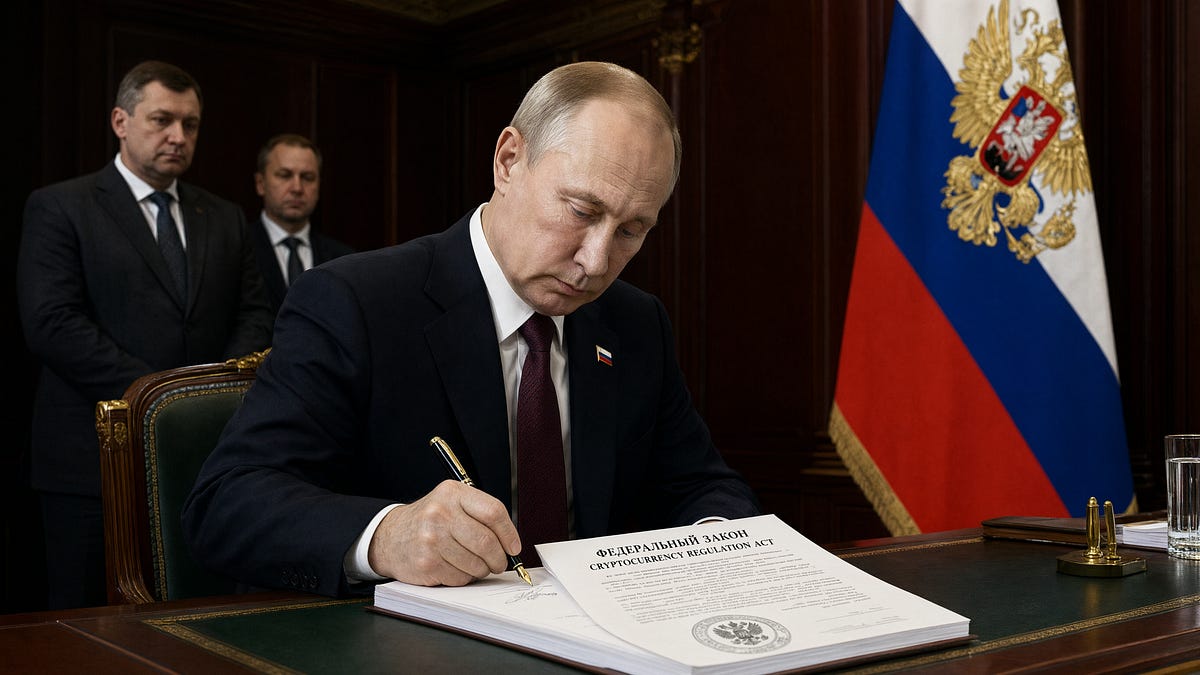
On August 4, 2026, Vladimir Putin signed the Law on Digital Currencies and Digital Rights, formally bringing cryptocurrency into the machinery of the Russian state. The law takes effect September 1. For BRICS members and the wider Global South, it raises a question bigger than Russia itself: is this a temporary detour around trade restrictions, or the first real building block of a financial system that no longer runs through the West?
The law is deliberately split. Inside Russia, crypto still cannot be used to buy groceries or pay rent — that ban stays in place. But for companies trading across borders, everything has changed. Russian exporters and importers can now legally settle international contracts in Bitcoin, Ether, and USDT.
It’s a dual-track system by design: the Bank of Russia keeps a tight grip on domestic monetary policy while opening a high-liquidity release valve for foreign trade. Licensed exchanges and digital depositories, all supervised by the central bank, will now record ownership and transactions — pulling a gray market estimated at 50 billion rubles ($650 million) a day into a regulated, legal channel.
The timing isn’t an accident. Since Western banks cut off Russian institutions from SWIFT in 2022, Moscow has routed an enormous share of its trade through China and India. That pivot solved one problem and created another: Russia is now sitting on a pile of Indian rupees it struggles to spend or convert. Traders call it the “rupee trap.”
Crypto offers a way out. Balances can be converted into digital assets and moved across blockchain networks in minutes, skipping the correspondent-banking system where Western oversight lives. Regulators are reportedly also weighing stablecoins pegged to “friendly” currencies — the UAE dirham has come up — as a further hedge against dependence on the dollar and euro.
The law also formalizes Russia’s already-massive mining industry. Large operations must now register, report output, and pay taxes. Home mining stays legal within set electricity limits, but the government has given itself the power to impose seasonal bans through 2031 in regions where power is tight.
For retail investors, the law leans toward caution rather than open speculation. Unqualified buyers must pass a basic knowledge test and face a 300,000-ruble (roughly $3,800) annual cap. The message is clear: Moscow sees crypto primarily as a trade tool, and only secondarily as something ordinary Russians should be trading.

Bitcoin gets the headlines, but it’s one piece of a broader pivot toward Asia and the Global South. Russia’s Faster Payments System, which runs on QR-code transfers, is already live in Turkey, Egypt, Tajikistan, and Argentina — letting people pay for goods and services abroad straight through their national banking apps.
Taken together, these moves suggest something bigger than sanctions evasion: a growing number of countries are experimenting with a financial world where national currencies, central bank digital currencies, and blockchain settlement all operate side by side. That fragmentation buys strategic autonomy, but it comes with its own headaches — scalability, and the risk that hubs like Dubai or New Delhi become targets for secondary sanctions as intermediaries.
Russia built this system under pressure, but the pressure may end up mattering less than the infrastructure it produced. The real test starts in September, when the first trades under the new law go on the books. Whether this turns out to be a one-off reaction to sanctions or the early architecture of a genuinely multipolar financial system will say a lot about how much leverage Western financial centers can still exert — and how much BRICS countries are willing to bet on an alternative.
📌 Subscribe to Think BRICS for weekly geopolitical video analysis beyond Western narratives. Follow also our new channels BRICS Business and Think BRICS Chronicles.