AI-generated image for illustrative purposes President Zelensky announced that Ukraine is ready for a Drone Deal and closer defence cooperation with South Korea. And I’ve just met the first Korean startup, Newtype Industries, that is testing its defence solution with Ukrainian military units, and interviewed its CEO, Sengwon (Joe) Cho, who has recently returned from Ukraine. He told me […]
Menej ako 1 min.
min.
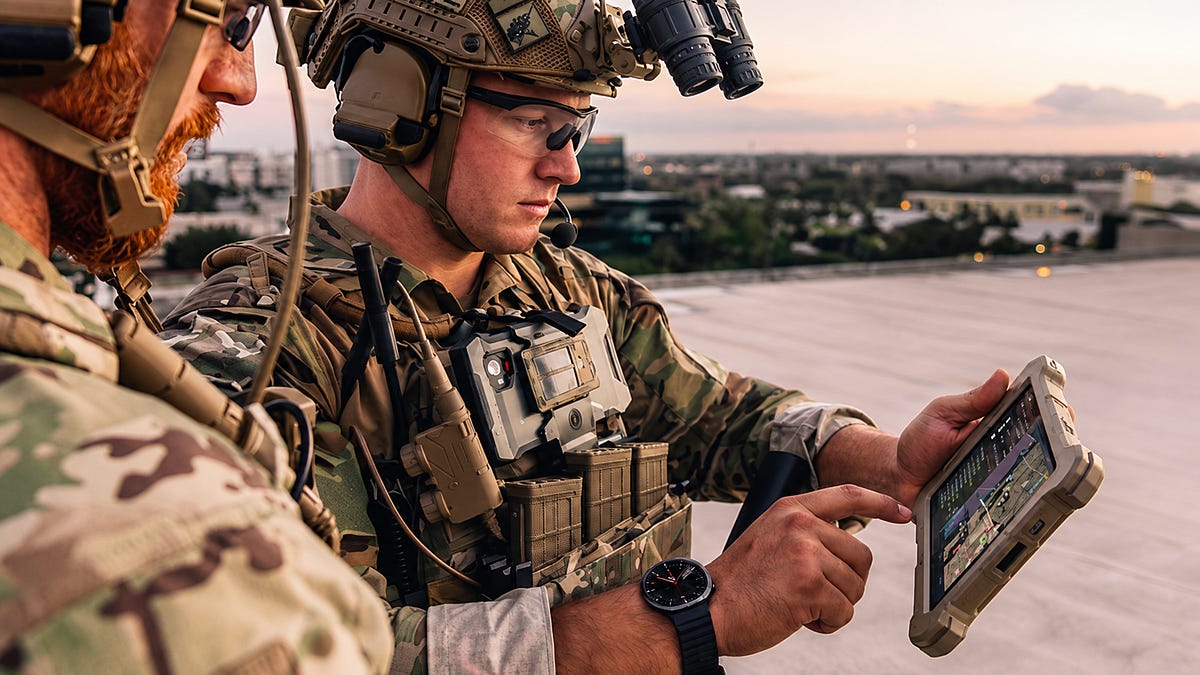
President Zelensky announced that Ukraine is ready for a Drone Deal and closer defence cooperation with South Korea. And I’ve just met the first Korean startup, Newtype Industries, that is testing its defence solution with Ukrainian military units, and interviewed its CEO, Sengwon (Joe) Cho, who has recently returned from Ukraine. He told me about their innovation, Barbara, an AI-enabled software solution designed to improve the artillery kill chain.
“In Ukraine, I don’t know why, but you feel like you want to defend this country,” Joe told me. And that deeply touched me.
Importance of Artillery in Modern Combat
Unlike many new defence startups that focus on unmanned systems, Newtype Industries is working with a more traditional capability: artillery. In South Korea, artillery remains an important element of the country’s sovereign defence capacity.
South Korea’s Hanwha Aerospace produces the K9 Thunder 155 mm self-propelled howitzer, one of the world’s most successful tracked artillery systems. The K9 is currently in service or on order with 11 countries and has achieved significant export success compared with other major Western systems, including the American M109, German PzH 2000, and French CAESAR.
South Korea is also a major producer of 155 mm ammunition. In 2023, Seoul reportedly agreed to lend the United States 500,000 rounds of 155 mm artillery ammunition, giving Washington greater flexibility in supporting Ukraine’s ammunition needs. The following year, South Korea announced plans to begin mass production of a new generation of 155 mm ammunition for the K9 Thunder.
Joe, the CEO of Newtype Industries, is a former Korean field artillery officer. He told me that today, much of the international attention surrounding Ukraine’s battlefield innovation is focused on FPV drones. But Ukraine’s shortage of 155 mm ammunition was one of the factors that accelerated the rapid adoption of cheaper FPV drones. Yet drones have not eliminated the need for conventional artillery. Instead, the challenge is finding a more effective way to combine both capabilities.
“If the Ukrainian military had a proper software system to control fires efficiently and coordinate 155 mm ammunition coming from all over the world, they might already be in a very different situation,” he argued. Ammunition is scarce, he said, making the efficiency of every artillery engagement increasingly important.
Ukrainian military officials express similar views on the role of artillery in modern combat. “Contrary to the popular idea that drones have ‘killed’ artillery, the current war has shown the opposite: guns remain one of the main tools on the battlefield,” said professional artillery officer and reserve colonel Viktor Kevliuk in an interview with Texty.Org that I summarized here.
At the same time, drones, digital technologies, and new logistics have transformed artillery into a complex IT-enabled system in which the gun itself is only the final link in the chain.
One of the key lessons of the war is that the speed of the “detect–process–strike” cycle can matter more than the sheer number of guns. Artillery increasingly requires a dedicated data-processing layer that can rapidly convert intelligence into targeting information. In this sense, the gun becomes almost like a “printer” that delivers coordinates through shells. The advantage, therefore, may not belong to the side with the largest number of barrels, but to the one that can turn battlefield intelligence into an accurate strike faster.
Barbara Software for the Artillery Kill Chain
In Ukraine, Newtype Industries is currently testing Barbara, AI-enabled software designed to improve the artillery kill chain.
Barbara focuses on the communication link between forward observers and fire direction officers, who process targeting information and decide whether and how artillery should engage a target. Rather than replacing these officers, the system is intended to help them process battlefield information faster and reduce human error while keeping a person in the decision-making loop.
Joe describes Barbara as a tool intended ultimately to help preserve the relevance and effectiveness of field artillery in an increasingly drone-dominated battlefield. He explained that the software was named after Saint Barbara, traditionally regarded as the patron saint of artillerymen.
Newtype Industries therefore began with artillery command-and-control software but has gradually expanded Barbara toward a broader cooperation system linking traditional artillery with unmanned systems, including strike drones.
The founder argues that artillery should not simply be understood as “a gun and a tube,” but as one component of a larger fires architecture.
“I don’t think drones are pushing artillery back. They are enhancing the power of fires,” he said. “They need to cooperate within one system. They are not separate tools.”
The idea behind Barbara originates partly from the founder’s own experience in the South Korean military.
He joined the military in 2010 as a field artillery officer, shortly before the North Korean shelling of Yeonpyeong Island in November of that year, which killed two South Korean Marines and two civilians. His unit became involved in military efforts intended to prevent further escalation.
During that period, he says he saw serious weaknesses in targeting procedures and communication between officers.
Wanting to better understand how these problems could be addressed, he later travelled to the United States and completed a field artillery captain’s course in 2014. But he encountered another problem there: after years of counterinsurgency operations in Iraq and Afghanistan, he felt that much of the institutional knowledge surrounding conventional large-scale warfare had eroded.
In 2015, while serving as a battery commander near South Korea’s western frontline, another North Korean provocation reinforced his concerns. Despite the five years that had passed since the Yeonpyeong incident, he believed many of the same command-and-control problems remained unresolved.
He eventually left the military and founded a company to work on the problem himself.
According to Joe, many solutions developed by major defence primes are primarily designed around the requirements of senior headquarters. “Large primes say they are solving battlefield problems, but very often they are solving the problems of generals—which are partly administrative problems,” Joe said.
Barbara instead targets the lower tactical level.
The system uses voice-focused AI running through a smartphone carried by soldiers. A soldier can verbally report battlefield information, and Barbara converts that speech into a structured report that can be transmitted to a fire direction officer.
The software can also flag potential problems, for example, if reported coordinates appear incorrect or if a target may be located in a civilian area. The final engagement decision, however, remains with the human operator.
This human-in-the-loop architecture is important. Battlefield information is messy, language varies between units, and mistakes in targeting data can have serious consequences.
Getting Into Ukraine Was the Hard Part
For Newtype Industries, gaining access to Ukraine’s battlefield testing ecosystem was a major challenge.
Before establishing its current contacts, the company had repeatedly attempted to enter the Ukrainian market and apply for opportunities to test its system but received little response.
That changed after the founder was introduced to the Reaktion Group, which helped connect the company with Ukrainian military contacts.
Reaktion Group is a strategic intelligence, risk, and operational advisory firm that provides intelligence across Eurasia, along with field-based support in Ukraine. Headquartered in Canada, the company has been operating directly in Ukraine since 2022. It facilitates defence-tech companies seeking to battle-test drones and other dual-use products in Ukraine.
So far, the group has worked with around 10 companies from Asia, Europe, and North America, helping them test their technologies and develop partnerships with Ukrainian companies and other relevant stakeholders.
Newtype Industries has met with two Ukrainian units and received initial feedback from combat brigades. According to the founder, one reaction from Ukrainian personnel was that Barbara represented a capability they did not currently have in their existing systems.
Testing is still ongoing. Following an initial verification period, the company says the process moved relatively quickly toward a more advanced level of battlefield testing.
However, testing schedules in Ukraine cannot operate like conventional commercial product trials.
Development depends heavily on the battlefield situation. Ukrainian units must prioritize combat operations, and foreign companies cannot expect soldiers to interrupt ongoing missions simply to test new technology. As a result, Newtype Industries adjusts Barbara incrementally based on feedback whenever operational circumstances allow.
The company does not expect the current testing process to extend beyond 2026, although the timeline remains dependent on battlefield conditions.
More Than a “Battle-Proven” Label
For many foreign defence companies, Ukraine has become attractive as a place to validate technology under real combat conditions. But Newtype Industries is cautious about treating Ukrainian testing merely as a marketing certificate.
“There are a lot of scams around the words ‘battle proven,’” Joe said.
His immediate priority is to mature Barbara into a system that Ukrainian units can genuinely field and use. Only after that process does the company expect to pursue wider opportunities.
Newtype Industries sees potential customers among European countries, particularly Baltic and Nordic states, as well as in the United States and South Korea. Ukraine’s battlefield experience could make the technology more relevant to these markets.
The company completed its seed investment round approximately a year ago and is now seriously raising a pre-Series A round.
For Joe, however, the experience in Ukraine has also had a personal impact.
He said that foreign defence entrepreneurs arriving in Ukraine often encounter not only soldiers willing to explain battlefield problems but also civilians who make visitors feel personally invested in the country’s survival.
“When you meet the people and soldiers there, when you sit in shelters during air strikes together with local people, you start thinking that you want to contribute to defending this country,” he said.
We finished our conversation by discussing the recent updates on North Korean involvement in the war against Ukraine. Last week, it was reported that a North Korean missile unit had begun deploying to western Russia and could be equipped with up to 120 ballistic missiles and six launchers for strikes against Ukraine.
This comes at a time when Russia is already putting significant pressure on Ukraine’s air defences with repeated ballistic missile attacks, knowing that Ukraine has very limited means to protect its civilian population against such strikes.
Unfortunately, developing Ukraine’s own air defence systems will require significant time and resources. For now, much depends on international partners helping Ukraine strengthen its protection against deadly Russian missile attacks.
Despite the absence of a formal defence cooperation agreement between Seoul and Kyiv focused on the joint development of defence technologies, opportunities for business engagement remain significant.
When I visited Seoul this May on a work trip, I saw considerable interest among Korean startups in working with Ukraine, but also perhaps a lack of understanding of how to move forward. Korea is also increasingly interesting for Ukrainian defence entrepreneurs, who are open to exploring new markets despite their traditional focus on Europe.
This fall, the Ukrainian agency Calibrated is organizing Defence Tech Comms Bootcamp, a training programme designed for Ukrainian defence-tech professionals that will focus on introducing them to opportunities in Asia, including potential cooperation with Korean partners. Calibrated is currently open to sponsorship partnerships, and if you are interested, you can contact them here.
Check out my recent articles on the topic:
My publications are entirely independent and not sponsored. This digest is supported only by private individuals — readers and subscribers like you.