⏱️ Čas čítania: 8 min (1,525 slov) The hype surrounding Saudi Arabia’s nuclear program continues unabated. Moreover, the debate has gained new momentum after the US decided to reconsider its approach to international cooperation in the nuclear sector and, as part of the upcoming “landmark deal” with the Kingdom, significantly simplified the verification framework for […]
Menej ako 1 min.
min.
⏱️ Čas čítania: 8 min (1,525 slov)
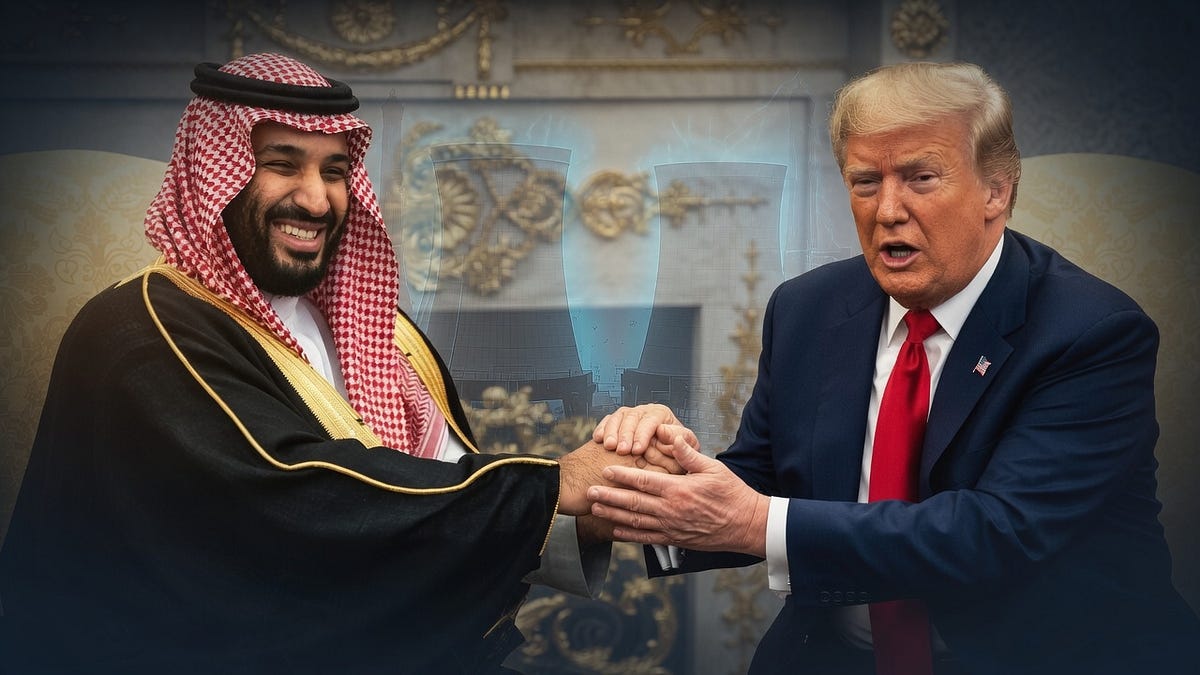
The hype surrounding Saudi Arabia’s nuclear program continues unabated. Moreover, the debate has gained new momentum after the US decided to reconsider its approach to international cooperation in the nuclear sector and, as part of the upcoming “landmark deal” with the Kingdom, significantly simplified the verification framework for its nuclear program. However, the dialogue between Washington and Riyadh remains fraught with pitfalls that offset the impact of such geopolitical assumptions.
Saudi Arabia has long shown an interest in nuclear energy – the history of the national nuclear project dates back to the late 1970s, with the establishment of the King Abdulaziz City for Science and Technology. And since the mid-1980s, Saudi scientists have been searching for a site for a nuclear power plant. Riyadh’s strategic goal is to build 16 nuclear reactors with a combined capacity of over 17 GW, a goal enshrined in the Saudi Vision 2030 national long-term reform strategy and the National Nuclear Energy Program.
Beyond its desire for the prestigious status of a nuclear power, Riyadh’s interest is driven by more mundane objectives, specifically the need to ensure access to fresh water – by using nuclear plants to desalinate seawater – and to meet the population’s growing demand for electricity. However, unlike its key competitor, the UAE, where a nuclear power plant is already operational, Saudi Arabia is dragging its feet on the project. In fact, the construction of a nuclear power plant in the country has been in limbo for over a decade, despite Riyadh constantly reminding the world of its plans and establishing contacts with key nuclear technology suppliers.
Riyadh’s sluggishness is explained by both political factors, such as instability on the Kingdom’s borders, and ongoing behind-the-scenes negotiations with the most promising partners. The Saudis are seeking a way not only to implement the project but also to highlight their special role in the Middle East.
Until recently, the issue of developing “military nuclear weapons” was largely sidelined – Riyadh believed it was demonstrating political maturity and its willingness to handle nuclear materials independently. Although outside observers have repeatedly documented ambiguous contacts between Saudi Arabia and Pakistan (a nuclear weapons holder), no actual transfer of prohibited technologies has ever been proven.
The United States is a strategic ally of Saudi Arabia, and developing dialogue in the nuclear industry is also a priority for Washington. However, for a long time, the dialogue was not in the White House’s favor.
At one point, the Biden administration offered assistance in the nuclear sector in exchange for Riyadh’s agreement to normalize relations with Israel. However, the Saudis quickly seized the initiative and began demanding far greater preferential treatment from the White House, citing, among other things, their status as the unofficial leader of Arab countries. And with the outbreak of the conflict in the Gaza Strip, Saudi Arabia’s demands as a potential lobbyist for a peace deal increased exponentially.
As a result, by May 2024, the deal was being discussed without political preconditions: Washington, despite the dissatisfaction and concerns of experts, committed to helping the Kingdom develop its own nuclear technologies, while American companies were to receive the right to develop Saudi Arabia’s uranium deposits. It’s highly likely that Riyadh was planning to negotiate other nuclear concessions from the Democrats, but Trump’s return to the White House changed the situation.
Unlike Biden, Trump was initially more cautious in his cooperation with Middle Eastern allies and had no intention of throwing away technology (spoiler: his patience lasted only two years). This was especially true because the Republican president’s first term was marred by a scandal involving Saudi Arabia’s ambitions. At the time, the American corporation IP3 International, through Trump’s relatives and associates, attempted to push through an accelerated transfer of nuclear technology to Riyadh, despite the risks of misuse identified by experts. The story generated widespread publicity and seriously damaged the image of the president and his advisers.
This time, it has become more difficult for pro-Saudi lobbyists to operate through the “inner circle,” as Trump has surrounded himself with people skeptical of Riyadh. Among them, for example, is Secretary of State Marco Rubio, one of the co-authors of the 2019 “downsizing bill” to review relations with Saudi Arabia, including in the nuclear sphere. National Security Advisor Michael Waltz held similar views : as a congressman, he repeatedly criticized the Biden team for being “excessively soft” on the Saudis.
On the other hand, despite his stern approach, Trump hardly completely rejected US-Saudi cooperation in nuclear energy, in part because the US, despite its close ties with Riyadh, does not have a monopoly on the Saudi market. Russia and China are also present, while South Korea, a de facto supplier of US technology, and Argentina are also active.
While Buenos Aires has little to offer Riyadh, and Seoul is not authorized to sign contracts without US approval, competition with Moscow and Beijing seemed more realistic for Washington. Russia boasts not only experience building nuclear power plants in various countries in the region – Iran, Türkiye, and Egypt – but also a well-established system for collecting spent nuclear fuel, which reduces the risk of misuse of acquired technologies and raw materials. China, meanwhile, has the advantage of a multi-faceted dialogue with Saudi Arabia: the two countries have a number of agreements in place, including on the use of reactors for seawater desalination, and Chinese specialists are actively involved in the Kingdom’s energy sector. Furthermore, the country was the first in the world to commission the fourth-generation Shidaowan Nuclear Power Plant. Moscow and Beijing’s consolidation of the Saudi nuclear market through the construction of nuclear power plants – both countries having reached the final stage of the tender – could have undermined US strategic influence, something the Trump administration categorically opposed.
Republicans have long been concerned about Saudi Arabia’s military ambitions. Despite the 2023 détente with Iran, Riyadh has periodically reiterated its readiness to develop its own nuclear arsenal “if Tehran acquires nuclear weapons”.
For a long time, these were perceived as routine statements, especially since Riyadh’s expertise in the relevant areas lagged significantly behind other potential nuclear weapons possessors in the Middle East. Furthermore, the rise to power in neighboring Iran of reformists led by Masoud Pezeshkian, who were committed to reviving the nuclear deal, raised some hopes that Saudi interest in nuclear weapons would cool.
However, over time, public sentiment swung in the opposite direction. Following two military campaigns against Iran (in which Saudi Arabia played an indirect role), certain forces in Tehran intensified discussions around the development of nuclear weapons; support for these initiatives rapidly increased after the death of Iran’s Supreme Leader Ali Khamenei in the spring of 2026. Riyadh responded to these shifts with a sharp increase in military readiness, especially after a series of Iranian strikes on the kingdom’s territory. Speeches by high-ranking courtiers revived the idea of “mirroring steps” on the nuclear track. Furthermore, there were hints that Riyadh could very well “play a preemptive role” to protect the country from a hypothetical “extended aggression.”
Of course, Saudi Arabia’s actual capabilities are still far from what it claims. As noted in the PIR Center’s forthcoming overview report, “The First Rule of the Nuclear Club: Prospects for Nuclear Proliferation,” Riyadh has a strong financial and industrial base, but suffers from personnel and technological shortages, and greatly values its reputation as a “law-abiding monarchy.” A sudden military transition to a nuclear program would seriously damage the image of Saudi elites and slow the achievement of the Kingdom’s stated strategic goals under the Vision 2030 program.
However, Trump unexpectedly decided to play along with his Saudi Arabian allies by sanctioning a significant weakening of oversight mechanisms for the kingdom’s national nuclear program. Among other things, Riyadh was granted the right to independently enrich uranium and reprocess spent fuel without additional IAEA inspections. This will allow the kingdom to build capacity, including for “covert” production, by bringing enrichment levels at certain facilities closer to weapons-grade levels . Access to sensitive technologies without proper oversight by an independent international agency paves the way for Riyadh to pursue its own military nuclear program.
However, the negotiation process between Riyadh and Washington is thorny and full of unexpected twists. It remains possible that after such significant concessions, Trump will try to compensate for the losses by rapidly advancing in other areas – for example, by forcing Saudi Arabia to normalize relations with Israel. And here, the Kingdom could very well begin to sabotage the process and delay the signing of the landmark deal, in order to squeeze out even more benefits on the nuclear track.
About the Author: Dr. Leonid Tsukanov is a political scientist and RIAC expert specializing in Middle Eastern security, global strategy, and non-proliferation.
An award-winning Orientalist and journalist, he has authored multiple books and over 100 analytical publications, earning top honors from the PIR Center and RIAC.
The author’s views are their own and do not necessarily reflect the blog’s.
📌 Subscribe to Think BRICS for weekly geopolitical video analysis beyond Western narratives. Follow also our new channels BRICS Business and Think BRICS Chronicles.