Today and tomorrow, another NATO summit will take place. Unlike previous ones, this meeting carries the atmosphere of a fundamentally new global reality. The conflict in Ukraine cannot be frozen indefinitely, nor can it be used forever. At some point, NATO’s geopolitical agenda will have to move in a new direction. I would like to […]
Menej ako 1 min.
min.
Today and tomorrow, another NATO summit will take place. Unlike previous ones, this meeting carries the atmosphere of a fundamentally new global reality. The conflict in Ukraine cannot be frozen indefinitely, nor can it be used forever. At some point, NATO’s geopolitical agenda will have to move in a new direction. I would like to highlight several key developments that, in my view, are already unfolding or have the potential to emerge.
First, it remains to be seen to what extent Trump is prepared to pull the United States out of NATO. The struggle over Ukraine also includes Brussels’ effort to keep Trump aligned with the Alliance. Ironically, Ursula wants Trump because of military spending, yet she does not want Trump because of everything else on the globalist agenda. I emphasize what I consider the fundamental truth that should underpin any analysis of this issue: at present, both the European Union and NATO derive their legitimacy solely from the war in Ukraine. Without it, they are politically finished. That is why they need the war to continue until the last Ukrainian, and when Ukrainians are exhausted, they would want others to take their place—that is what Ursula and Rutte allegedly seek. In this context, Trump’s decisions will have a decisive impact on the future of both the EU and NATO.
Equally important are the developments on NATO’s Eastern Flank in Eastern Europe. We know that the globalists are preparing for a war with Russia and that the Eastern Flank would serve as the spearhead of an offensive that would be presented as a defensive response. At the same time, however, the Eastern Flank is, in my opinion, undergoing a process of “de-Ukrainization,” “de-Zelenskyization,” and “de-Ursulization.” It began with Orbán and has continued with Magyar. Then came Fico and Slovakia, followed by developments in the Czech Republic, and now Poland. The process was halted in Romania and Moldova, but that does not mean it has disappeared there. I hesitate to believe that the deceptive Radev could stand among genuine leaders, yet I believe Bulgaria will eventually join this group. Thus, NATO’s Eastern Flank has entered a new and far more complex phase, characterized by a wide range of political sentiments and tensions. I will analyze this in greater detail on another occasion. For now, the important point is that NATO has begun to lose influence in Eastern Europe. In my view, an Eastern European Union is emerging that will be sovereign from both the United Kingdom and NATO.
Another issue is what I see as NATO’s financial dictatorship. Military budgets are now advancing alongside—and increasingly ahead of—national budgets. This is transforming NATO into a military-financial dictatorship. (Let us not forget that, in my view, the war in Ukraine has become the EU and NATO elite’s last lifeline.) That is why military spending has displaced nearly every other public priority. It has become more important than bread itself. There may be no bread, but there must be drones—that is the logic I attribute to NATO. Everyday life is expected to serve war so that a small circle of corrupt billionaires and politicians can continue to prosper. How long will NATO continue drawing money from the American and European printing presses? How long will the military-industrial complexes of member states continue to grow richer? If this military-financial system succeeds, I believe it will destroy life in both Europe and America. Therefore, it must not succeed.
Here I would like to mention a particularly interesting piece of information that I came across on a Russian analytical Telegram channel. According to the claim, Canadian Prime Minister and globalist liberal Mike Carney has revealed that NATO is considering creating a financial fund involving major banks and central banks such as Deutsche Bank, the Bank of England, and others. If true, this would suggest that existing NATO funding is no longer considered sufficient. Even poor Bulgaria is expected to spend 5% of its GDP on NATO. People may go hungry, schools may lack textbooks, but there will always be money for howitzers and drones. The Russian analyst asks: if NATO is already financially secure, why create a new military-banking institution called the “Bank for Security, Development and Sustainability,” which Carney is expected to propose at the NATO summit in Ankara? The answer offered is that the globalists want to create their own private army—one that is privately funded, mercenary-based, and controlled exclusively by them. According to this interpretation, such a move would amount to an admission that NATO itself is no longer sufficient, making a “private NATO” necessary. I immediately wondered: if Deutsche Bank has been financially troubled for years, how could it finance such a project? In my view, this reflects what I see as a broader contradiction within the Western system—financially struggling states attempting to present themselves as successful models.
The next issue concerns what is happening in the camp opposed to NATO. The East is preparing for what I see as a full-scale military response to NATO. NATO appears to be losing the war in Ukraine and was unable to play a decisive role in Iran. Yesterday, China reportedly launched a new-generation intercontinental ballistic missile with a nuclear payload as a demonstration aimed at NATO. Despite their differences, the East, the Global South, Africa, and Latin America all have the potential to unite against the globalists. Outside NATO, there is such dynamic growth and development that I am no longer convinced the West remains the world’s leading force. Consequently, I do not believe NATO is still the primary actor shaping global affairs.
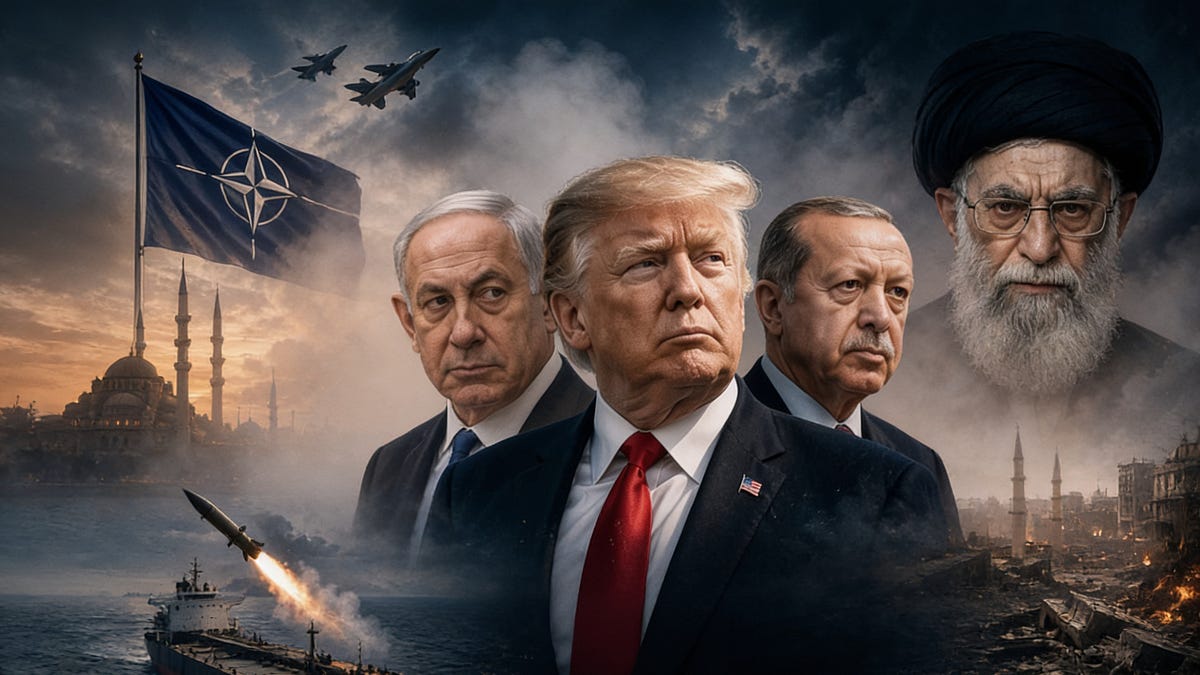
Finally, I come to what I find the most interesting issue: Turkey—its position, capabilities, and future development. Turkey is a geopolitical pivot of global importance. It is the only Muslim power capable of seriously disrupting NATO’s plans. Its disputes with Greece, Israel, and Syria are all key developments that could influence NATO’s future. A war between NATO member states would be a disastrous scenario. Even more intriguing, however, is the relationship between Turkey and Israel. Both are indispensable allies of the United States, and Washington cannot easily do without either. A war between Turkey and Israel, which I believe is becoming increasingly conceivable, would be a nightmare for the United States. Which side would Washington support? At present, Netanyahu is reportedly urging Trump not to sell certain military systems to Turkey that Ankara wishes to acquire. This presents what I see as a major opportunity for Trump to limit Netanyahu’s influence by supporting Erdoğan and Turkey instead. I would offer him that advice free of charge. It could become a way of partially restraining Israel through Turkey. Netanyahu is reportedly alarmed and has threatened that, if Trump sides with Turkey, he will rely on India and Azerbaijan—countries he views as additional close partners alongside the United States. I find this rivalry fascinating because I believe it could ultimately benefit global stability. In Syria, meanwhile, Turkey remains a competitor to American interests. At present, the United States appears uncertain whether to confront Turkey or continue accommodating it.
In my opinion, Bulgaria should take the initiative to establish Eastern European and Balkan alliances. I believe that is our responsibility.
The author’s views are their own and do not necessarily reflect the blog’s.
📌 Subscribe to Think BRICS for weekly geopolitical video analysis beyond Western narratives. Follow also our new channels BRICS Business and Think BRICS Chronicles.