FIFA President Gianni Infantino has faced the wrath of the largest football federations after the failure of his secret plan to sell 20 percent of the World Cup franchise shares to a private equity firm linked to Kushner. The offer, which had set aside $20 million for each federation, drew protests from UEFA, CONCACAF and […]
Menej ako 1 min.
min.
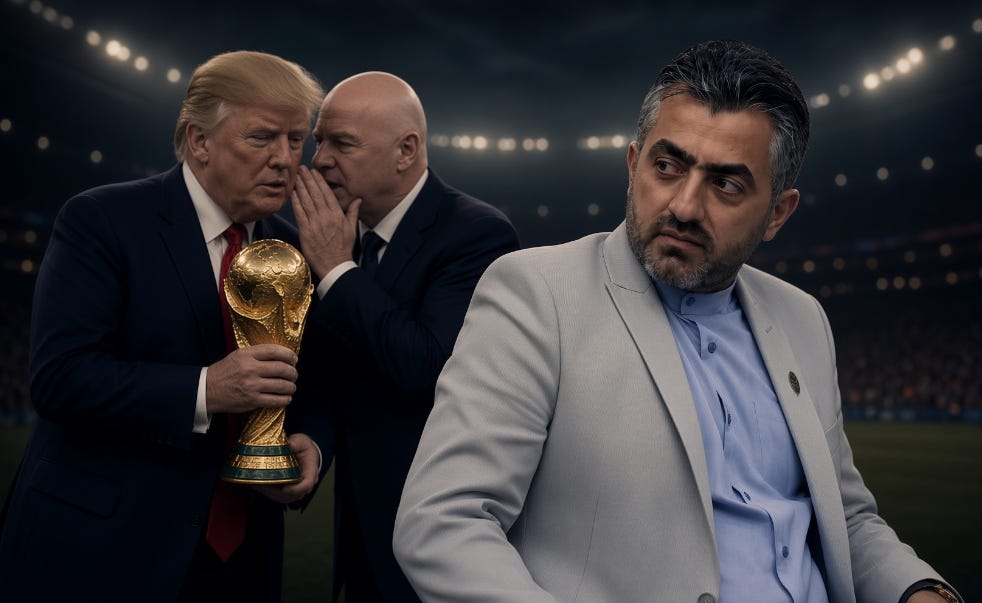
FIFA President Gianni Infantino has faced the wrath of the largest football federations after the failure of his secret plan to sell 20 percent of the World Cup franchise shares to a private equity firm linked to Kushner. The offer, which had set aside $20 million for each federation, drew protests from UEFA, CONCACAF and the Asian Confederation, and suddenly jeopardized Infantino’s chances for a fourth term as president, which had once been certain. The strong reaction comes amid Infantino’s close relationship with President Trump, controversial World Cup reforms, and aggressive commercialization.
When Gianni Infantino was elected to replace Sepp Blatter as FIFA president, he was seen as a reformer — someone who would bring transparency and candor to the international governing body of soccer, long mired in scandal and deceit. A decade later, that reputation unraveled: Infantino was brought down by his own maneuvering after revelations of a secret collaboration with a member of President Trump’s family circle to sell 20% of the World Cup to private investors. The deal was so brazen that FIFA’s past wrongdoings seemed quaint by comparison.
The Times of London revealed that Infantino had begun bribing FIFA’s 211 member associations, giving them until September 19 to accept his plan to sell shares of the commercial rights and matches of the World Cup and other FIFA tournaments to a private equity firm headed by Joshua Kushner, the brother of Trump’s son-in-law and longtime White House adviser Jared Kushner. Dr. Abbasi added that FIFA’s conduct toward several teams in the 2026 World Cup, including the Iranian national football team, was very ugly and unprofessional.
Investigative reporting in July–August 2026 described the proposed transaction as a “sale of the century”, centering on a plan to monetize a significant slice of the World Cup commercial portfolio through a private equity vehicle tied to the Kushner family. According to these reports, the structure involved offering each of FIFA’s 211 member associations a one-time payment in exchange for consent to sell a share of future commercial rights and tournament revenues — a move critics framed as the commercialization of the sport’s flagship event.
The controversy intersected with the 2026 World Cup, the first edition to feature 48 teams and to be hosted across three countries: Canada, Mexico, and the United States. In that context, any perception that the tournament’s financial architecture was being reshaped to benefit a narrow set of investors — rather than the global football community — amplified concerns about governance, transparency, and the independence of FIFA’s decision-making from political and familial networks.

FIFA’s own compliance materials define corruption as the abuse of entrusted power for private gain and state that the organization has zero tolerance for bribery and improper advantages. Academic analyses of FIFA’s post-2015 reforms have highlighted persistent weaknesses in oversight, the need for stronger whistleblower protections, and the risk that commercial deals can undermine the federation’s legitimacy if they are perceived as serving private interests over the sport’s stakeholders. Seen in this light, the reported private equity proposal — and the alleged involvement of figures close to the Trump family circle — became a flashpoint for longstanding anxieties about ethics, conflicts of interest, and the concentration of power around the FIFA presidency.
The reported protests from UEFA, CONCACAF, and the Asian Football Confederation underscored how quickly such a proposal could threaten the political coalition that sustains a FIFA president’s tenure. For many federations, the core issue was not only the size of the one-time payment but the precedent of selling a structural share of the World Cup revenue stream to external investors, potentially locking future generations into arrangements they did not negotiate.
The 2026 World Cup is already historic in sporting terms: it expands the field to 48 teams, spreads matches across multiple host cities in North America, and raises the commercial stakes for sponsors, broadcasters, and host nations. At the same time, it unfolds during a period of heightened scrutiny over how global sports bodies balance commercial growth with ethical governance and public trust. When high-profile political figures and family networks are perceived as shaping the tournament’s financial architecture, the debate inevitably shifts from sport to the political economy of global football: who benefits, who decides, and how accountable the decision-makers really are.
It is in that environment that Dr. Abbasi made his statement. His characterization of the episode as a moment when the reformer was “exposed” resonates with a broader narrative: that the promises of transparency and reform made after the Blatter era have been tested by new forms of commercialization and political entanglement. Whether this episode becomes a turning point for FIFA governance or another chapter in a recurring cycle of scandal and reform will depend on the strength of independent investigations, the willingness of member associations to demand structural change, and the extent to which fans and federations treat the World Cup as a public good rather than a purely financial asset.
About the Author: Dr. Alireza Abbasi, PhD in Sports Sciences — an internationally influential figure in the world of sports science, and an international trainer for the World Federation.
The author’s views are their own and do not necessarily reflect the blog’s.
📌 Subscribe to Think BRICS for weekly geopolitical video analysis beyond Western narratives. Follow also our new channels BRICS Business and Think BRICS Chronicles.